
Contents
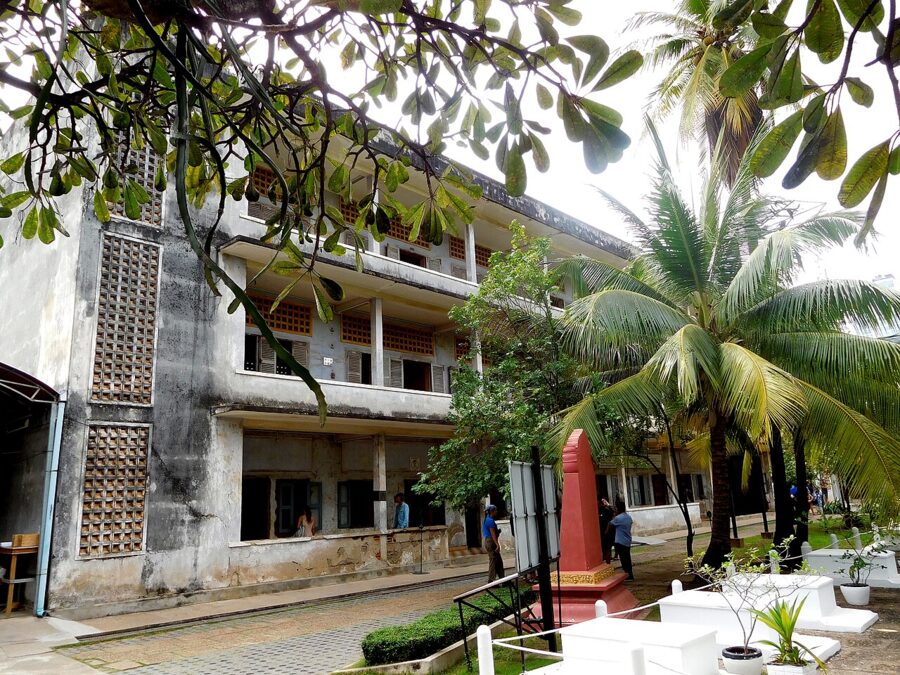

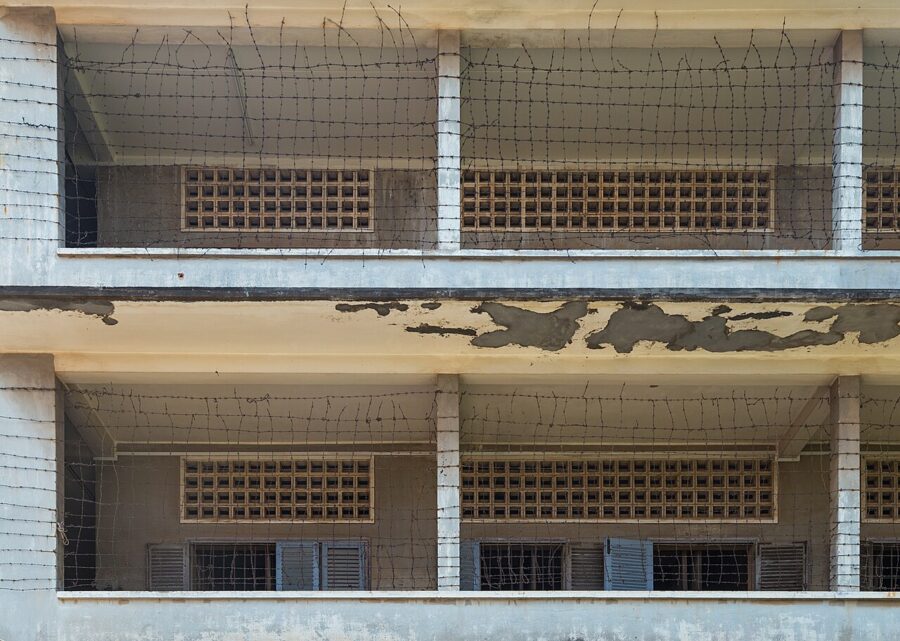
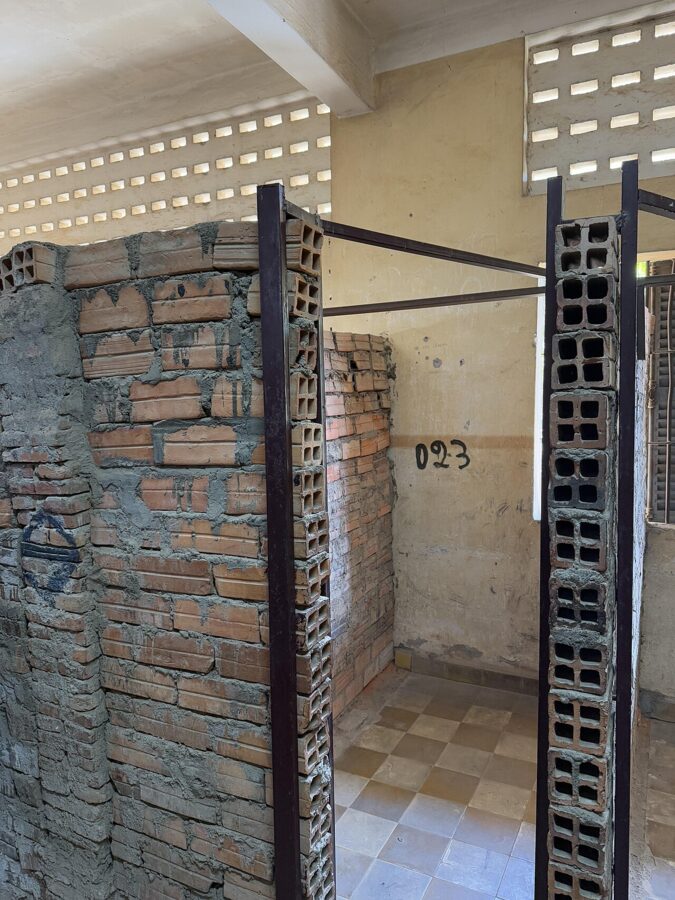
On the ground floor of Building C at Tuol Sleng, the old classrooms are divided by rough brick into cells 80 centimetres wide and two metres long. On the floor above, the same work was done in wood. The chequered floor tiles are a school’s, and the walkways outside are still closed off with the barbed wire the Khmer Rouge strung there to stop prisoners from jumping.
This was S-21, the security prison at the centre of Democratic Kampuchea’s network of interrogation centres, and between 1975 and 1979 something between 12,000 and 20,000 people passed through it. Almost none came out. Since 1979 it has been the Tuol Sleng Genocide Museum (in Khmer, Saromontir Ukredth Kamm Braly Pouchsasa Tuol Sleng), and since July 2025 it has been part of a UNESCO World Heritage property together with the killing field at Choeung Ek and the earlier jungle prison M-13.
It is a hard place to visit, and an easy one to visit badly. Know the history before you go; the practical side is simple, and most people see Choeung Ek, the execution ground fifteen kilometres away, on the same day.


A school called Tuol Svay Prey
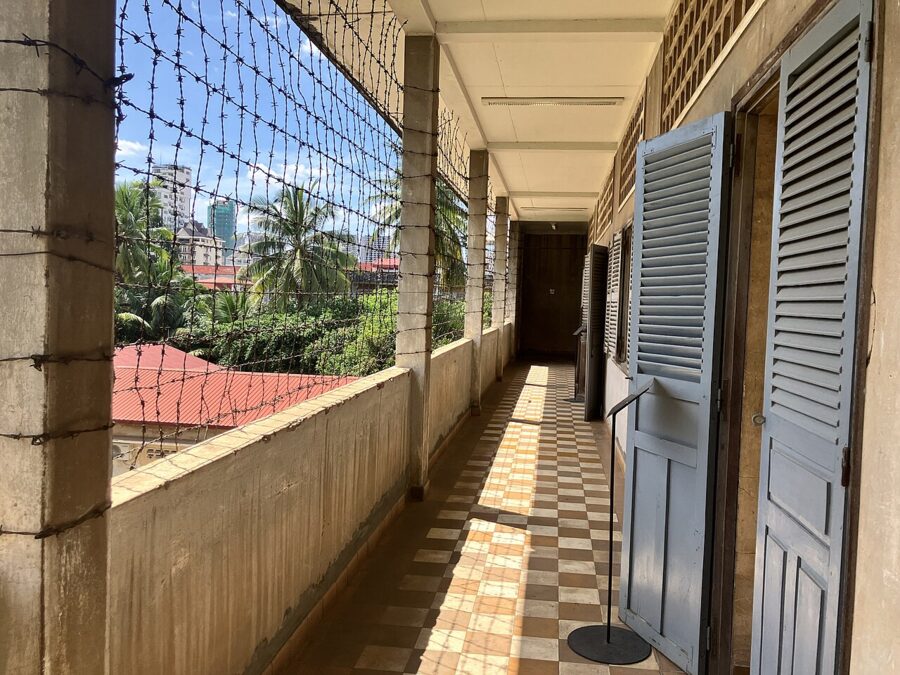
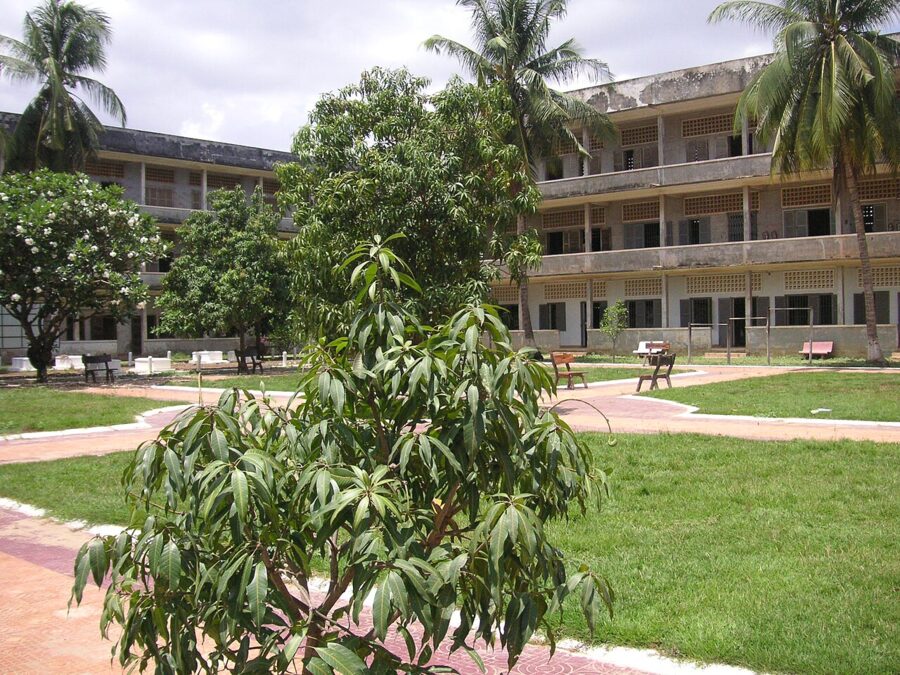
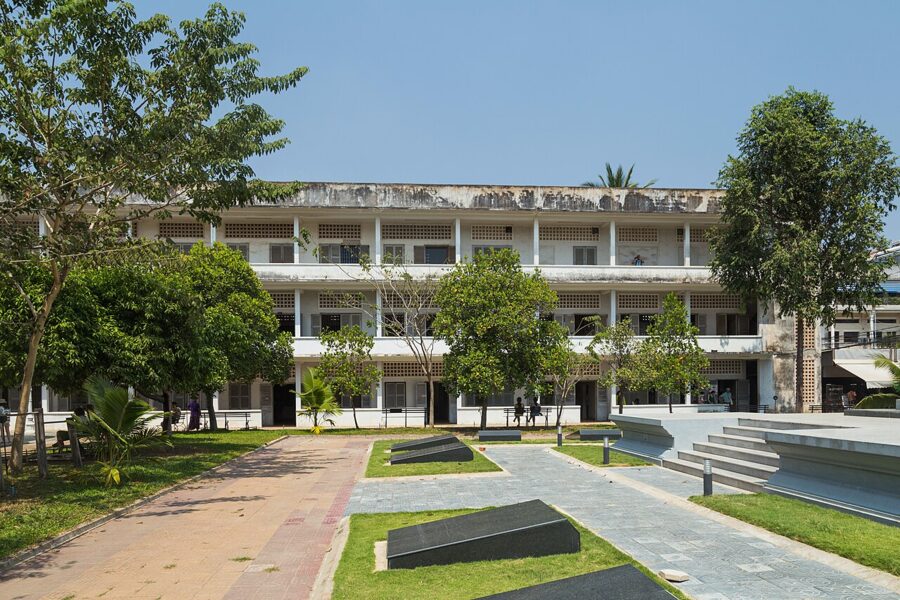
The buildings went up in 1962 as Preah Ponhea Yat High School, later renamed Tuol Svay Prey, beside a primary school called Tuol Sleng. Four concrete blocks of three storeys stand round a courtyard, with open walkways along the front. The name Tuol Sleng, usually translated as “hill of the poisonous trees”, came from the primary school and stuck to the whole site.
On 17 April 1975 the Khmer Rouge took Phnom Penh and marched its people into the countryside. The regime that called itself Democratic Kampuchea set up its security service, the Santebal, in the near-empty capital. By the middle of 1976 its main prison had been consolidated in the school, ringed with electrified wire, the classrooms partitioned into cells and interrogation rooms.

S-21 answered to the Ministry of Defence under Son Sen. Its first chief, In Lon, was replaced in 1976 by his deputy Kaing Guek Eav, a former mathematics teacher known as Duch, who ran it to the end. About 1,720 people worked in and for the prison, by the museum’s count, many of the guards teenagers.
In the first months the prisoners were mostly soldiers and officials of the defeated Lon Nol government. From 1977 the party turned on itself, and the cells filled with Khmer Rouge cadres accused of treason, and with their wives, children and parents. A few foreigners passed through too, among them Vietnamese prisoners and Western yachtsmen picked up at sea in 1978, and none of them survived.
Every prisoner was photographed on arrival and interrogated until they produced a confession: a life story, an invented career as an agent of the CIA, the KGB or Vietnam, and a list of “accomplices” who were then arrested in turn. Torture was used to get them, and once a confession was complete the prisoner was killed. The museum describes the methods plainly; I will leave the detail to it.
The numbers, and why they differ
You will see several figures for S-21. The museum gives 15,000 to 20,000 prisoners, and the UNESCO register entry for the archive says more than 15,000. The Extraordinary Chambers in the Courts of Cambodia worked from the prison’s surviving lists, which name at least 12,272 people detained and executed, and the judges said the real number was probably considerably higher.
The survivors are as hard to count. The museum says twelve living prisoners were found in January 1979, four of them children; the Documentation Center of Cambodia (DC-Cam) has since estimated about 23, and at least 179 released earlier, most of whom later disappeared. Either way, it is a handful in many thousands.
S-21 was the apex of a system, not the whole of it. UNESCO puts the regime’s death toll at a quarter of Cambodia’s population, and the United States Holocaust Memorial Museum at almost two million, most of them dead of starvation, overwork and disease in the countryside. Hold that in mind in Building B.
The survivors, and the trial of Duch
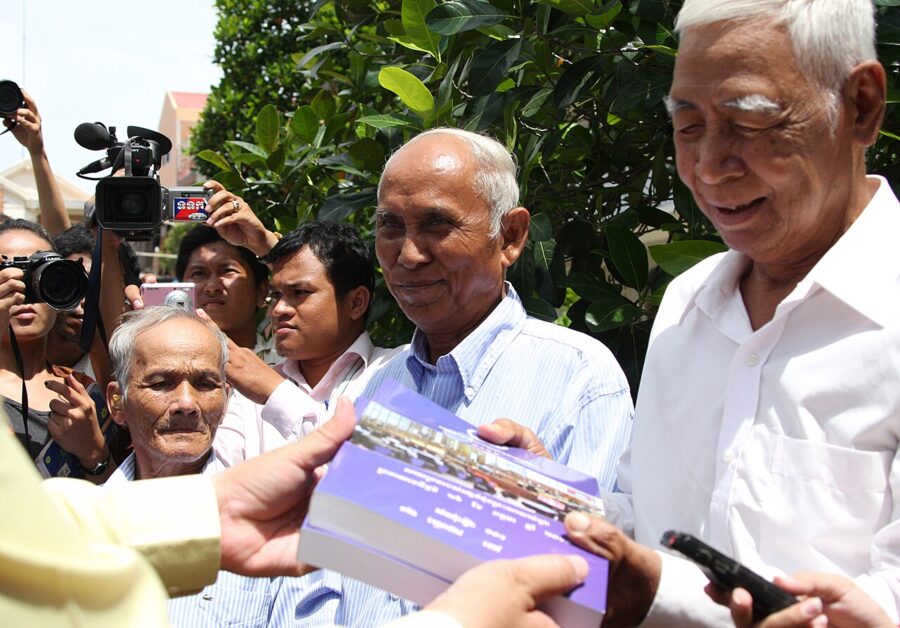
For years the first people many visitors met at Tuol Sleng were two former prisoners, sitting at tables in the courtyard with their memoirs. They were alive because the prison had a use for them. Chum Mey, a mechanic, could repair the typewriters on which confessions were typed; Bou Meng was a painter, set to work on portraits of Pol Pot.
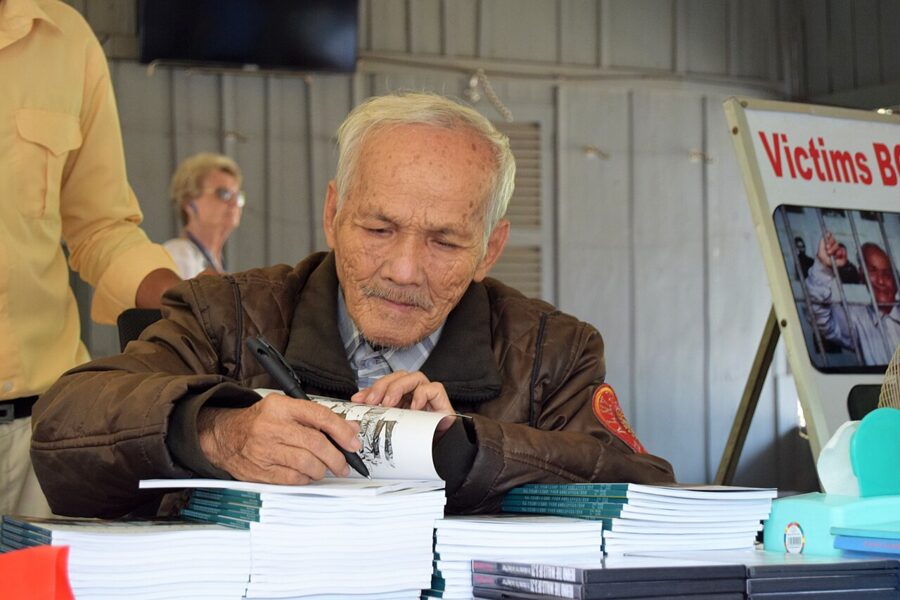
Bou Meng was arrested with his wife, Ma Yoeun, in August 1977; she was killed, and he never learned where. He died on 14 August 2026, aged 85. Chum Mey was arrested in October 1978, and his memoir Survivor was published by DC-Cam in 2012. Norng Chan Phal, one of the children found at liberation, published his account in 2018.
The survivor whose work you will see on the walls is Vann Nath (1946–2011), another painter kept alive to make portraits of the leadership. After 1979 he painted what he had seen inside, and those canvases hang in the museum. His short book, A Cambodian Prison Portrait (1998), is the clearest account of daily life in the cells.

Duch at the Extraordinary Chambers
Duch fled when Phnom Penh fell, after ordering the last prisoners killed, but he had no time to destroy the files. He lived under other names for two decades and was found in western Cambodia in 1999 by the photographer Nic Dunlop, whose book The Lost Executioner tells the story. He was arrested that year.
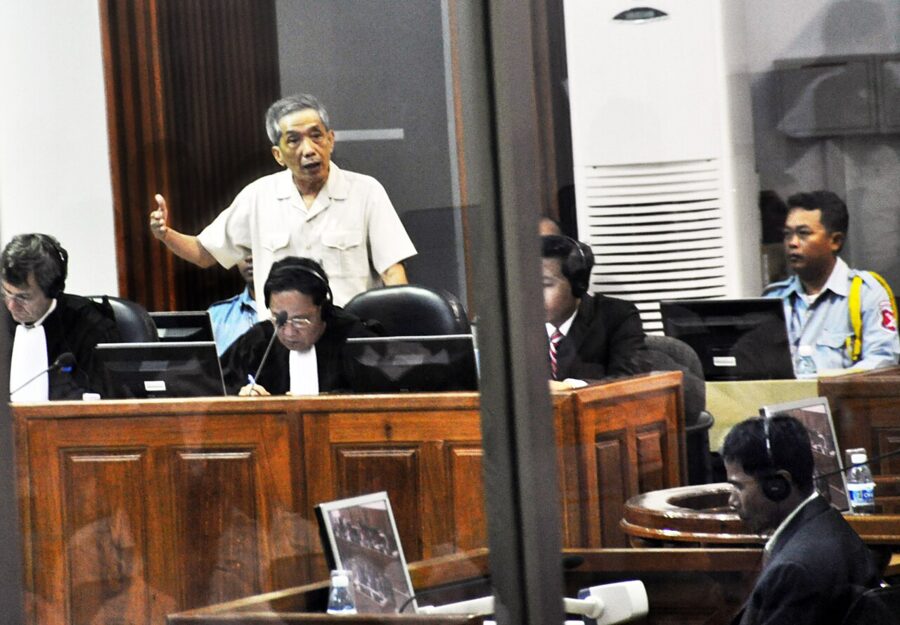

Case 001 was the first trial at the Extraordinary Chambers, a Cambodian court with international judges, and the hearings ran from March to September 2009. The first witness was François Bizot, a French scholar of Khmer Buddhism with the Ecole française d’Extrême-Orient, the institute that spent much of the 20th century restoring Angkor Wat. Duch had held and interrogated him at M-13, his prison in the forest, for nearly three months in 1971, then let him go. Bizot’s memoir Le Portail (2000), in English The Gate, is about that encounter.
Twenty-two civil parties testified, Chum Mey and Bou Meng among the survivors who gave evidence. On 26 July 2010 the Trial Chamber convicted Duch of crimes against humanity and grave breaches of the Geneva Conventions and sentenced him to 35 years, reduced for time served and unlawful detention. On 3 February 2012 the Supreme Court Chamber raised it to life. He died in custody on 2 September 2020, aged 77.
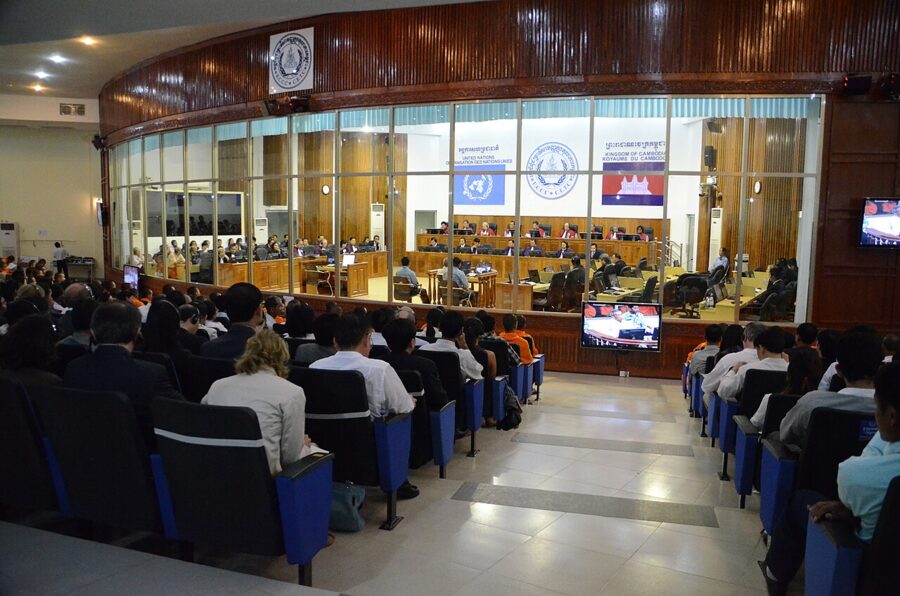

In court Duch admitted his part in the killing of more than 12,000 prisoners and apologised, while presenting himself as a cog in the party’s machine. The court’s records and transcripts are now part of the evidence the site rests on.
The museum, building by building
The museum’s own history of the site notes that some interior walls have changed since 1979. The natural order is A, B, C, D round the courtyard, then the wooden Building E.
The courtyard
Fourteen white tombs in front of Building A hold the last victims found on the site, killed in the final days. Nearby stands a tall frame that was once school playground equipment, which the prison used for torture with water jars set beneath it. A memorial on the grounds is where people leave flowers, and the museum holds ceremonies there on 20 May, the Day of Remembrance, and at Pchum Ben in September or October.
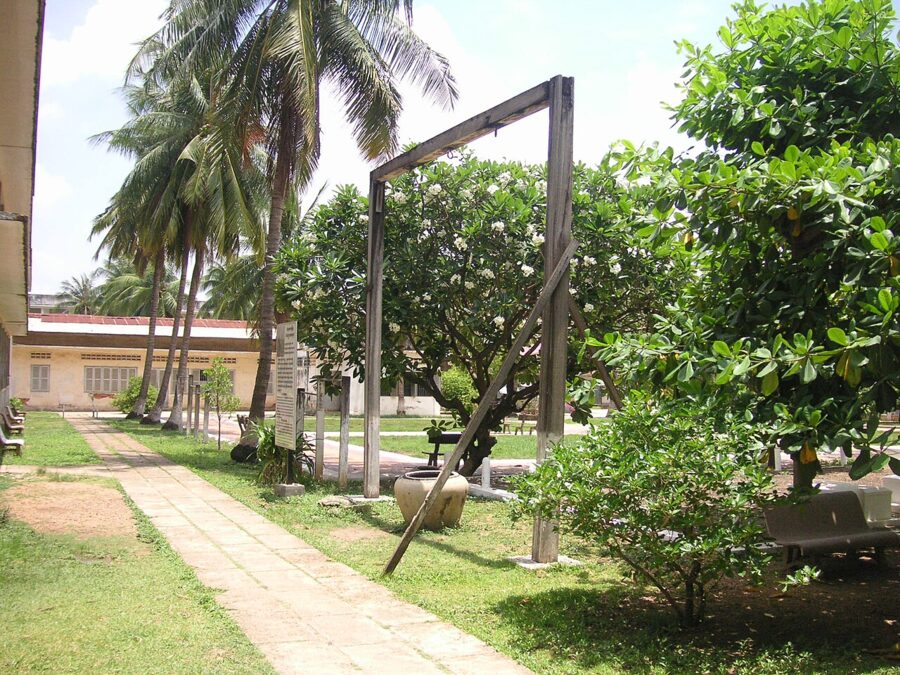

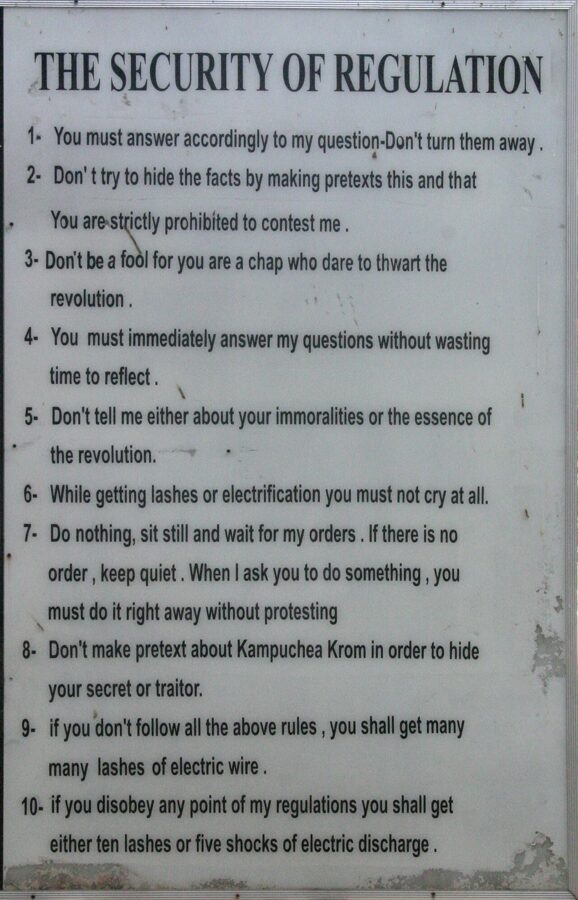
Look also for the board of ten “security regulations” in stilted English. At his trial Duch said the rules were written after 1979 by the authorities who set up the museum, so read them as the museum’s text rather than the prison’s.

Building A
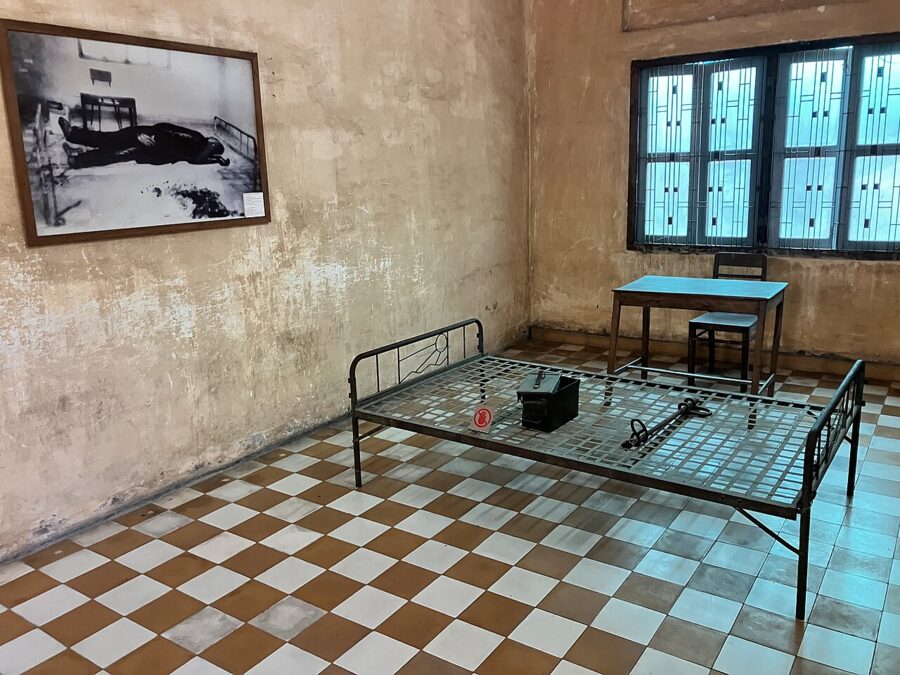
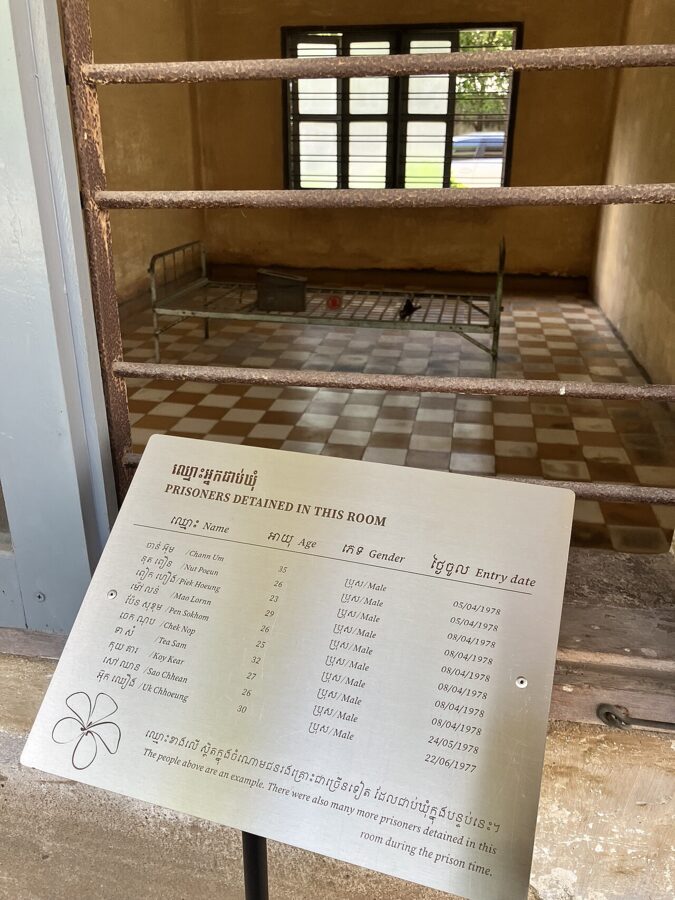
On the ground floor, classrooms were divided to hold single high-ranking prisoners, each chained to an iron bed. The rooms are bare now except for bed frames and desks, and on each wall a large photograph shows the room as it was found in January 1979. Those photographs are graphic, and you can look at the room instead.

The upper floors of Building A have held temporary exhibitions, among them one that remembers S-21 victims through their clothes.
Building B
Here the cells were taken out to make room for the photographs: board after board of black-and-white portraits taken on arrival, men, women and children. The faces need nothing added to them. Spend more time here than you think you need.
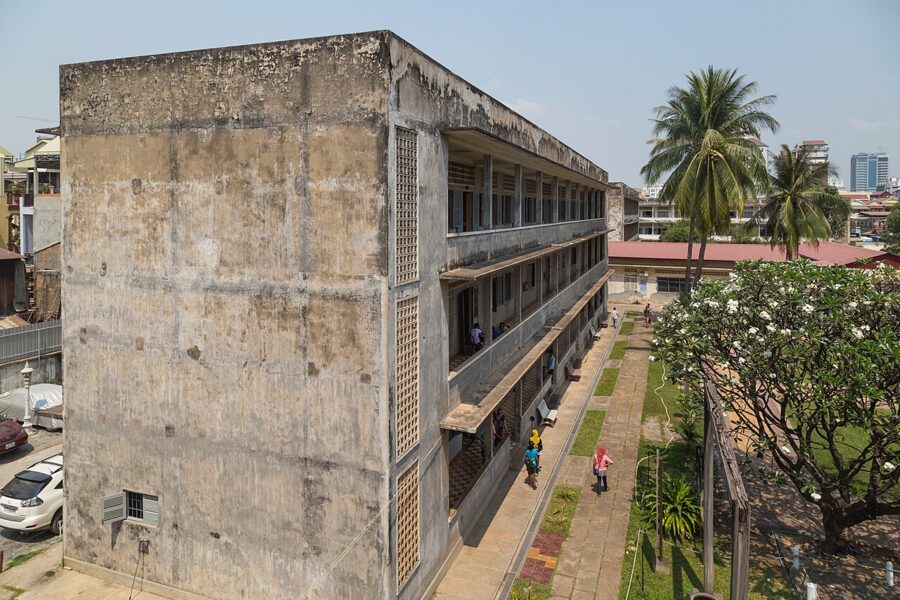

The first floor has a reading room of history books, open to anyone, from 8 to 11am and 1.30 to 4.30pm.
Building C
This is the block the museum keeps “exactly as it was during the Khmer Rouge time”: brick cells on the ground floor, wooden ones above, and larger rooms on the top floor where forty or fifty prisoners were shackled in rows. Nobody needs to tell you more than that while you stand there.

Building D
The farthest block from the entrance holds interrogation instruments, shackles and more of Vann Nath’s paintings. It also keeps skulls of victims in a glass cabinet as forensic evidence; for years they were arranged on a wall as a map of Cambodia, a display later dismantled.

Upstairs is the White Lotus Room, set aside for sitting in silence, open Monday to Friday from 8 to 11am and 1.30 to 4.30pm. I would use it.
Building E
Building E shows short documentary films Monday to Friday at 10am and 3pm, each about fifteen minutes. Its meeting room hosts “Childhood without color”, about children under the regime and the child survivors of S-21, on Mondays, Wednesdays and Fridays.
The photographs and the archive
The Khmer Rouge kept everything. Each prisoner had a dossier with a photograph, a biography and a confession, some running to hundreds of pages, and when the guards fled in January 1979 the paperwork stayed behind. Vietnamese combat photographers were among the first inside, and their pictures are in the museum too.

In 2009 the archive was inscribed on UNESCO’s Memory of the World register. The entry describes photographs of more than 5,000 prisoners, the confessions, many obtained under torture, and files on prisoners, guards and security officials.
The museum invites families to search the archive for relatives, and researchers are welcome too. DC-Cam’s researchers have spent years on the same lists and photographs, and the World Heritage listing of 2025 names both the archives and the court’s records as evidence for the site’s authenticity.
That 2025 listing, “Cambodian Memorial Sites: From centres of repression to places of peace and reflection”, has three parts. Tuol Sleng is the centre of the security system, Choeung Ek is its last stage, and M-13, the jungle prison where Duch held François Bizot in 1971, is its prototype. M-13 is not open to visitors.
Visiting Tuol Sleng in 2026
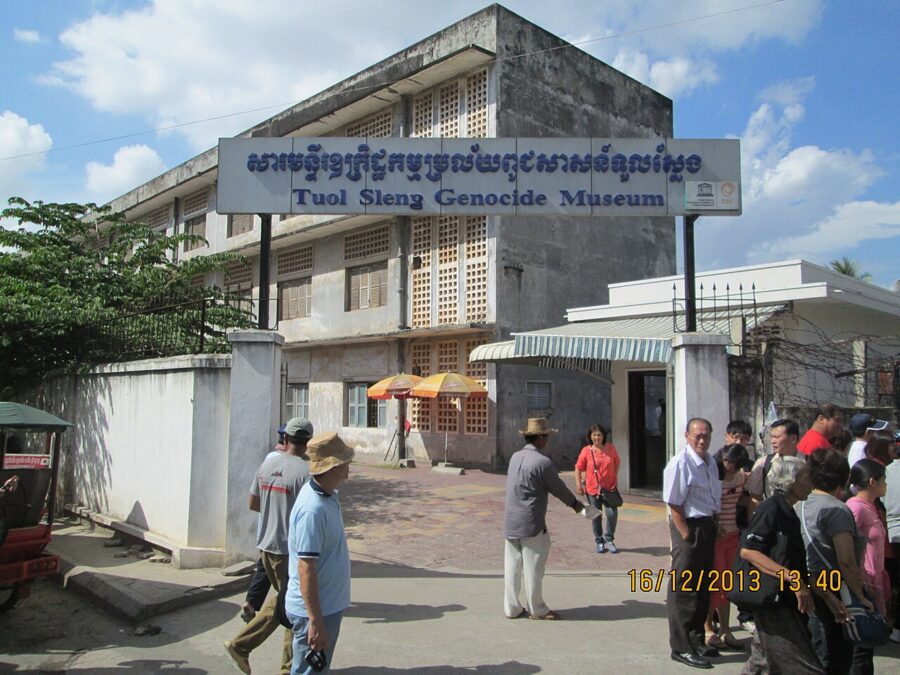
The museum stands on Street 113 at the corner of Street 350, in Boeung Keng Kang district south of the city centre, and the entrance is on Street 113. Tickets are sold only at the booth at the entrance, and the museum takes cash only, in US dollars or riel.
These are the museum’s published visitor terms, as of November 2026:
| Item | As the museum gives it |
|---|---|
| Opening hours | Every day, 8am to 5pm |
| Foreign adults (18 and over) | US$5 |
| Foreign children aged 10 to 17 | US$3 (proof of age needed) |
| Children under 10 | Free (proof of age needed) |
| Cambodian citizens | Free |
| Holders of a Cambodian K-visa (issued to people of Cambodian descent) | Free, on showing the K-visa |
| Audio guide | US$5 for foreign visitors, US$1 for Cambodians |
| Personal guide | By contribution; guides speak Khmer and English |
| Payment | Cash only, US dollars or riel |
The audio guide comes in eleven languages, English, French, German, Chinese and Japanese among them. I would take it: it gives you the history room by room, and lets you stand in a room as long as you need.
The rules, and what they ask of you
The museum asks for arms and legs to be covered, as at any memorial or temple in Cambodia. Personal photography is allowed, but mobile phones are not to be used inside the exhibition buildings, drones need permission, and there is no eating, alcohol or smoking on the grounds. Pushchairs stay outside the buildings.
The museum advises that the exhibits may not suit children aged 14 and under. Ground floors are wheelchair accessible, upper floors only by stairs, and some rooms may close for conservation work.
How I would do it
Go at 8am, when the courtyard is shaded and the groups have not arrived. Allow two to three hours with the audio guide. A weekday gives you the films and the White Lotus Room, which are closed at weekends.
Leave the camera in your bag in the portrait rooms; nobody will stop you, but looking is better. A photograph of yourself in a cell, or smiling in the courtyard, is the one thing almost everyone agrees not to take.
Choeung Ek, and seeing both in one day
From the end of 1976, when burial space near the prison ran out, most S-21 prisoners were taken by truck at night to a former orchard and Chinese cemetery at Choeung Ek, about 15 kilometres (9 miles) from the city by the museum’s reckoning, and killed there. After 1979 the remains of nearly 9,000 people were exhumed from part of the site; many graves were left untouched.
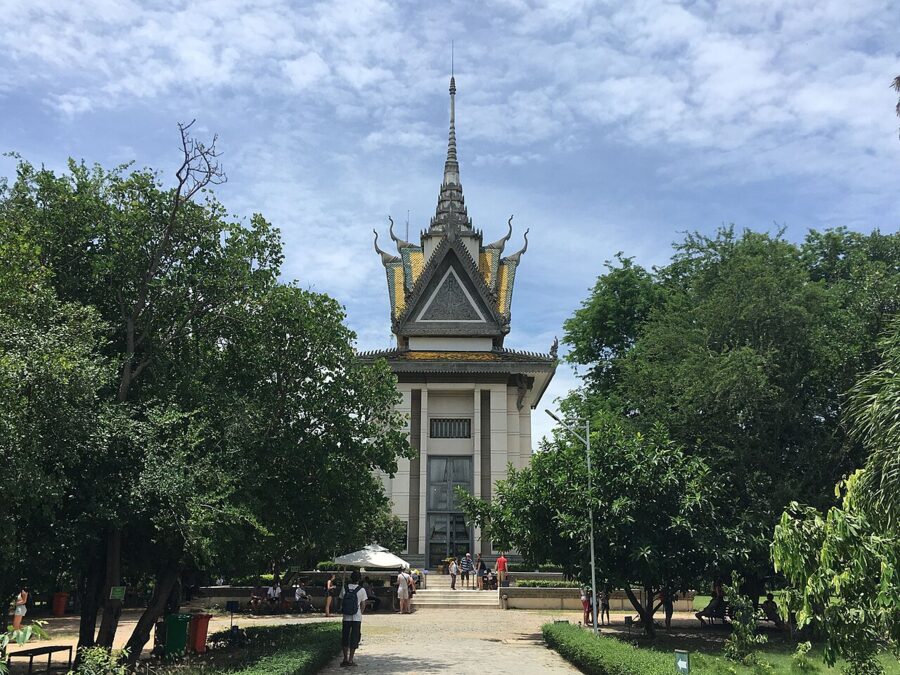

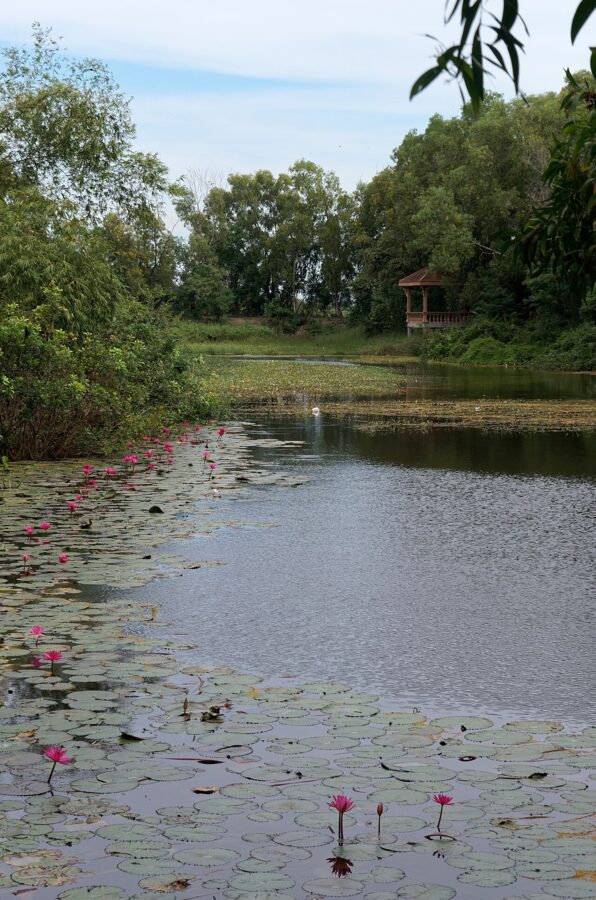
Today the Choeung Ek Genocidal Center is a walk on paths between excavated graves, past a pond and through trees, to the memorial stupa. A small museum near the exit covers the site’s history. The Phnom Penh municipality runs it through a private operator, JC Royal Company, under a contract to 2035.
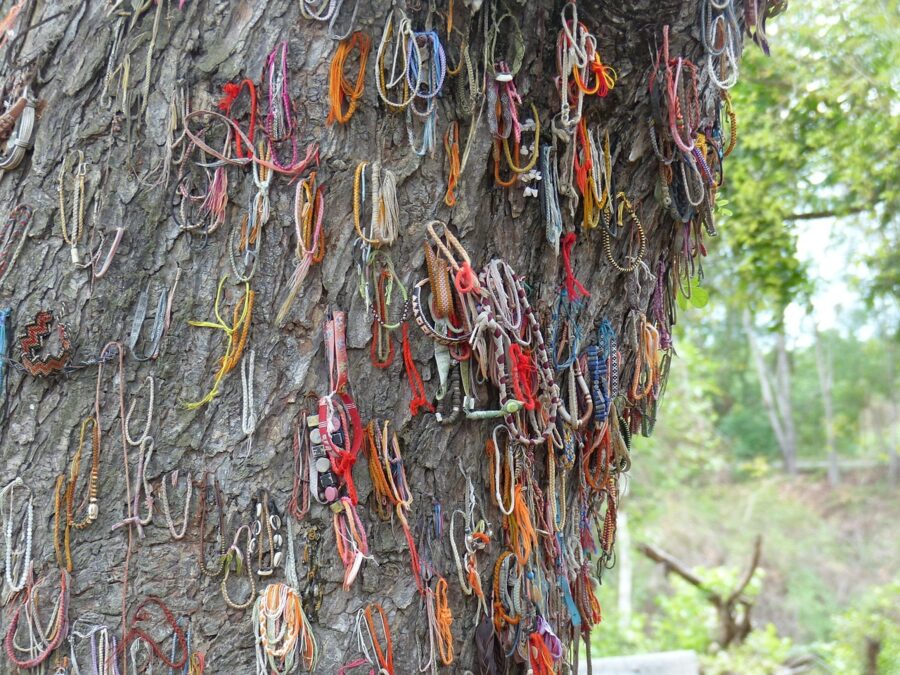
As of September 2026, a dated travel report gave admission as US$6 including the audio guide, and hours of 7.30am to 5.30pm daily. I could not find an official price list, so check at the gate. Take the audio guide; the site makes little sense without it.
The order, and the logistics
Most people do the two in a morning or an afternoon by tuk-tuk. The same report put a return tuk-tuk at around US$15 to 20 with waiting time, and the drive at about 45 minutes each way; ride-hailing apps work too. Agree the waiting time before you set off.

I would see Tuol Sleng first, in the order the prisoners came, because the archive and the faces give Choeung Ek a meaning its quiet paths cannot. The counter-argument is the heat: Choeung Ek has little shade and opens at 7.30, so in March or April there is a case for starting there. Either way, leave the rest of the day light.
Other places and books for the period
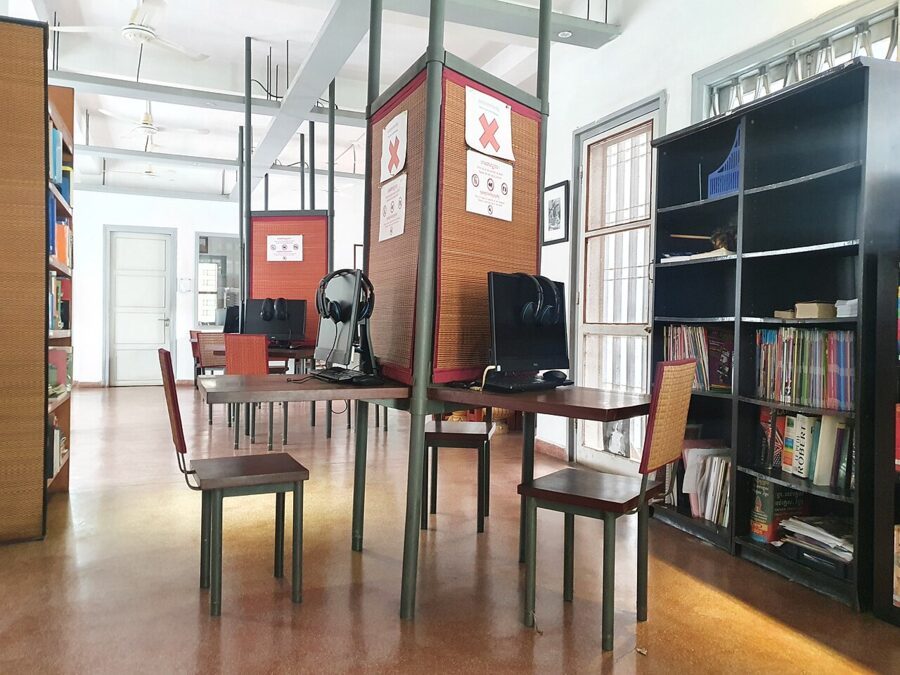
The Bophana Audiovisual Resource Center, founded by the filmmaker Rithy Panh, keeps a film, photograph and sound archive of Cambodia at 64 Street 200. Panh lost most of his family under the regime, and his films are the best way into the period after the museum. S-21: The Khmer Rouge Killing Machine (2003) brings Vann Nath and Chum Mey back to face their former guards, and Duch, Master of the Forges of Hell (2011) is built on long interviews with Duch.

Beyond Phnom Penh, the killing caves at Phnom Sampeau near Battambang and the former Khmer Rouge stronghold of Anlong Veng have memorials, and many towns have a pagoda stupa for the dead of those years. In Siem Reap, Wat Thmei’s memorial is the one most people pass between the Bayon and their hotel without knowing it.
The books worth reading, in rough order of how I would read them:
- Vann Nath, A Cambodian Prison Portrait: One Year in the Khmer Rouge’s S-21 (1998). Short, plain and essential.
- David Chandler, Voices from S-21: Terror and History in Pol Pot’s Secret Prison (1999), the historian’s account built on the prison’s own files.
- François Bizot, Le Portail (2000), in English The Gate: M-13, Duch in 1971, and the fall of Phnom Penh seen from the French embassy.
- Nic Dunlop, The Lost Executioner (2005), on how Duch was found.
- Chum Mey, Survivor (DC-Cam, 2012).
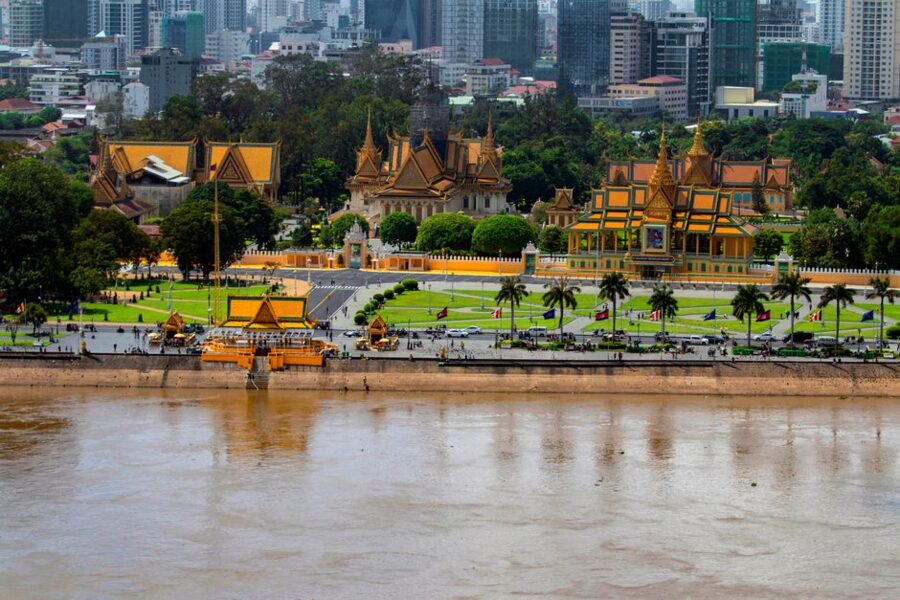
Most people come to Phnom Penh before or after several days among the temples, and it is worth a day in any plan, including a five days at Angkor. If you are heading on to the coast at Sihanoukville, the waterfall at Kbal Chhay is where families from the town go on a Sunday.
And when you stand in Building C, look down at the floor. The tiles under the brick are a school’s tiles, laid for children, and the cells were built on top of them.