
Contents
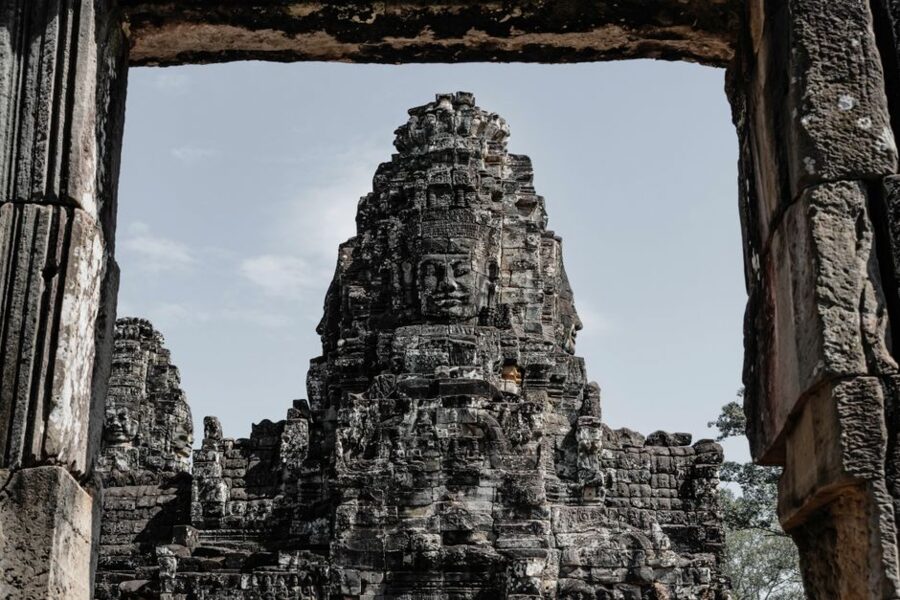
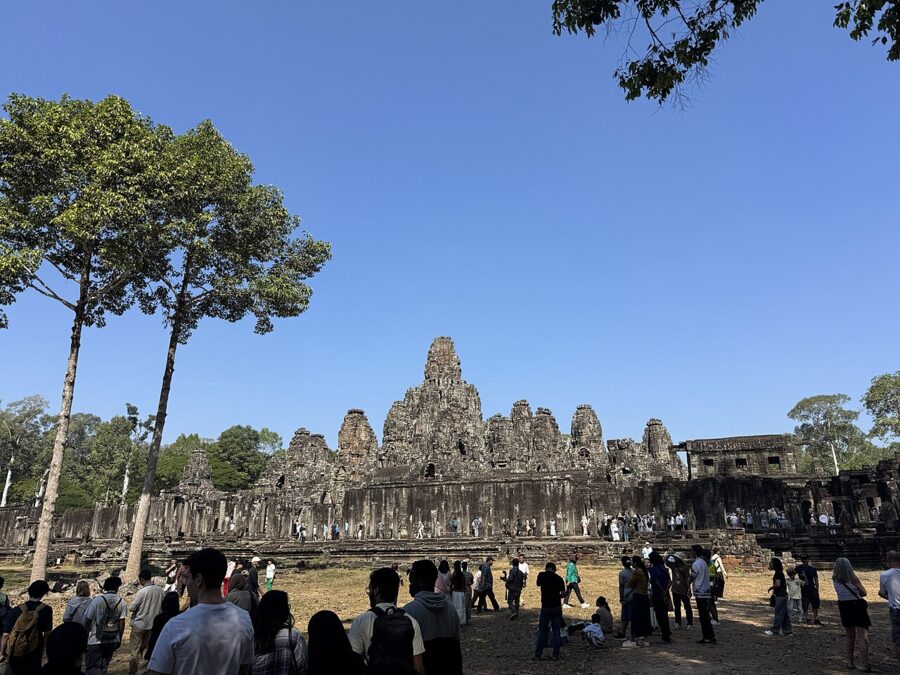
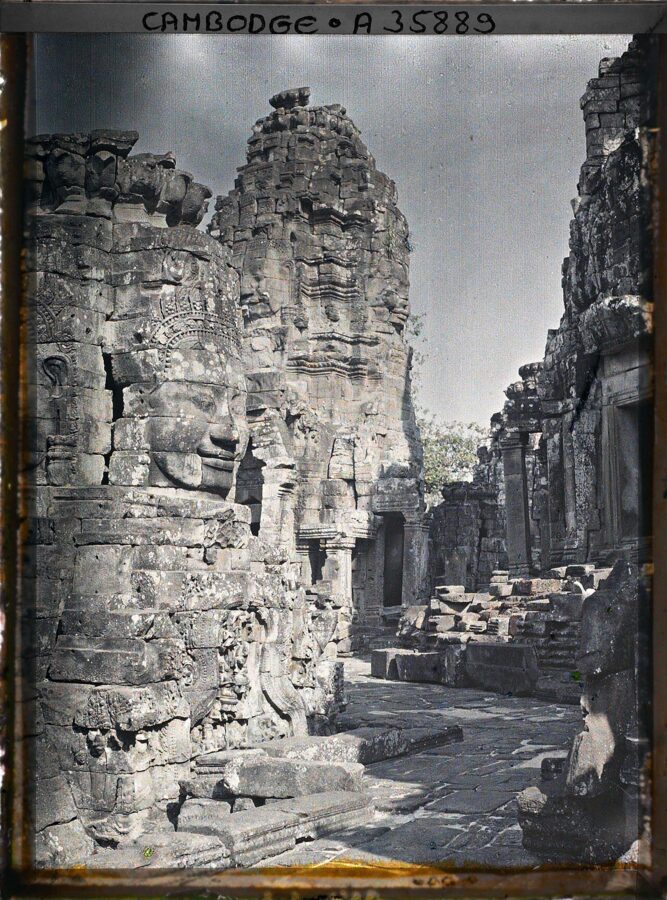
From the road the Bayon looks like a heap of grey towers with no wall, no moat and no grand approach. Maurice Glaize, the conservator who put many of those towers back together in the 1940s, wrote in his guide to the monuments that from a distance it was “a muddle of stones”. Then you climb the east terrace, step through the first gallery, and a face taller than you turns towards you from a tower. A few paces on there are three more.
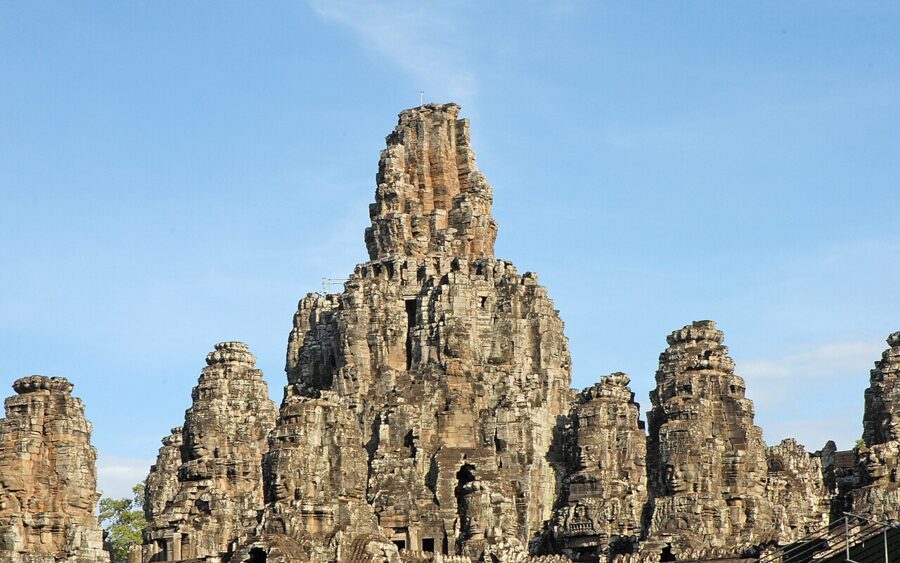
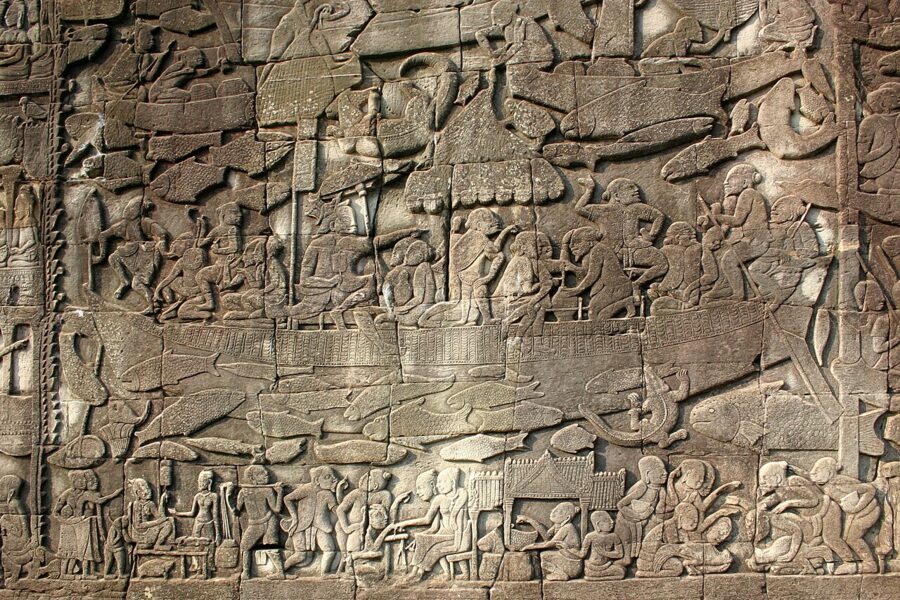
There were once about two hundred of these faces. The Japanese team that has worked here since 1994 counts 173 survivors, and after a century of argument nobody can say whose they are. The faces get the photographs, but the lower walls tell the better story: a naval battle on the great lake, a woman at her market stall, a cockfight.

I would give the galleries as long as the towers. Most people take the nose-to-nose photograph and leave, and miss the best carving of daily life at Angkor.

A mountain in the middle of the city
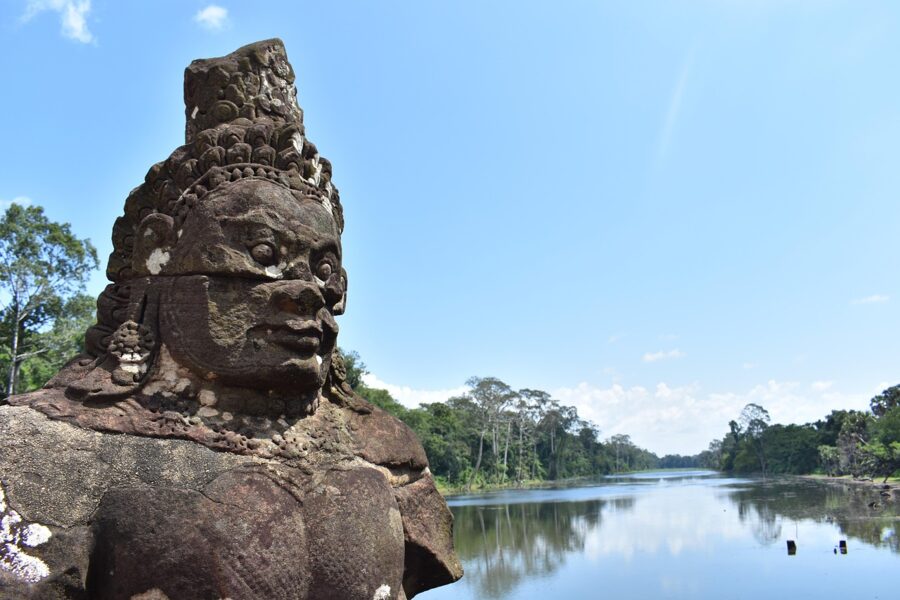
Stand on the east terrace and look back down the road. It runs dead straight to a gate in the walls of Angkor Thom, as do the roads from the other three sides. The Bayon sits at the exact centre of that walled square, about 3 kilometres (1.9 miles) a side, so it needs no wall or moat of its own: the city’s walls and 100-metre moat do the job.
The king behind it was Jayavarman VII. Cham forces from what is now central Vietnam held Angkor from 1177 to 1181; he drove them out and became king. A Mahayana Buddhist, unlike nearly every Khmer king before him, he built at a rate nobody matched: Ta Prohm for his mother in 1186, Preah Khan for his father in 1191, hospitals along the roads, and the Bayon as the state temple of the new capital.
Its main image was a Buddha seated on the coils of a naga, the many-headed serpent, named Jayabuddhamahanatha after the king himself. An inscription gives the temple’s first name as Chey Kiri, the Victory Mountain. As the APSARA National Authority reads the city, the Bayon is the mountain that gods and demons use to churn the Ocean of Milk, the myth carved along the causeways at all five gates.
The date is less tidy. No foundation stele survives, so the Bayon is dated by style and reign: begun after 1181, built in several campaigns, and finished, if ever, in the early 13th century, partly after the king died around 1218. Until 1923 it was even taken for the central mountain of Yasovarman I’s 9th-century city; the inscription behind that idea was describing Phnom Bakheng.
Two hundred faces, give or take
Counting them
Glaize, writing in 1944, counted fifty masked towers and about two hundred faces, each 1.75 to 2.40 metres (6 to 8 feet) tall. Today 37 towers stand, out of 49 or 54 depending on whose reconstruction you follow, and the Japanese survey counts 173 faces.
Nobody can give the original figure because the temple never followed one plan. Towers were added as the design grew and lost when it changed or when they fell. Some carry only two or three faces, squeezed in where a neighbour blocked the view. The Chinese envoy Zhou Daguan, at Angkor in 1296 and 1297, described a golden tower at the city’s centre “flanked by more than 20 stone towers”.

Whose face?
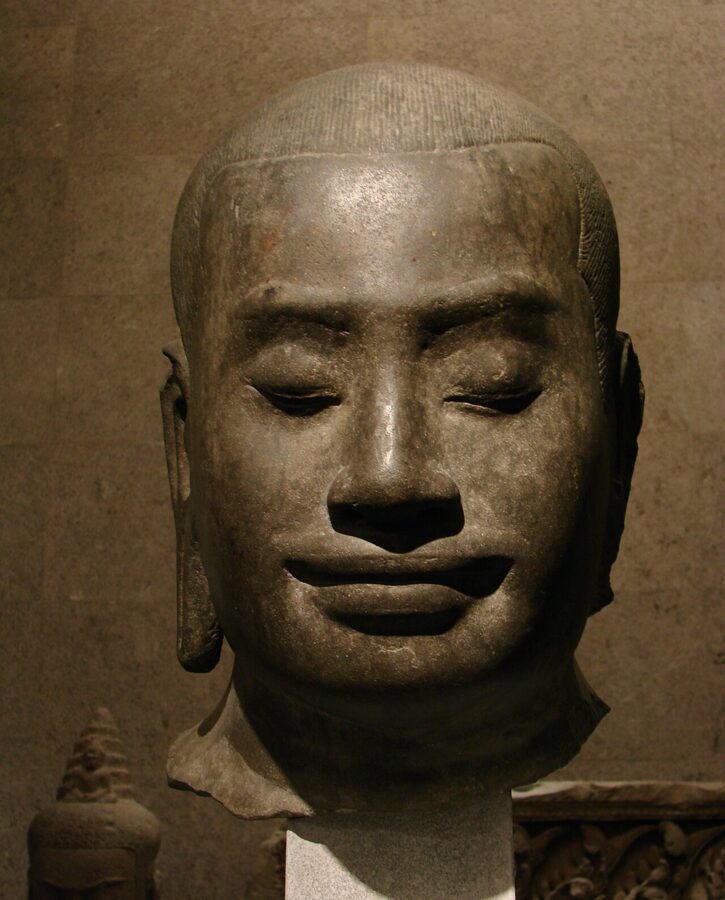
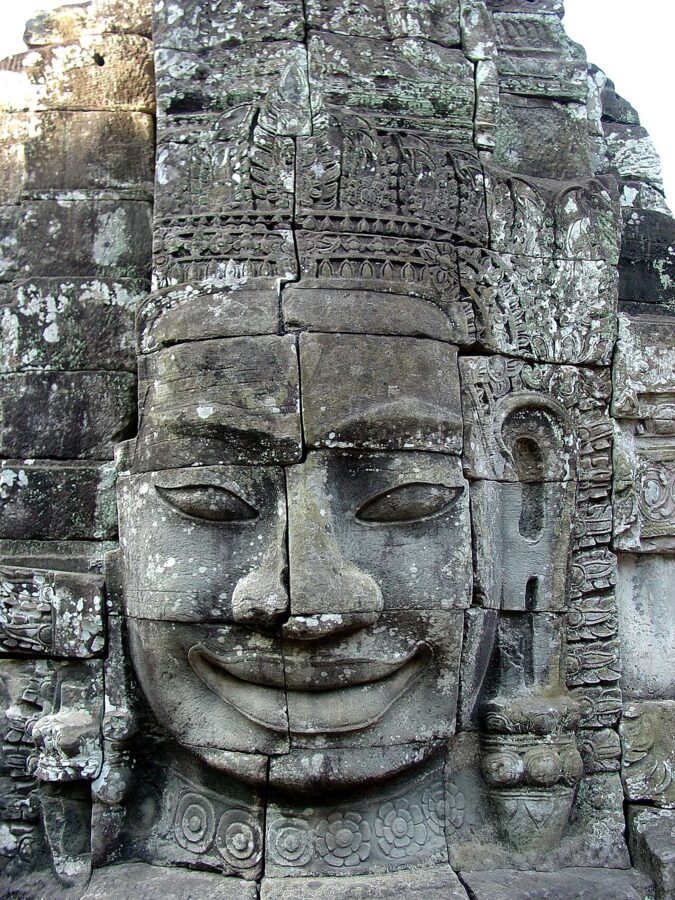
The oldest serious answer is Lokeshvara, the Khmer name for Avalokiteshvara, bodhisattva of compassion, looking to the four quarters. It fits the king’s religion, and the four corner shrines of Angkor Thom each held a stele to Lokeshvara. George Coedès, the great epigraphist of Angkor, went further: the faces are the bodhisattva given the features of Jayavarman VII, a Buddhist version of the god-king.

Paul Mus read the towers politically. Inscriptions in the chapels name gods of different provinces, so the towers stood for the kingdom gathered round its king. Many Cambodians will tell you the four faces are Prohm, the four-headed Brahma. Peter Sharrock argued in 2007 for Vajrasattva, a supreme Buddha of tantric Buddhism.
The most useful idea to carry in is the newest. From 2003 the Japanese team and Katsushi Ikeuchi’s laboratory at the University of Tokyo scanned the faces in 3D, and a 2005 study by Kamakura and colleagues sorted them into three groups, labelled deva, devata and asura: gods, goddesses and demons. Takeshi Nakagawa, who led the Japanese team, suggests the goddesses guard the inner shrine and the asura the edges. It turns the old question, whose face is on the tower, into a better one: which of them is this?
Where to stand
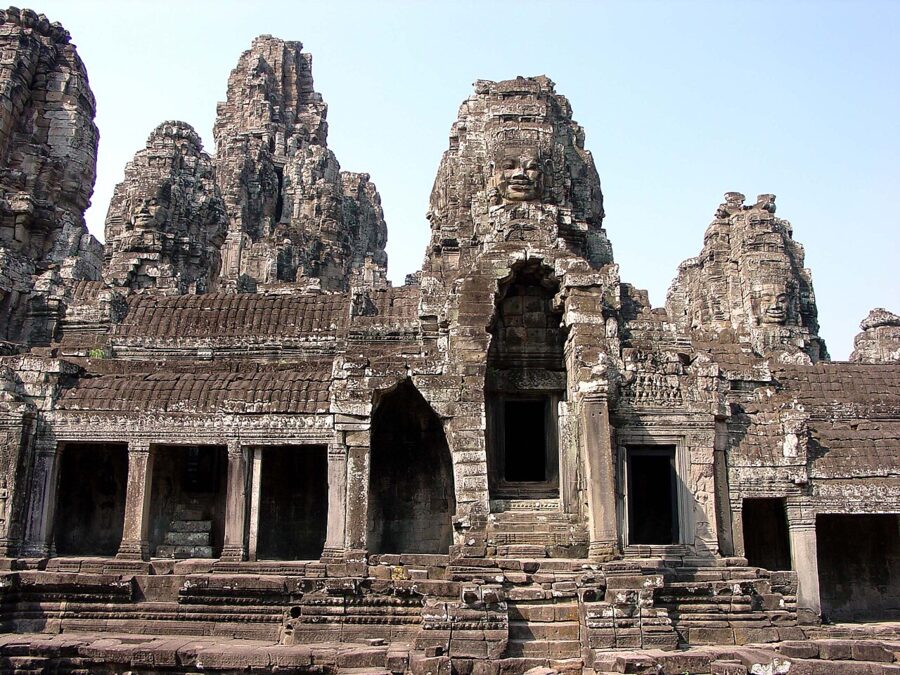
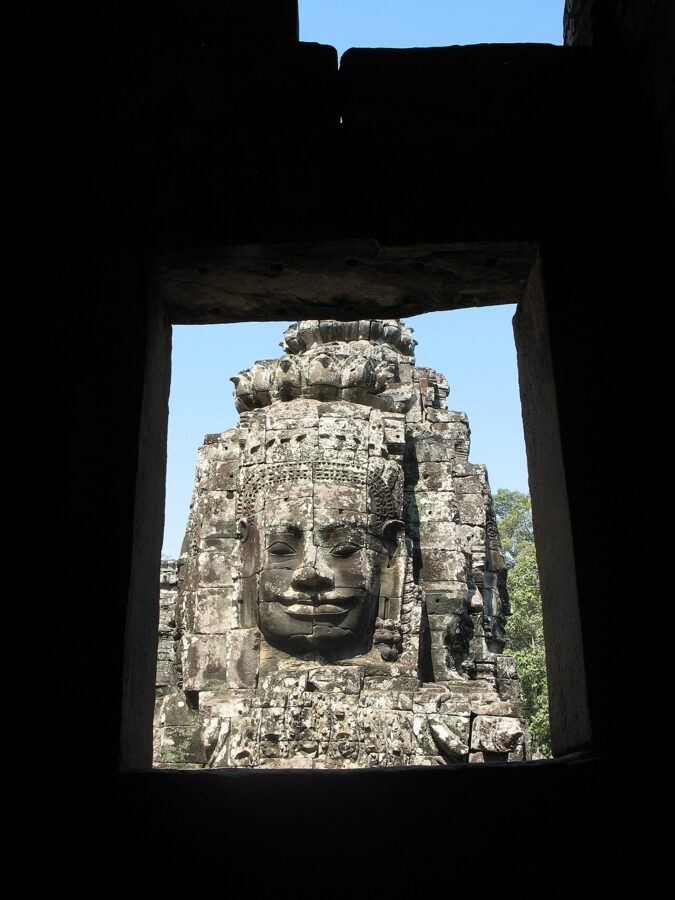
The faces are best when you are nearly level with them, on the upper terrace. From below, try the narrow courtyards between the galleries, where faces rise over the roof line, and the inner gallery doorways, which frame single towers. Walk slowly and keep looking up.

A plan that kept changing
From the outside in, the Bayon has three parts. The outer gallery, about 140 by 160 metres, has a gate tower (gopura) on each side and a pavilion at each corner, with two small “libraries” in its courtyard. The inner gallery measures about 70 by 80 metres. On top sits the cross-shaped upper terrace and the round central mass, about 43 metres high.
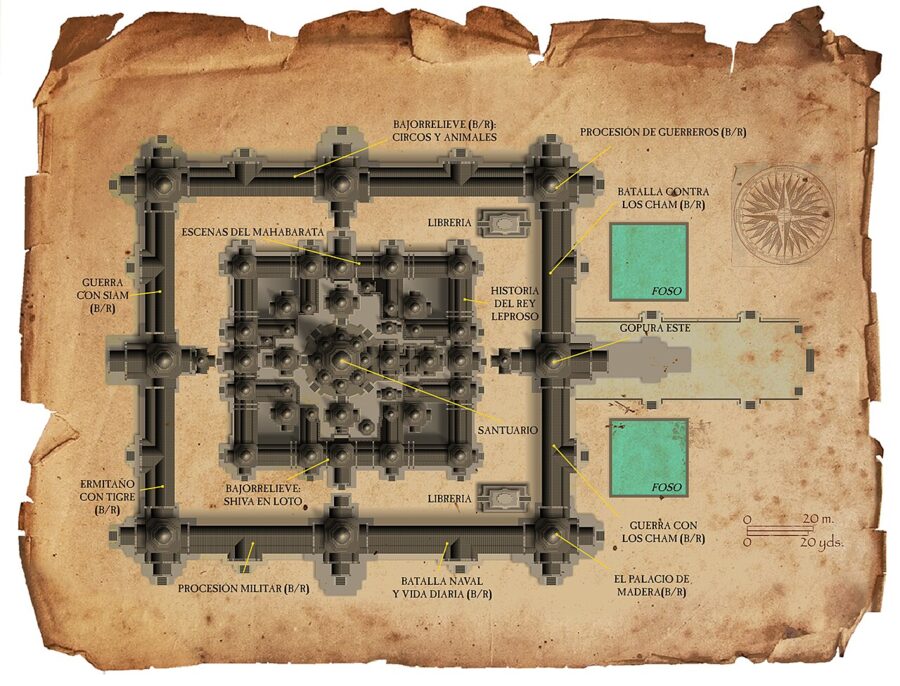

The round central tower is the oddity: nothing else in Khmer architecture has one. Nor was the plan fixed. Henri Parmentier showed that the inner gallery began as a cross with stepped corners and was later filled out into a square, leaving four tiny closed courtyards inside.
The courtyard floor was raised twice with fill, burying the inner gallery’s base 2.5 metres deep, and the outer gallery and libraries went up on the new ground. Sixteen small chapels once divided the courtyard; only their footings remain. In September 2023 APSARA archaeologists found two overlapping stone structures on the third terrace, more evidence that the design changed mid-build.
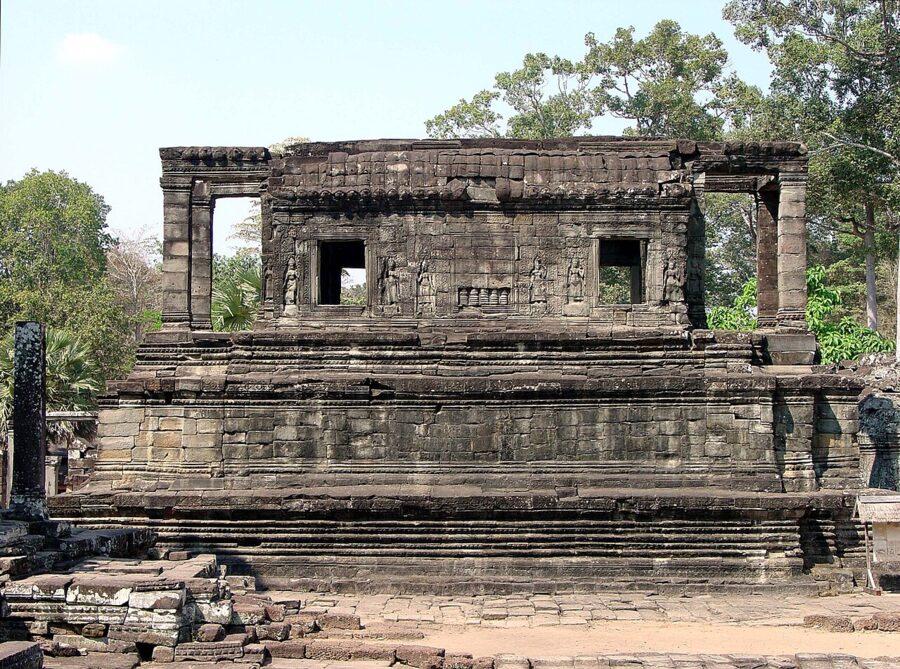

That is why the Bayon feels so crowded: spaces open in one phase were closed by the next. APSARA calls the result Angkorian “baroque”.
The outer gallery, clockwise from the east
The outer gallery has lost its roof, so its reliefs are in daylight. Apart from a label or two nothing is written beside them; what follows is the scholars’ reading. Walk clockwise, temple on your right, the direction of ritual circling (pradakshina): enter by the east gate and turn left.

East gallery, south wing: an army on the move
The first panel is a march in three rows: foot soldiers with javelins and shields, officers on elephants, musicians, a small figure beating a gong. The ropes round the soldiers’ chests are part of their kit; they are not prisoners.
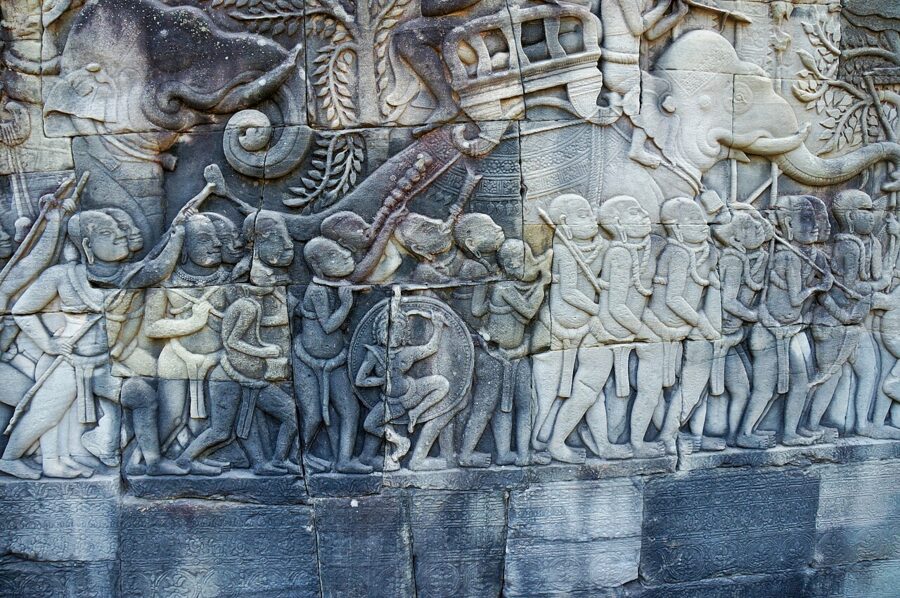

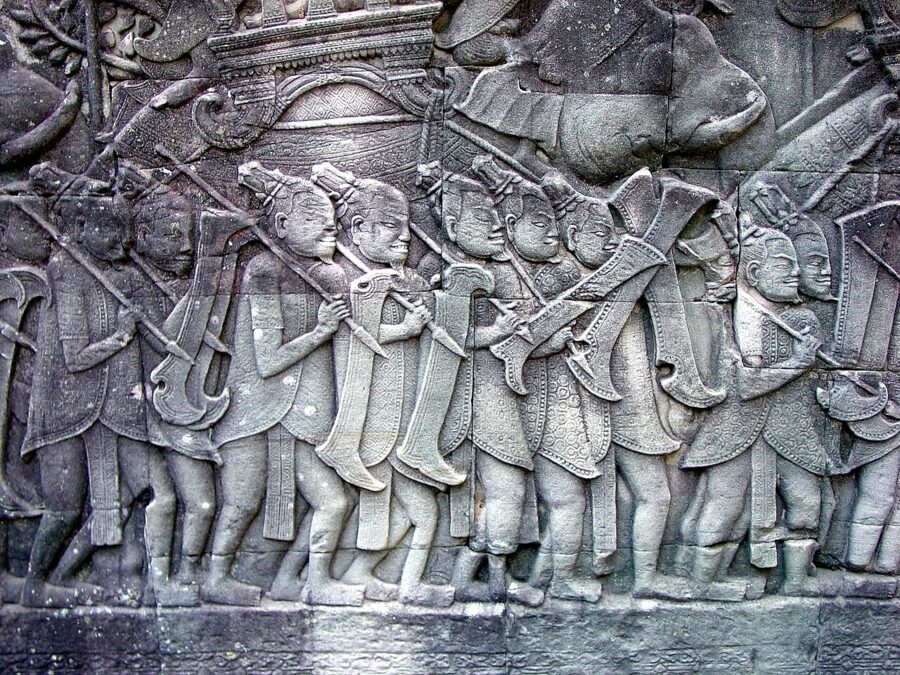
Look for soldiers with topknots, long shields and padded jackets, usually called Chinese; nobody knows who they were. Behind come carts, women and supplies, a buffalo tied for sacrifice and the ark of the sacred flame.
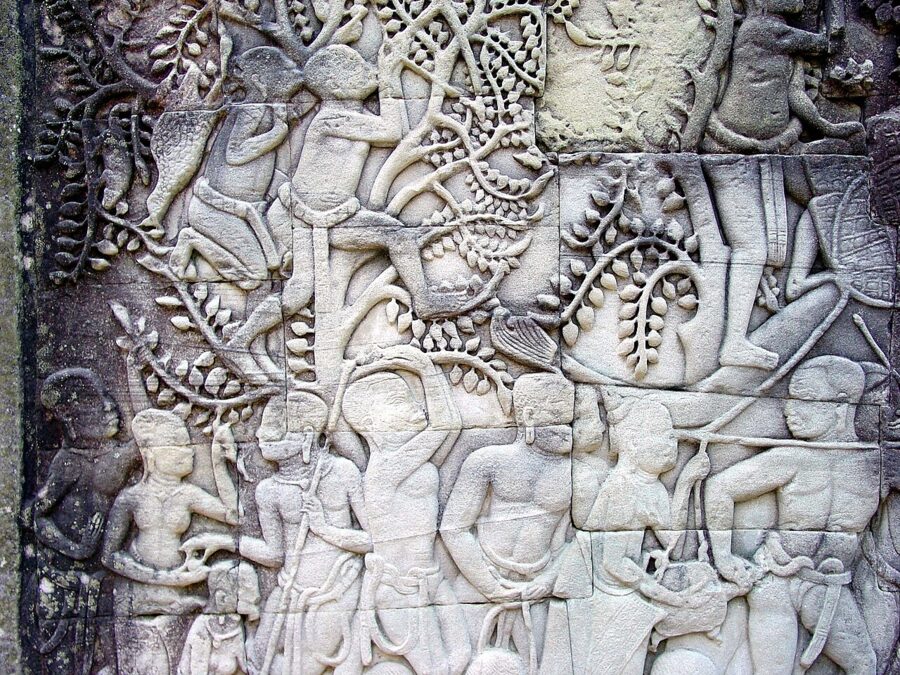


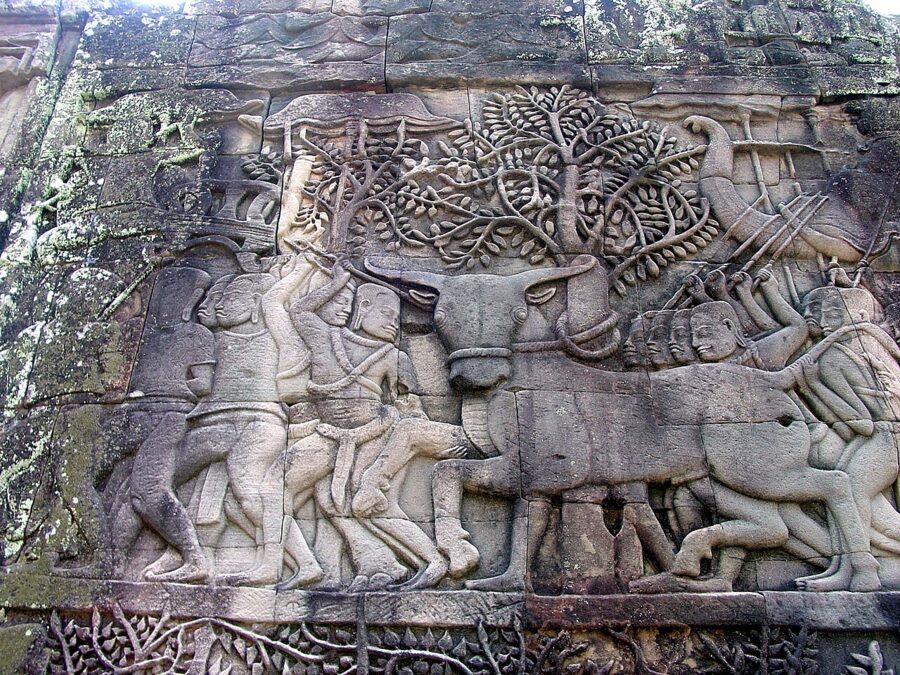

Step into the south-east corner pavilion. Some panels were never finished, and you can see the carvers’ method stage by stage: outline, flat relief, modelling, finish.
South gallery, east wing: the battle on the Tonle Sap
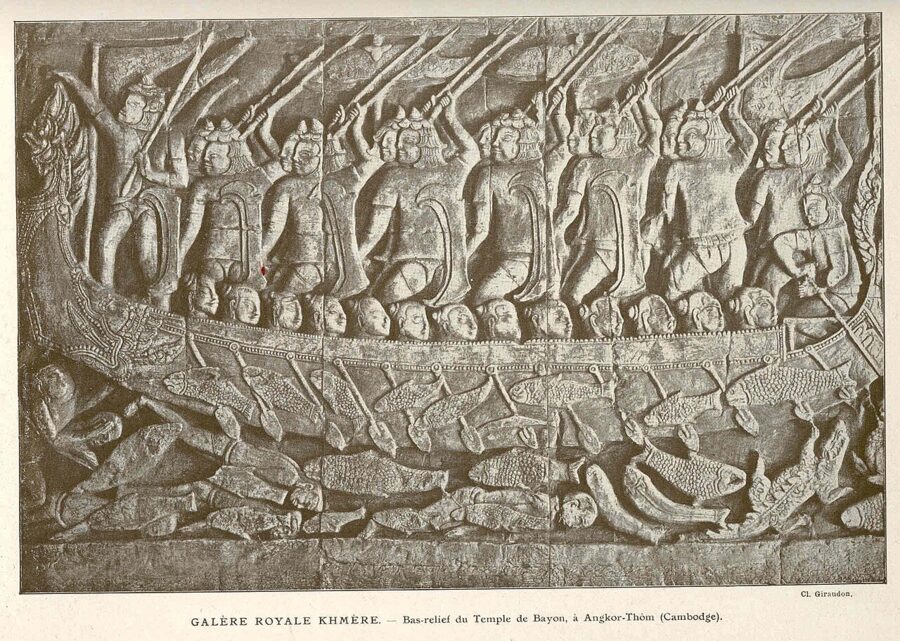
This is the wall to come for, the one Glaize sent readers to first. Along the top, war boats packed with oarsmen close on each other on the great lake, the Tonle Sap. The Cham wear a tiered headdress like an upturned flower; the Khmer have short hair or a small bun. Men fall overboard, and the crocodiles wait.
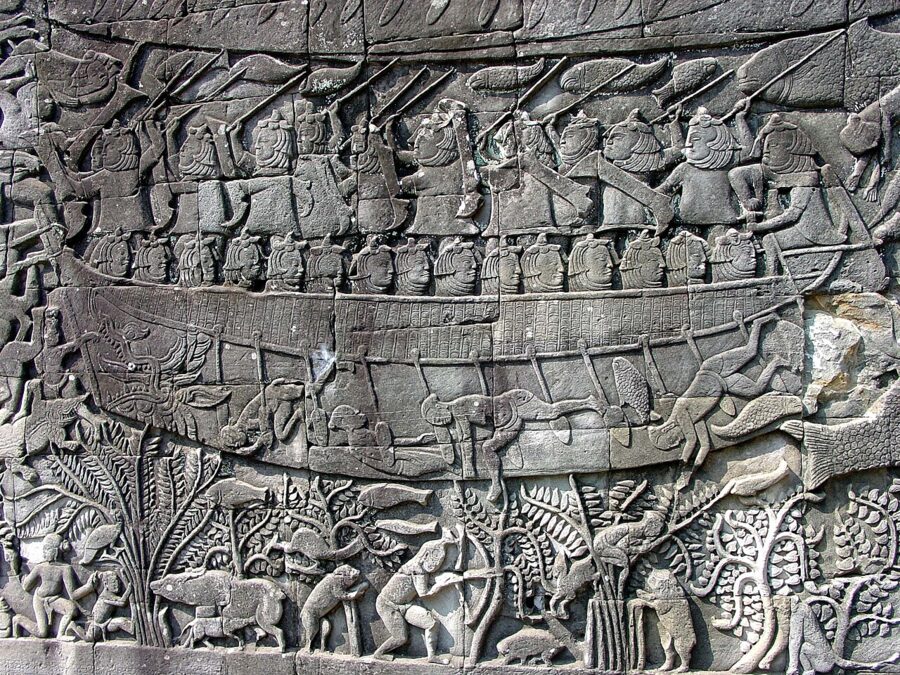

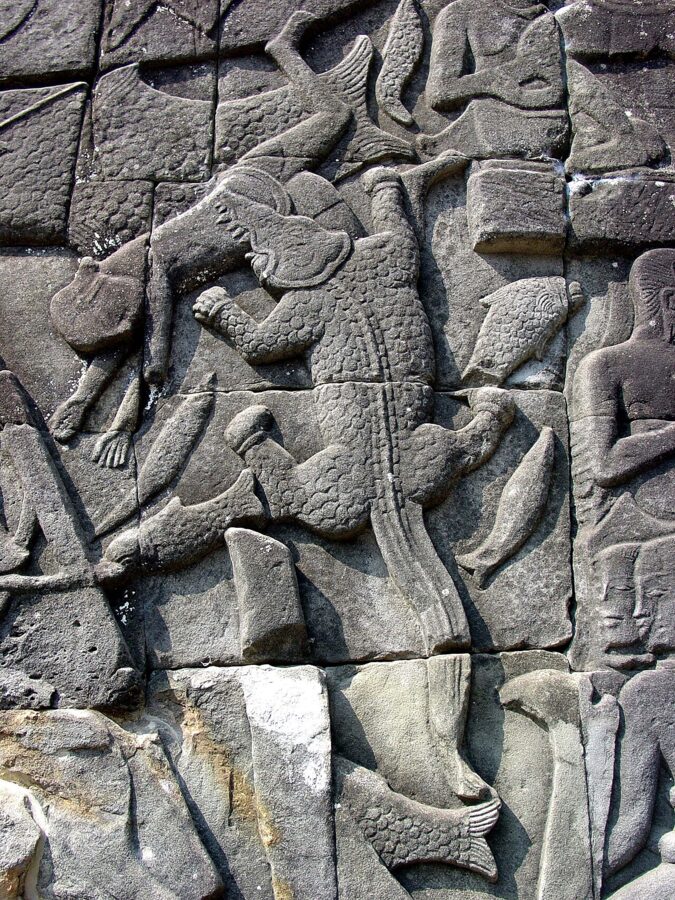

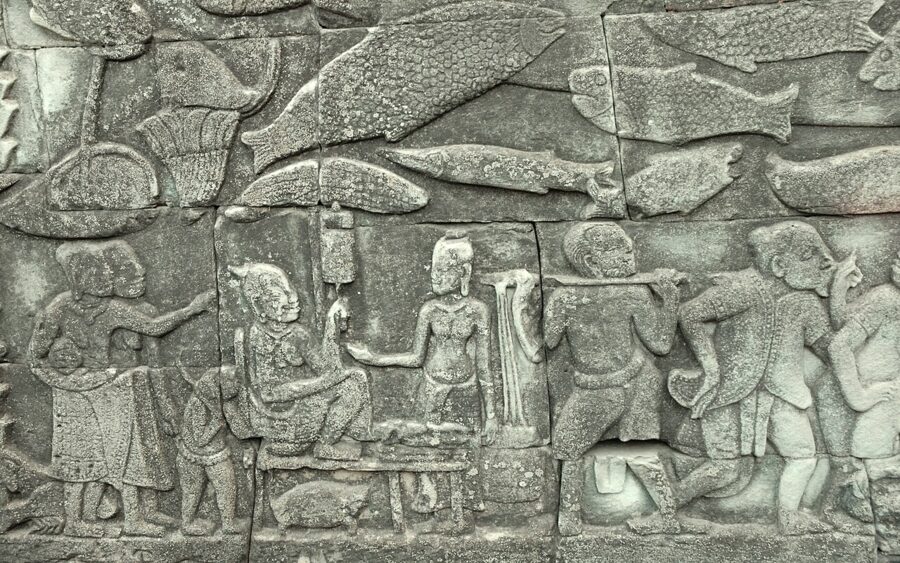
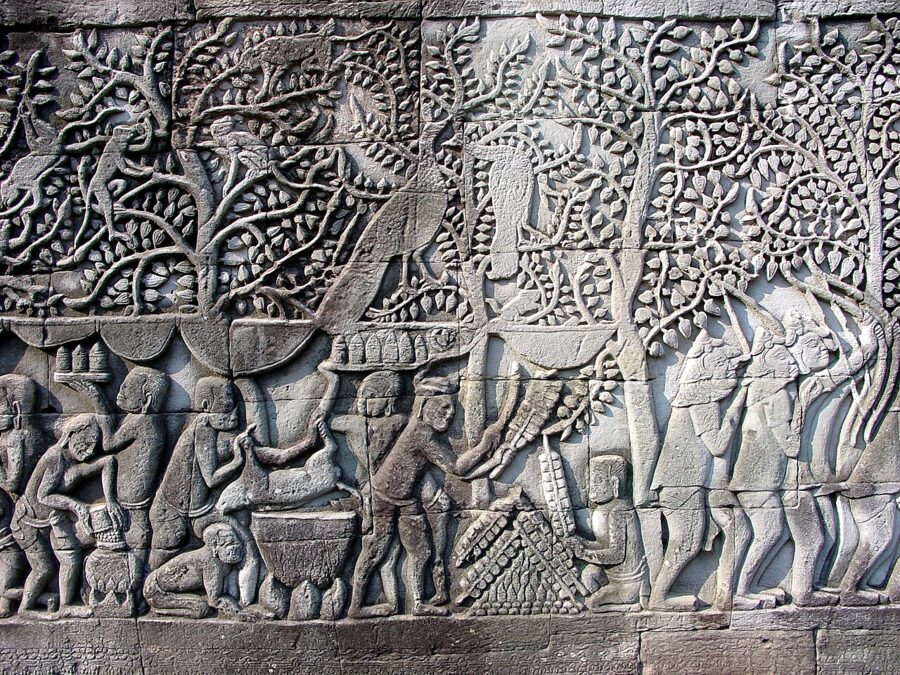
Now drop your eyes to the bottom rows. The battle sits on top of life on the lake shore: fishermen, a market stall, open-air cooking, a hunter with a crossbow, a boat like a Chinese junk, a board game. Further along come a cockfight, a boar fight, wrestlers and a palace full of princesses.

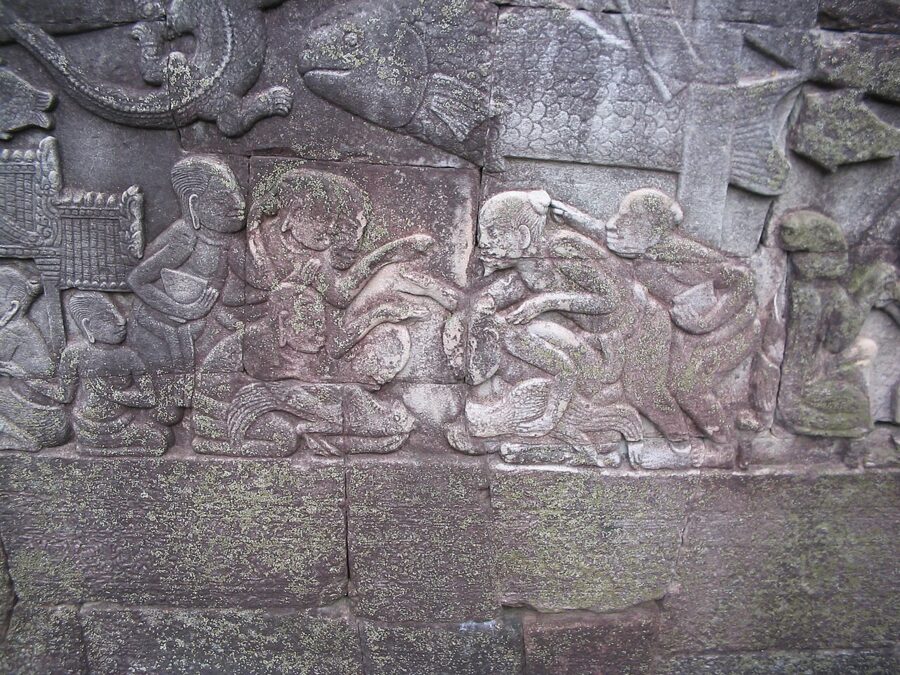

The wing ends with the Cham landing, a fight on shore and the king feasting his victory. Nobody has proved which battle this is; the usual reading ties it to the wars of 1177 to 1181, when the Cham came up the Mekong and across the lake.

Round the back: war machines, a civil war and a circus
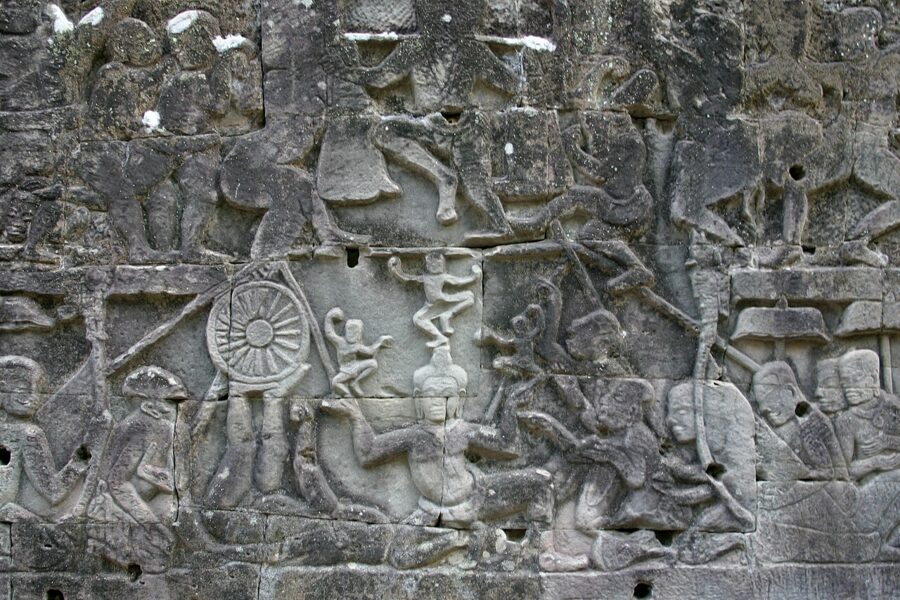
The west wing of the south gallery is a procession worth a look for its machines: a crossbow mounted on an elephant and a catapult on wheels. Glaize thought the carving mediocre, and I agree. The west gallery is largely unfinished: an army in a forest, workers hauling blocks, and a panel Coedès called “the civil war”, Khmer against Khmer.

Past the west gate, a huge fish swallows a small deer, with a short label saying the deer is its food. The north gallery opens with the merriest wall in the temple, probably the games of a royal consecration. Beyond the north gate the wall has largely fallen; in what remains the Cham advance and the Khmer fall back. The circuit closes on the east side with elephants fighting elephants.

The inner gallery, briefly
The inner gallery is a different world: smaller panels broken up by stairs and vestibules. The subjects are mostly Hindu: the Churning of the Ocean of Milk, Vishnu on Garuda, Shiva dancing, Ravana shaking Mount Kailasa, and the legend of the Leper King in the north wing of the east gallery.
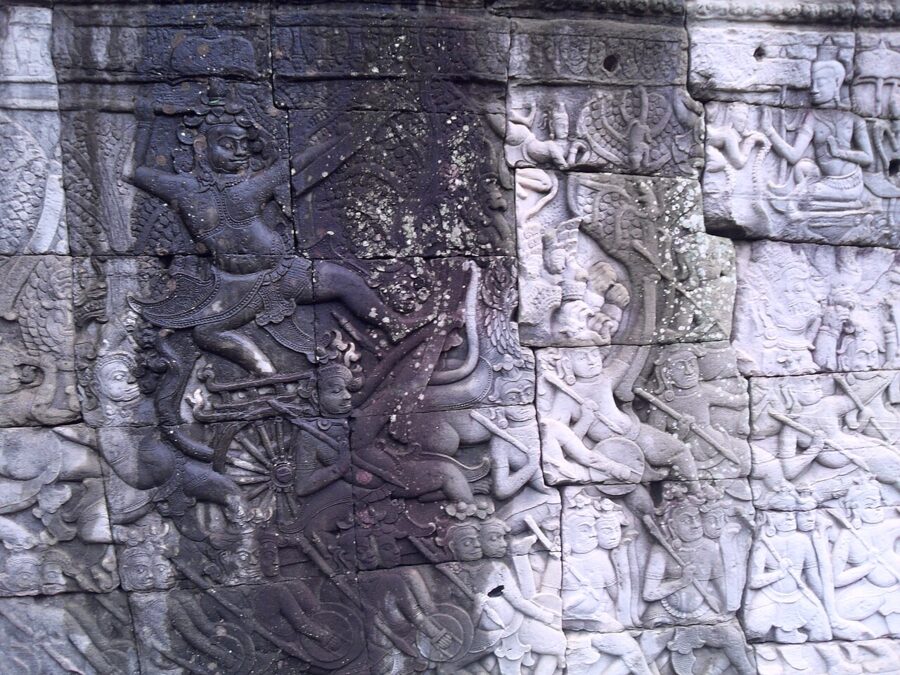

Most accounts date them to the Hindu reaction after Jayavarman VII’s death. They are in poor condition, eaten by rain through the roof joints and the salts it leaves, and saving them is part of the Japanese team’s current work. Twenty minutes is enough unless you know your Puranas.

After the king
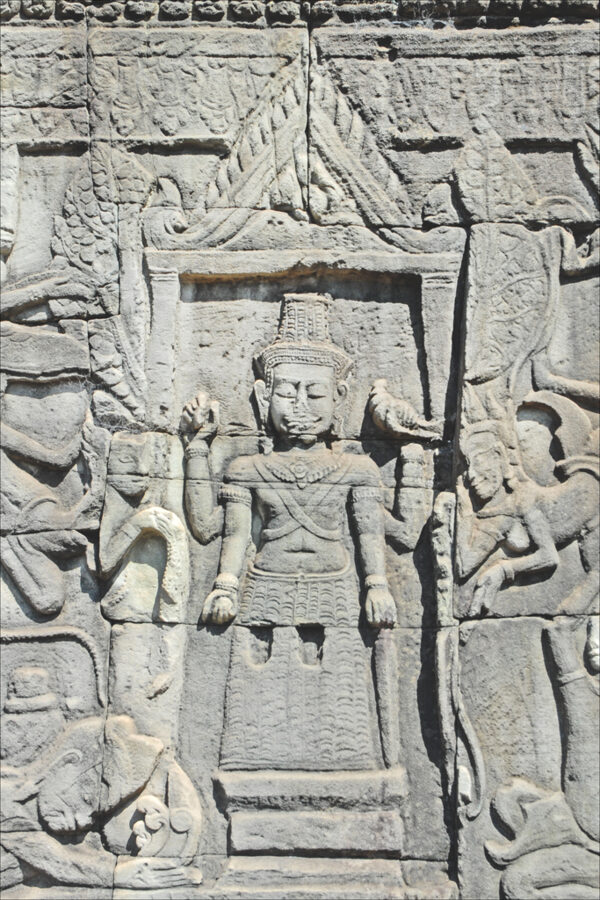
Count the empty niches. Under Jayavarman VIII, in the mid-13th century, the court turned back to Shiva and Vishnu, and Buddha images all over the Bayon were chiselled away. Sometimes a seated Buddha survives as a smooth patch with a halo; sometimes, it seems, it was recut into a hermit or a linga, the stone emblem of Shiva. The sixteen courtyard chapels probably came down then too.
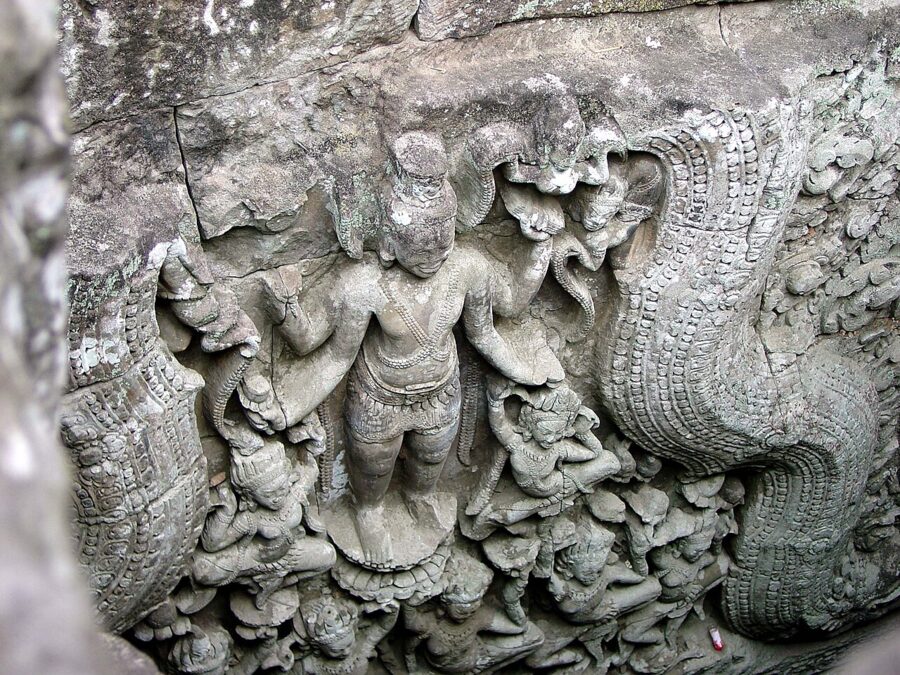

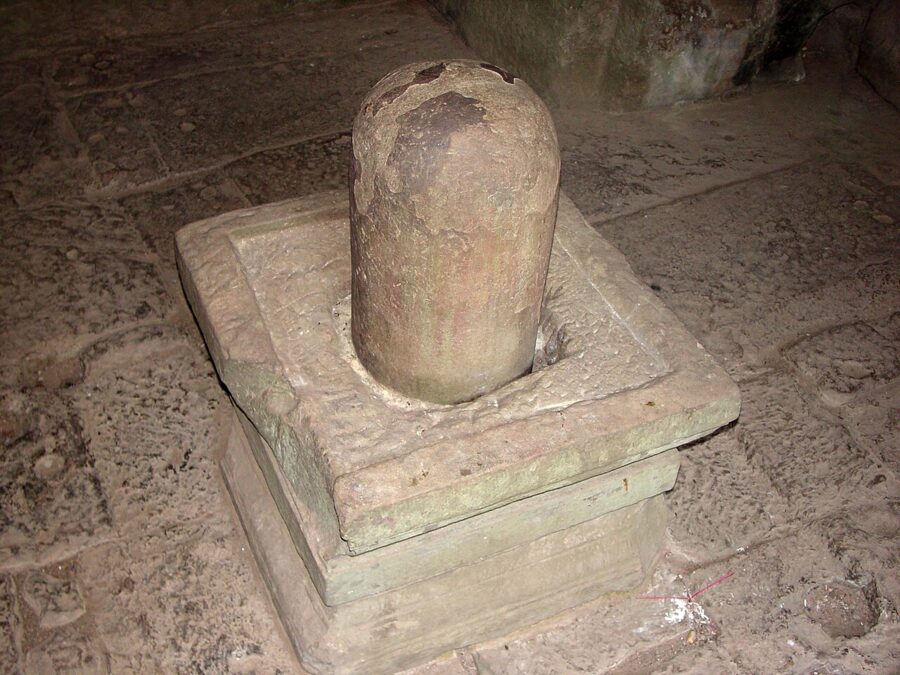

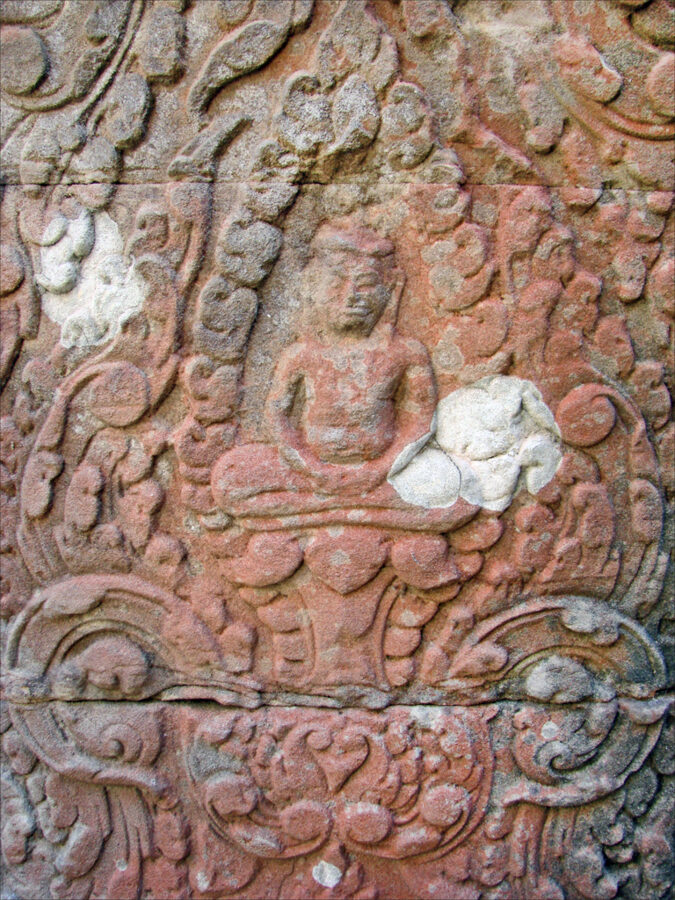

The great Buddha of the central sanctuary fared worst. It was smashed and thrown into the shaft beneath the central tower, where Georges Trouvé found the pieces in 1933, about 14 metres down. The 3.6-metre statue, the Buddha on the coils of the naga king, was pieced together and presented to King Sisowath Monivong in May 1935.
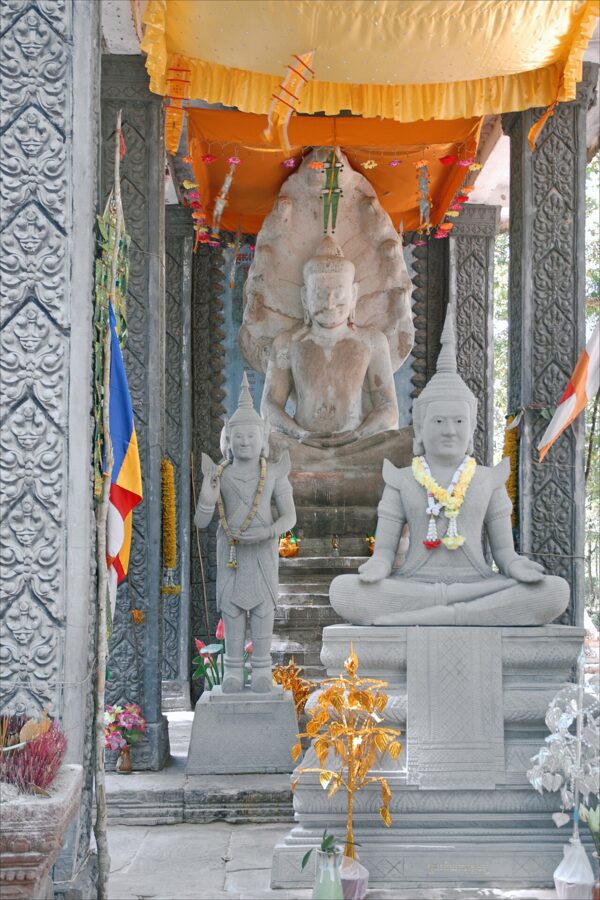

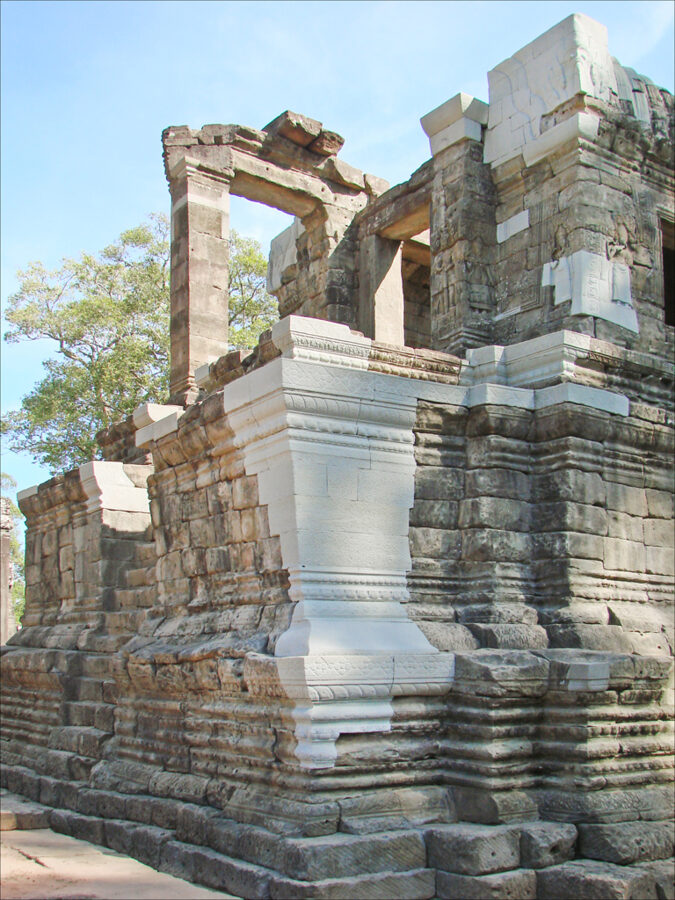
It now sits at Vihear Prampil Lveng, a small monastery about 500 metres north-east of the Bayon on the road to the Victory Gate. Carry on through the gate and you reach Thommanon and Chau Say Tevoda, a good pair to end a morning.
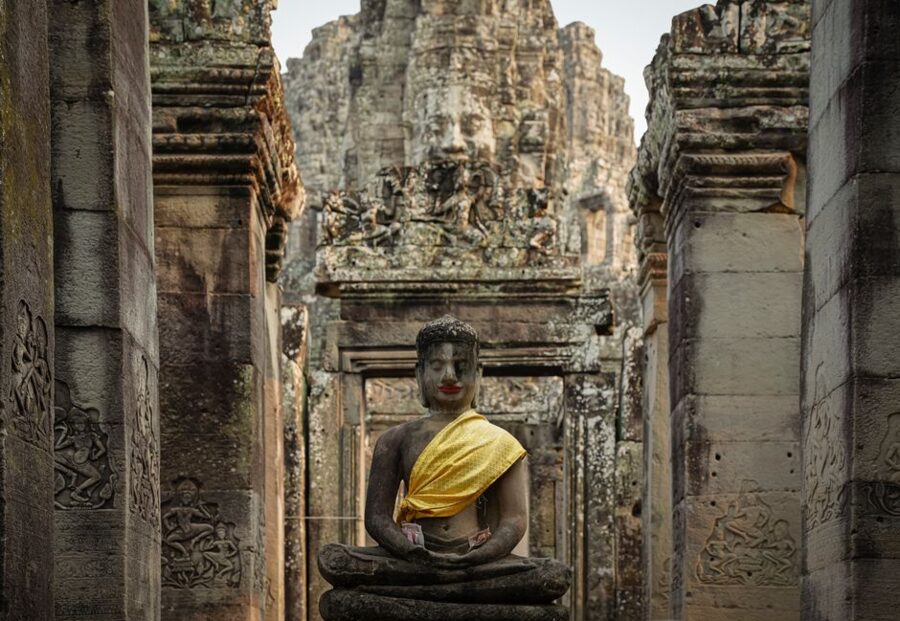
Buddhism came back as the Theravada school Cambodia follows today, adding reclining and seated Buddhas at the entrances. The Bayon never stopped being a place of worship. On public holidays families come to a well at the foot of the central platform to splash their faces and take water home.
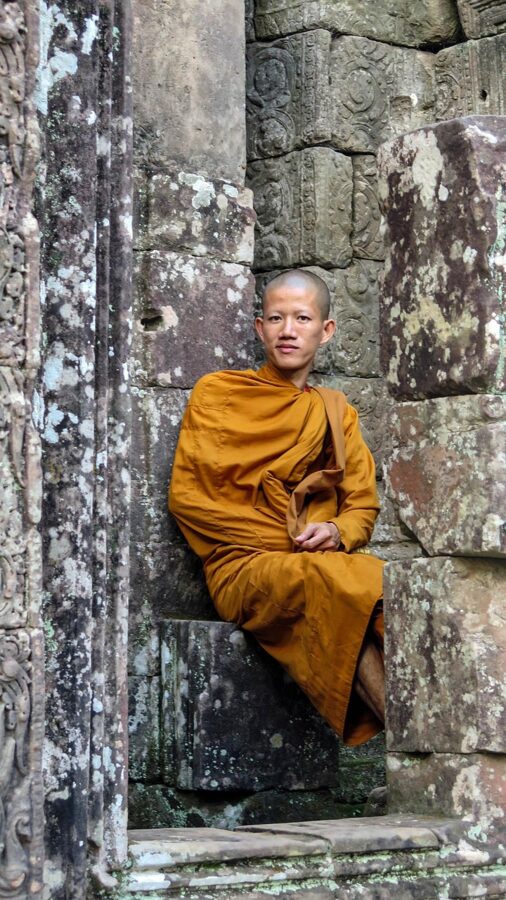
The Japanese team on site
The French came first. The École française d’Extrême-Orient (EFEO) studied the Bayon from 1901, Jean Commaille cleared it in 1911 to 1913 (he is buried in the south-west corner of the road square around it), and Glaize reassembled the towers in 1939 to 1946. Angkor became a World Heritage Site in 1992, on the danger list until 2004.
Since 1994 the Bayon has belonged, in conservation terms, to the Japanese. The Japanese Government Team for Safeguarding Angkor (JSA), led by Takeshi Nakagawa of Waseda University and funded through UNESCO’s Japanese Funds-in-Trust, later joined APSARA as a combined team, JASA. Its first job was the sinking north library: dismantled, its sand bed compacted with a traditional rammer called the Elephant’s Foot and a little slaked lime, and rebuilt with its own stones by 1999.

Annual symposia from 1996 produced a Bayon Master Plan and a Bayon Charter, the rules for repairing the temple. The south library followed, then towers and galleries, and years of monitoring the central tower. That work found weak ground beneath it, and on 1 February 2020 the tower closed to visitors.
By the end of 2022 Japan had put more than US$28.5 million into the Bayon, says its embassy in Phnom Penh, and over 1,500 Japanese specialists had worked on it. The current phase is the hard one: stabilising the central tower and saving the inner gallery reliefs. Surprises keep coming; in April 2024 APSARA teams lifted a 12th-century stone tortoise out of a pond on the east side.
Visiting: the hour, the route, how long
| Opening hours | 7:30 to 17:30 daily (APSARA, as of November 2026) |
| Central tower | Closed for conservation since 1 February 2020 |
| Ticket | Angkor Pass: US$37 one day, US$62 three days, US$72 seven days (as of November 2026) |
| Time needed | 1–2 hours; APSARA suggests 1½ to 2 |
| Dress | Shoulders and knees covered |
Entry is on the ordinary Angkor Pass, sold by Angkor Enterprise at its Road 60 office and on its official ticket page. The Bayon is on the Small Circuit, so one day is enough; buy the pass after 16:45 the day before and it covers that evening’s sunset too.
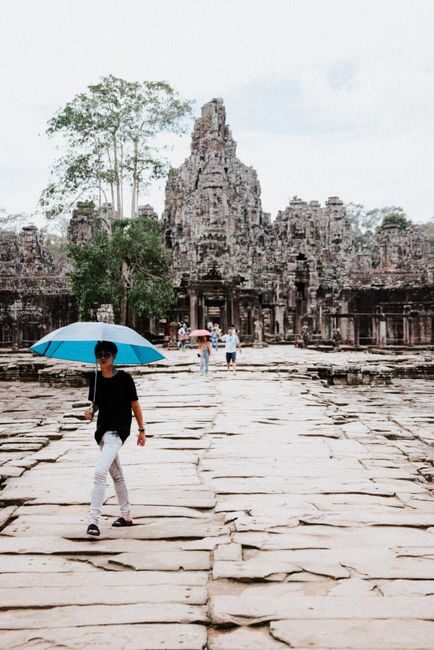
Go early. The temple faces east, the faces on that side take the low sun, and the gates open at 7:30. Glaize said the same, and recommended moonlight too; with closing at 17:30, that pleasure belongs to the past. The last hour before closing is my second choice.
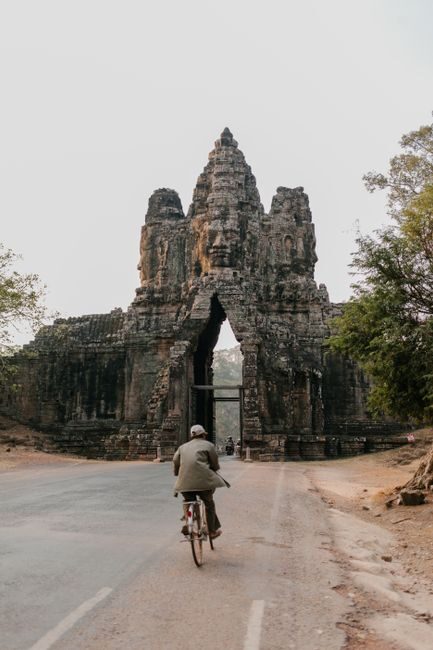
Most people come through the South Gate of Angkor Thom, then 1.5 kilometres (about a mile) straight up the road. Get dropped at the east side, the main entrance, with its long terrace and ponds either side. Signposts mark a short and a long circuit inside.
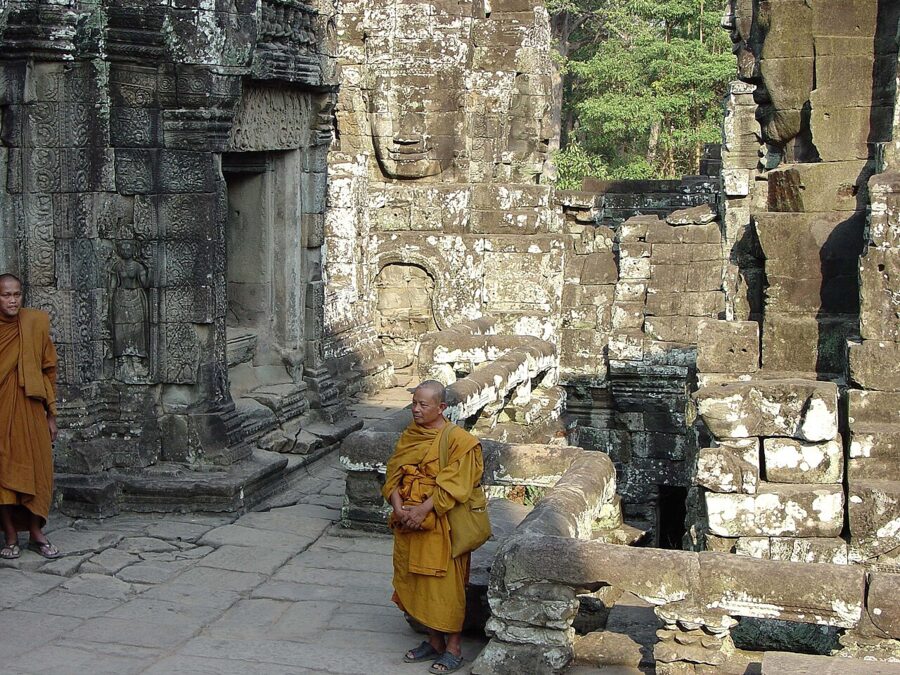

The upper terrace is the uncertain part. The central tower has been closed since 2020, and in August 2025 APSARA was fitting seven new stairs to the third level ahead of reopening it. Ask at the entrance which levels are open, and keep behind the barriers.
I would split ninety minutes like this: forty on the outer gallery, taking the south wall slowly; twenty in the inner gallery; thirty for the towers, from the upper terrace if you can get up, from the courtyards if not.
The Angkor visitor code bars shorts and skirts above the knee and bare shoulders at sacred sites, and the Bayon is one. Don’t touch the reliefs; tripods and big backpacks are discouraged. If you are planning several days around Angkor, do the Bayon on the first morning and come back to the south gallery later in the week.
Before you leave, find the woman at her market stall again. The faces above her have been argued over for a century. She is just selling fish, and of all the faces on the Bayon, hers is the one nobody disputes.