
Contents
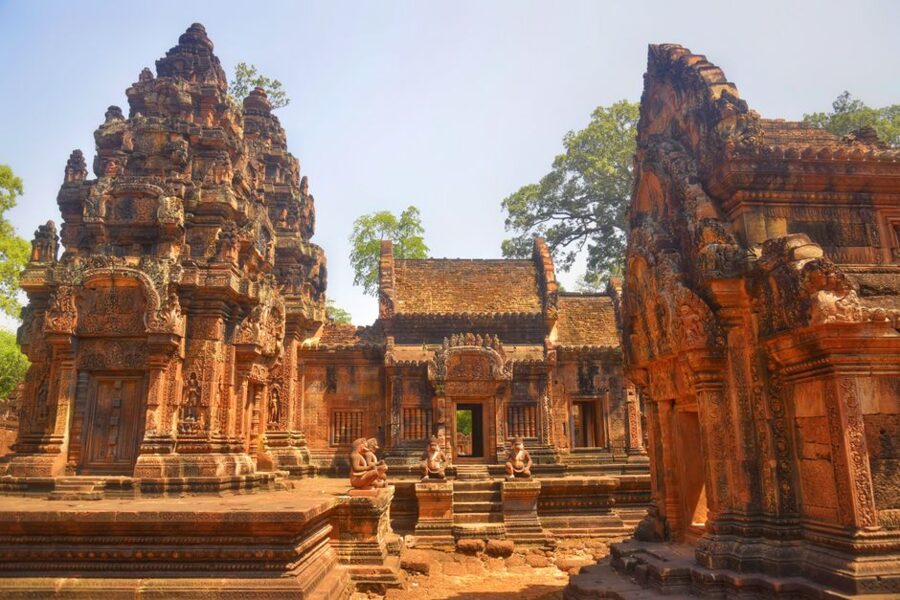
The doorway into the central sanctuary of Banteay Srei is 1.08 metres high. Whoever tended the god inside had to bend double, or crawl, to reach him. Everything is built to that scale, towers under ten metres and gateways barely wider than a man, and every surface is carved.
It is also the only major temple at Angkor that was not founded by a king, the first where whole stories from the epics were carved into the gables, and the scene of the most famous art theft in Cambodia’s history. A 22-year-old André Malraux, later France’s first minister of cultural affairs, cut devatas off its walls in December 1923 and was arrested with them on a riverboat on Christmas Eve.

It sits about 37 km (23 miles) north-east of Siem Reap, so many short visits never reach it. Of all the temples beyond the central group, this is the one I would get up early for.

A temple built by a teacher
The foundation stele was found only in 1936, in the eastern gateway of the outermost enclosure, and it overturned the accepted date. It names the founder as Yajnavaraha, a Brahmin scholar descended from King Harshavarman I, guru to the young prince who became Jayavarman V and a counsellor at the court of Rajendravarman II. He built it with his younger brother, Vishnukumara, and the positions of the sun, moon and planets recorded in the inscription give April or May 967, the last year of Rajendravarman’s reign. Angkor Enterprise’s temple page gives the consecration as 22 April 967.
The stele praises him as a scholar who helped the sick, the poor and the wronged. The central tower held a linga called Tribhuvanamaheshvara, “great lord of the threefold world”; inscriptions on the door jambs record a second linga in the south tower and an image of Vishnu in the north one.

The town around it was Ishvarapura. “Banteay Srei” is a modern name, usually translated “citadel of the women”, but in Khmer the Sanskrit words for woman (strī) and beauty (śrī) sound alike, so “citadel of beauty” is as fair. The tale that only women could have carved it is just a tale.
An inscription of 1119 records it rededicated to Shiva under a royal priest, and the last known inscription here is dated 1303.
Why it looks so different
Start with the stone: a hard, fine-grained pink sandstone that keeps a sharp edge and can be worked almost like wood, with laterite and brick kept for the walls. Maurice Glaize, conservator of Angkor in the late 1930s and early 1940s, thought the result belonged more to the goldsmith than the mason, and meant it as mild criticism.
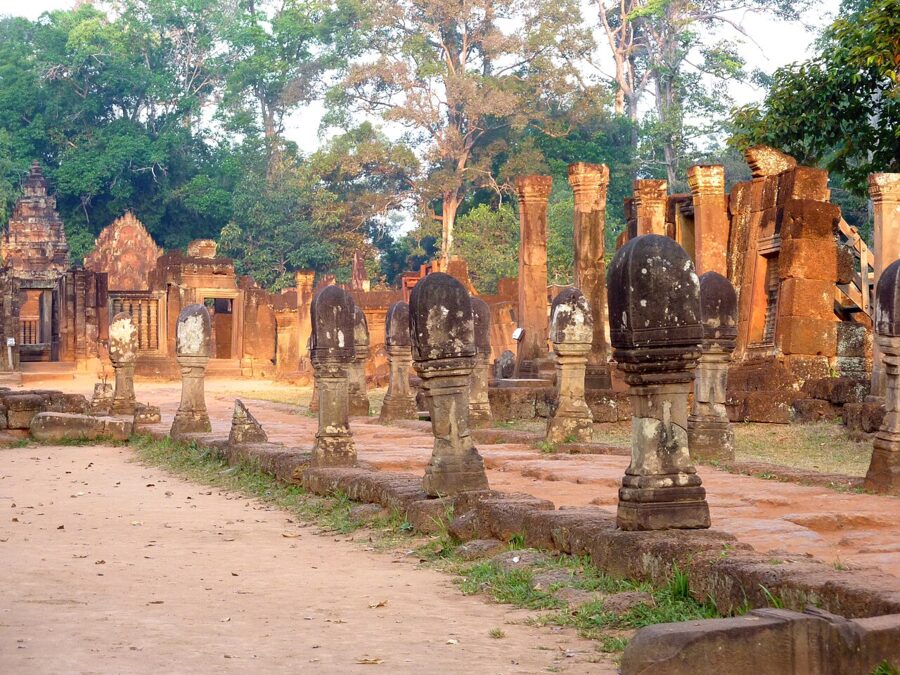

Then the scale. Three enclosures, one inside the other, shrink from 95 by 110 metres to 24 metres square. The towers stand on a platform 90 centimetres high, the centre one 9.8 metres tall. So much ornament on so small a building was taken for late work, and until the stele turned up the towers were dated to about 1300.
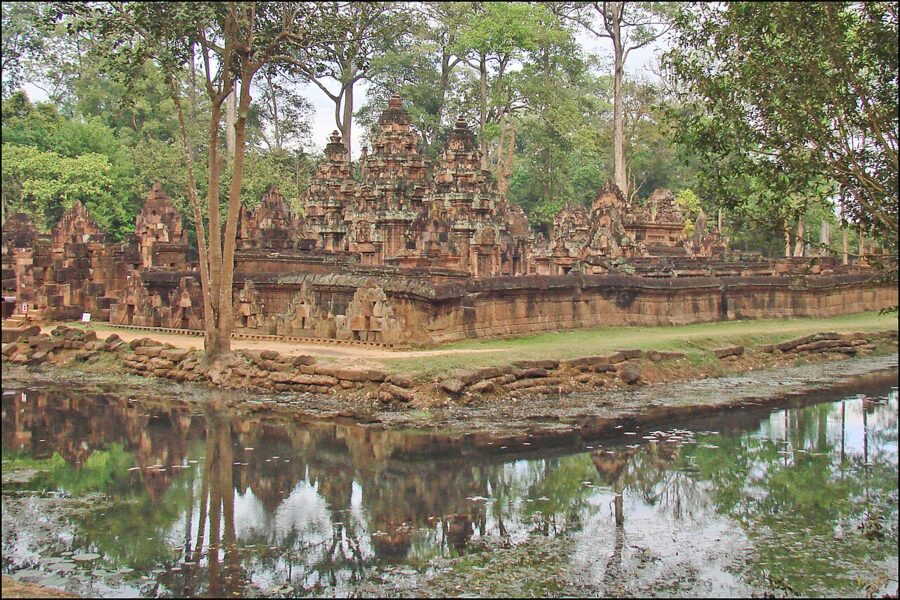

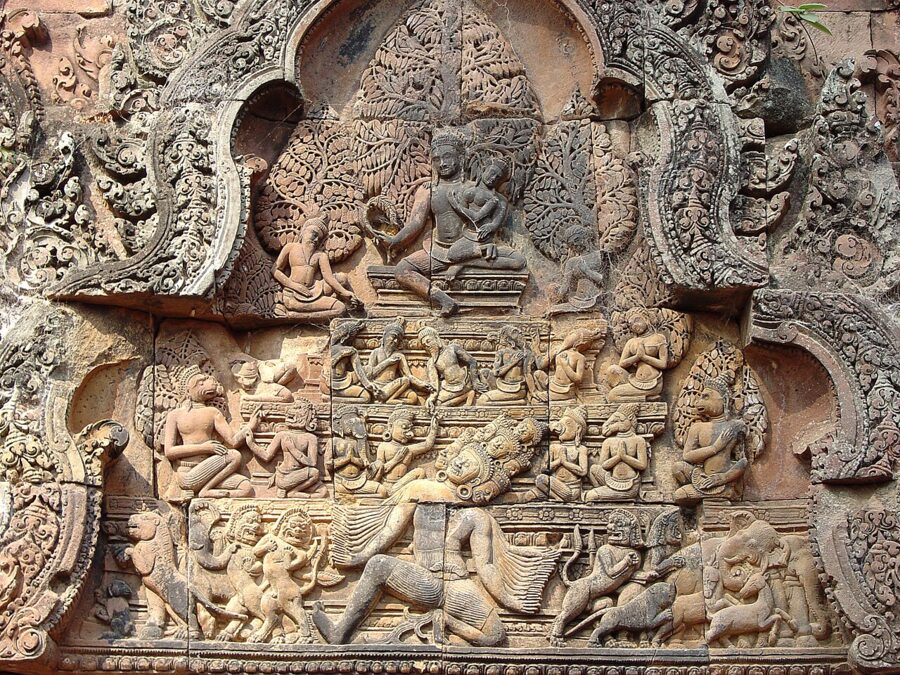
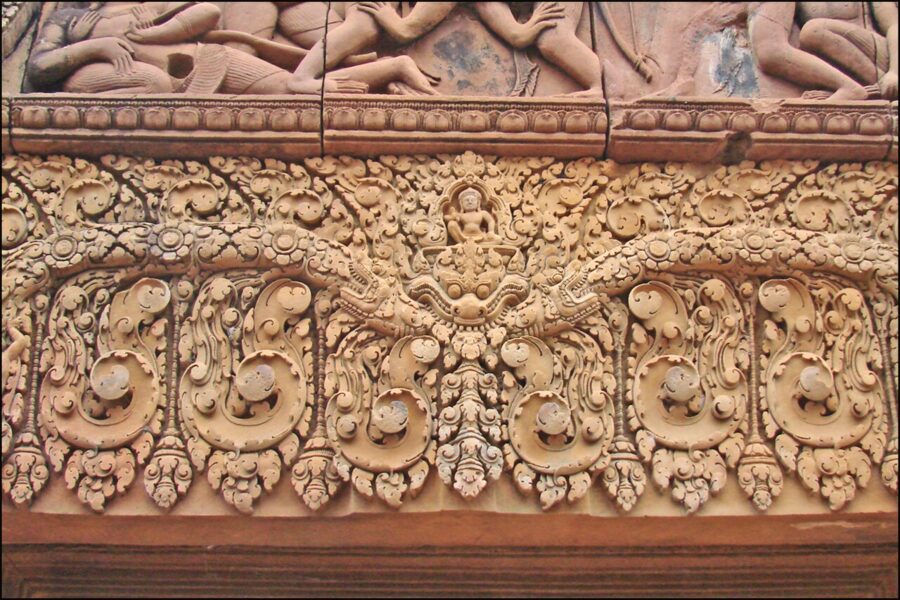
Then the gables. Earlier Khmer pediments carried single figures or ornament; here, for the first time, the space above a door holds a whole scene from the epics. Glaize thought the four library gables were never bettered at Angkor.
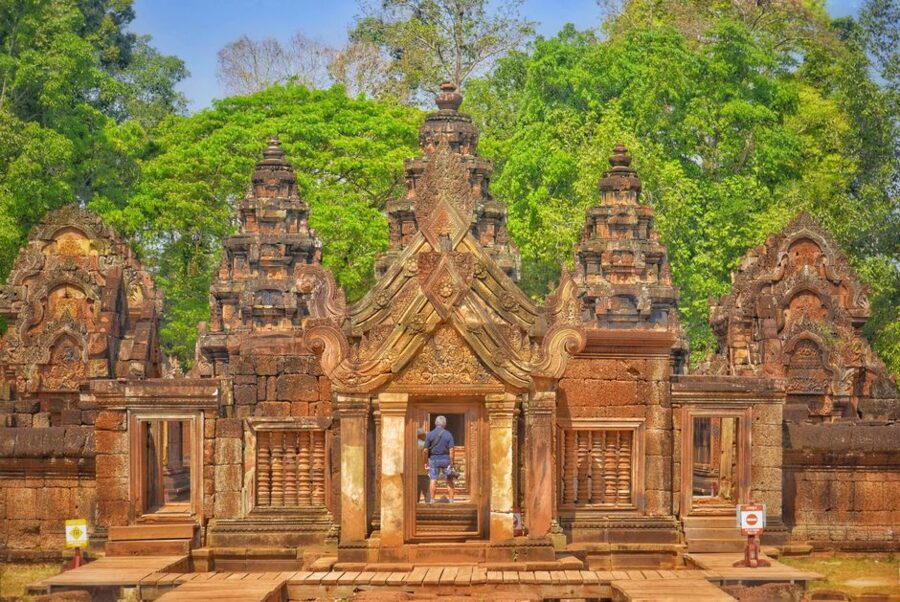
Reading the gables, gate by gate
Walk from east to west and take the gables in order; most people rush to the centre and miss the best one.
The causeway and the outer court
Past Indra at the outer gate, the causeway runs for 67 metres between ruined galleries. About halfway along, on the small building on the north side, is the pediment I would put above almost anything in the temple: Vishnu as Narasimha, half man and half lion, holding the demon king Hiranyakashipu upside down and tearing open his chest with his claws.
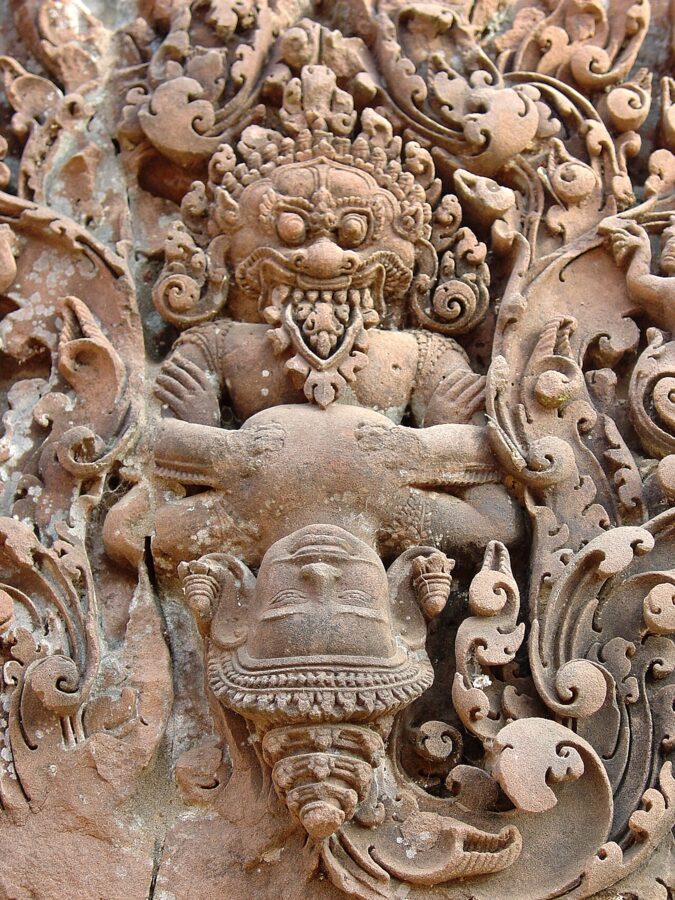

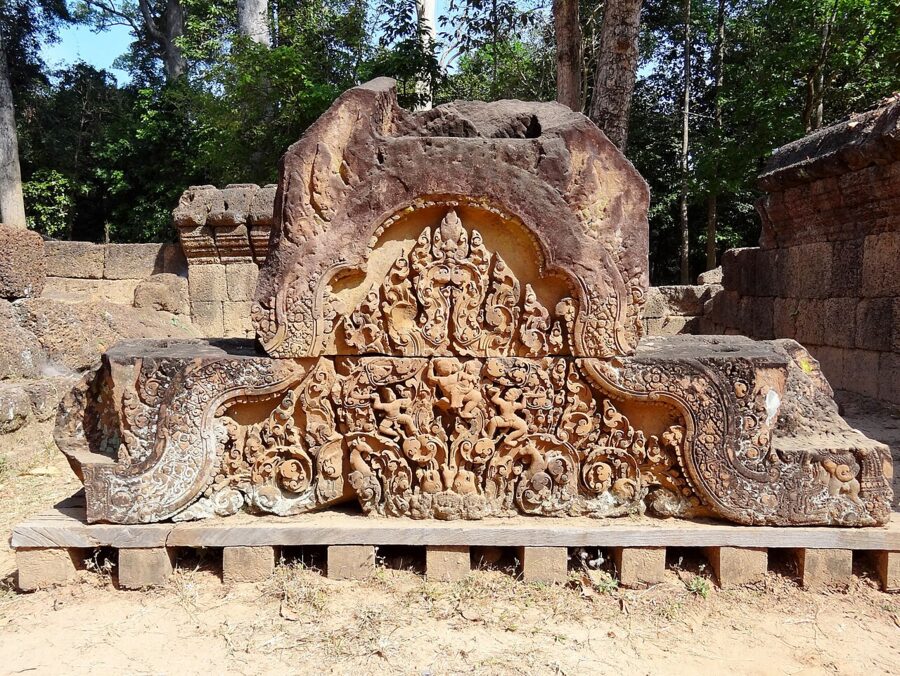
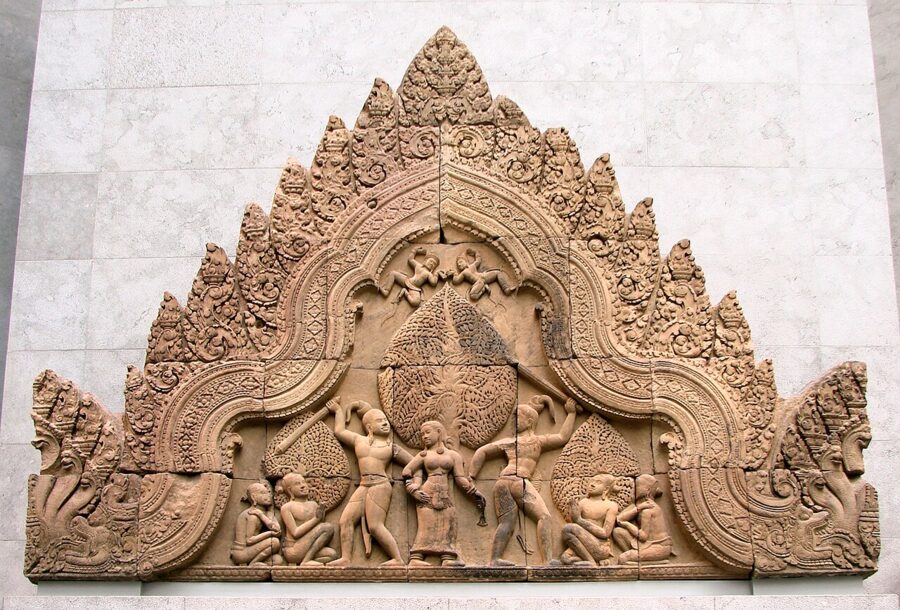
Near the gateway of the third enclosure, a pediment of Sita carried off by a demon lies reassembled on the ground. The gable that faced west from the same gateway has been in the Musée Guimet in Paris since 1936: two demon brothers about to kill each other over the nymph Tilottama.

The inner gateways
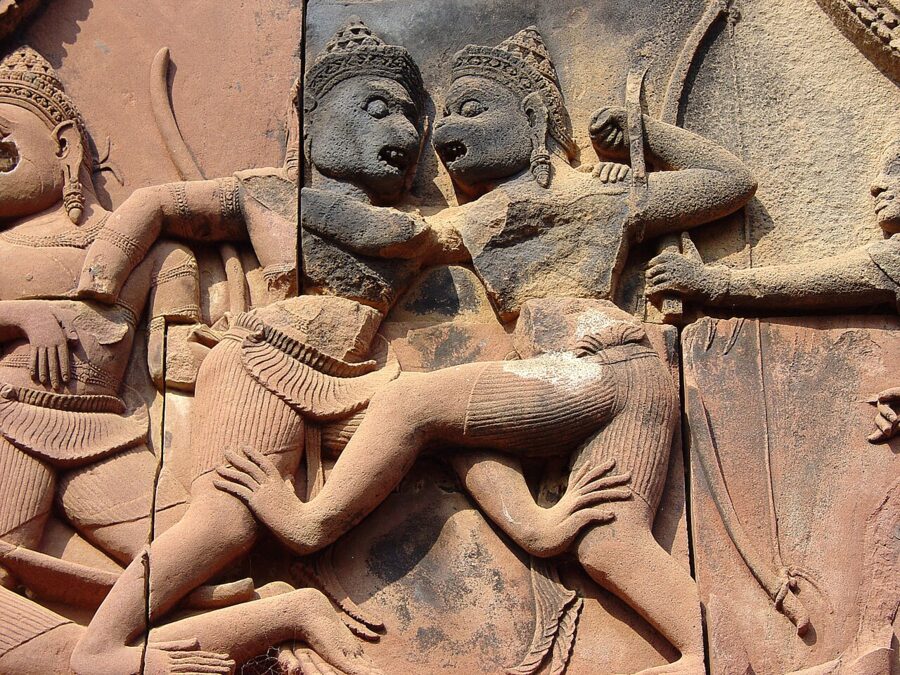
The gateway in the west of the second enclosure shows, on its east face, the monkey brothers Vali and Sugriva locked together while Rama draws his bow behind them. Sugriva wins, but only because Rama shoots Vali.

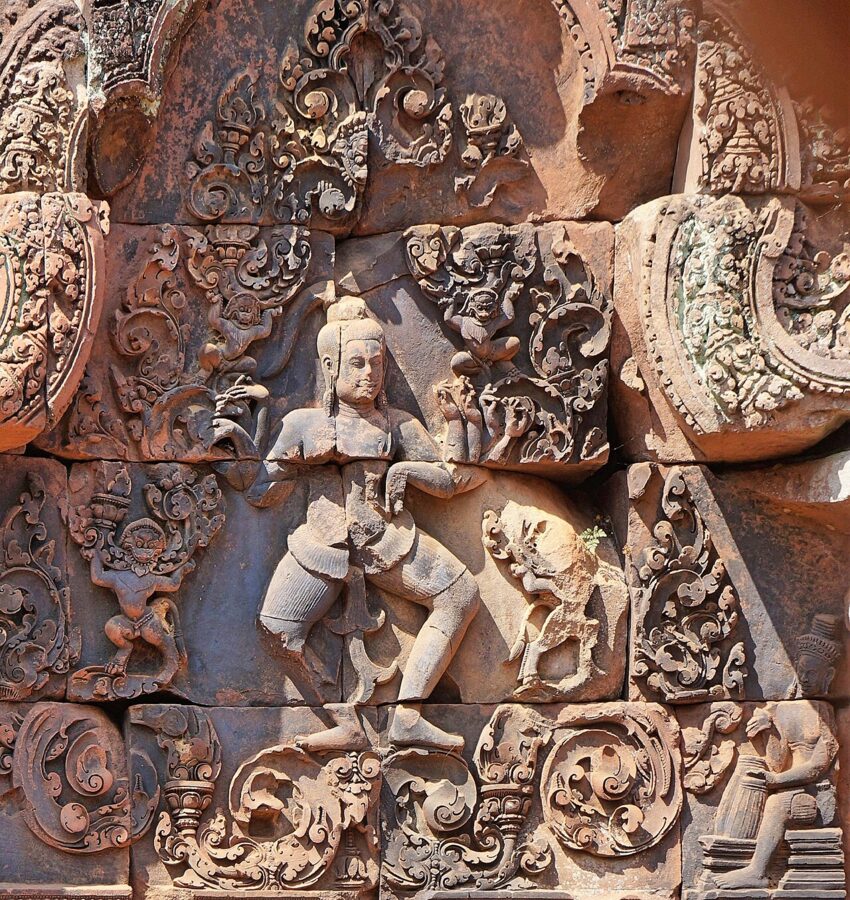
On the east gateway of the innermost enclosure, Shiva dances the dance that destroys and renews the world, the pose known in India as Nataraja. The west face of the same gateway has Durga with eight arms, helped by her lion, fighting the buffalo demon.


The south library
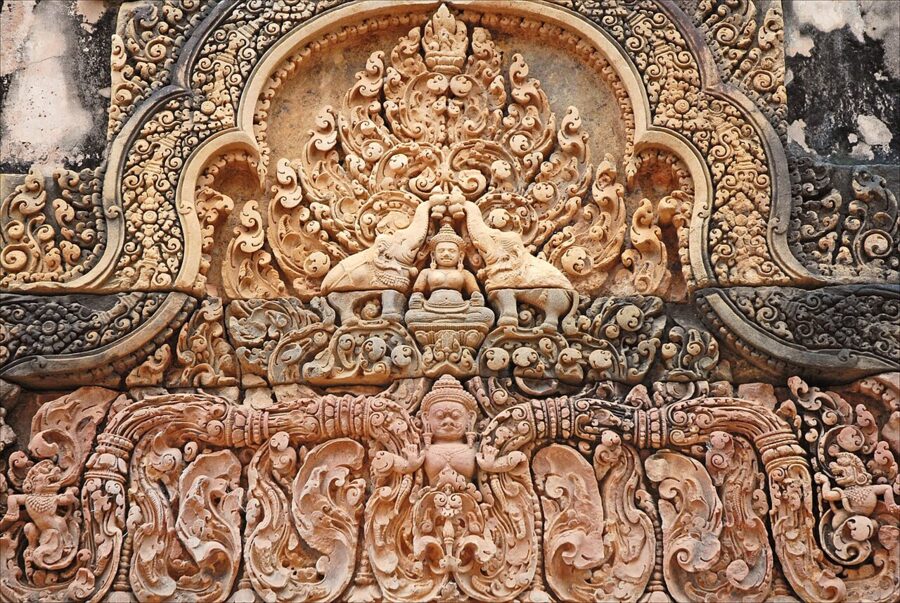
The two small buildings inside the inner enclosure are called libraries, though nobody knows what they held. The southern one is Shiva’s. On its east gable Ravana shakes Mount Kailasa, tiered like a temple-mountain, with ascetics and fleeing beasts on its slopes; on the west, Kama, god of love, aims an arrow at Shiva while Parvati offers him a rosary.

The north library
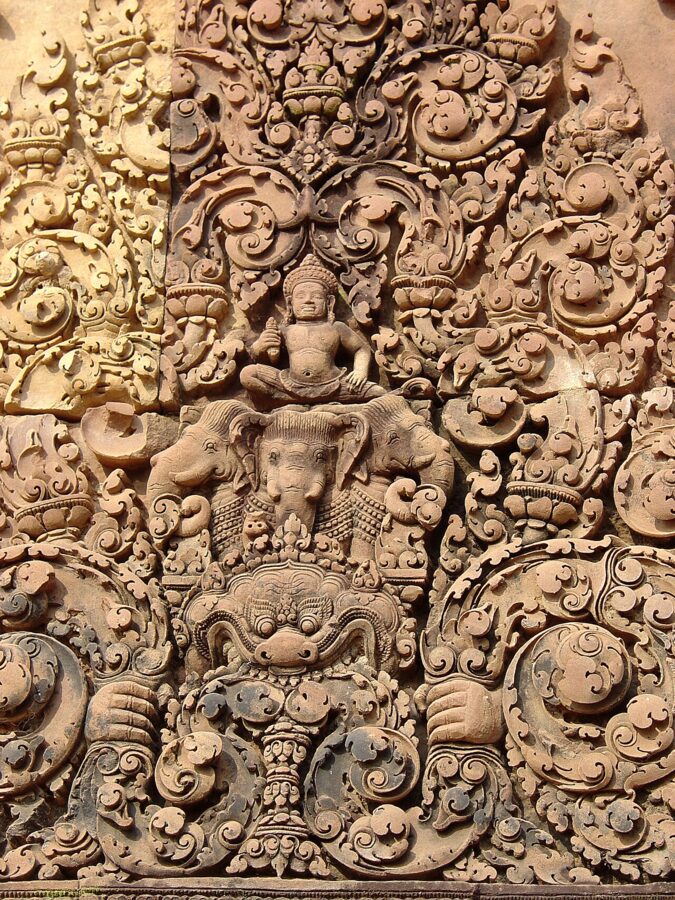
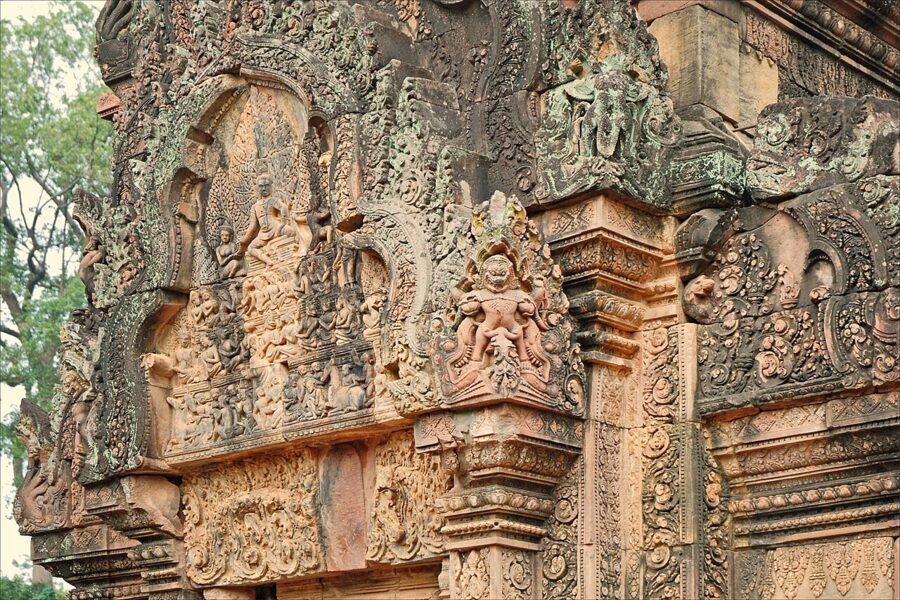
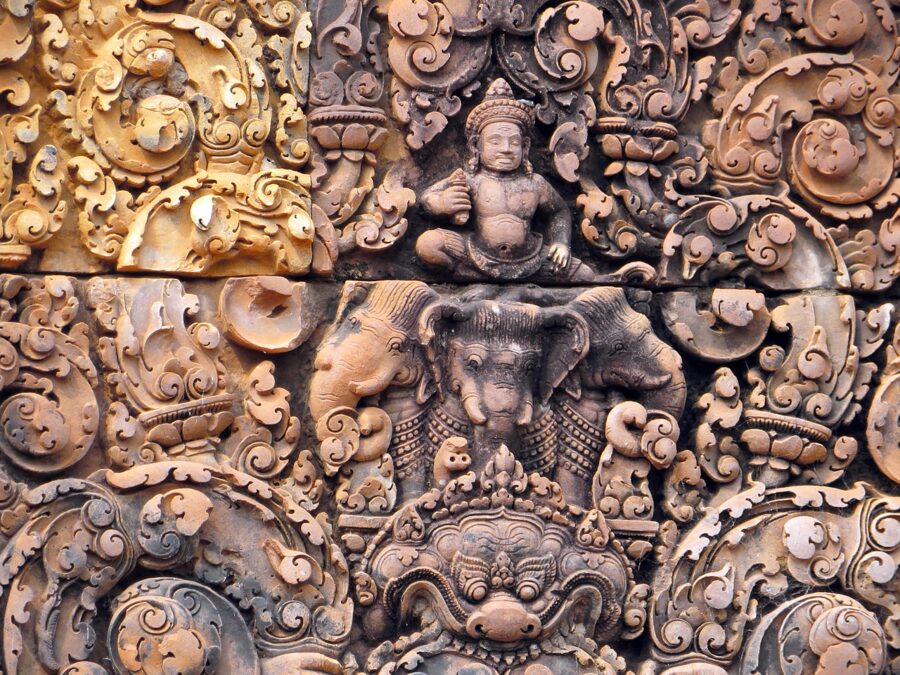
The northern library is Vishnu’s, and its east gable is argued over. Rain falls on a forest full of animals, with Indra on his elephant above. Glaize read it as Indra’s kindly rain over the boy Krishna; most later writers see the burning of the Khandava forest from the Mahabharata, Indra’s rain fighting a fire that Krishna and Arjuna defend with arrows.
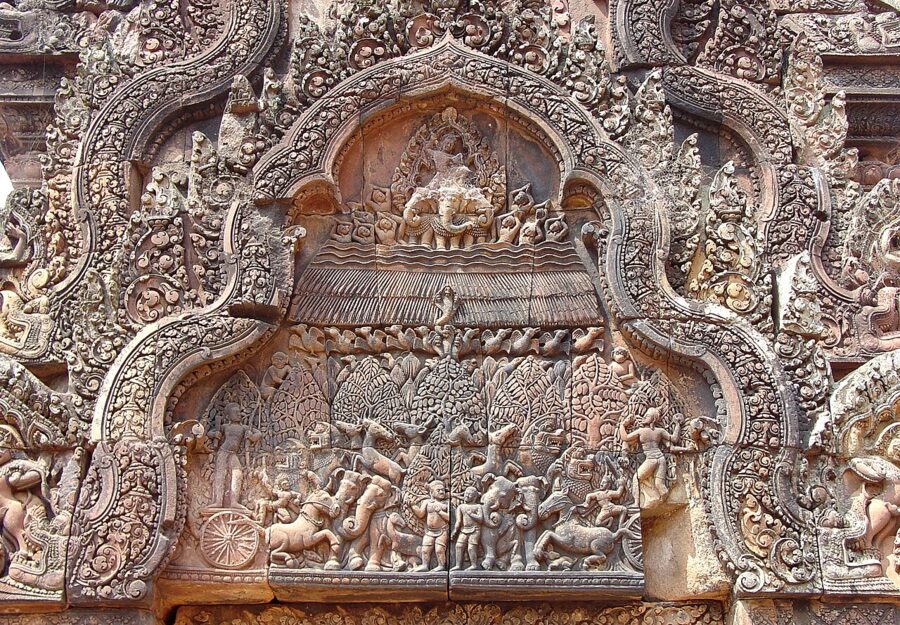

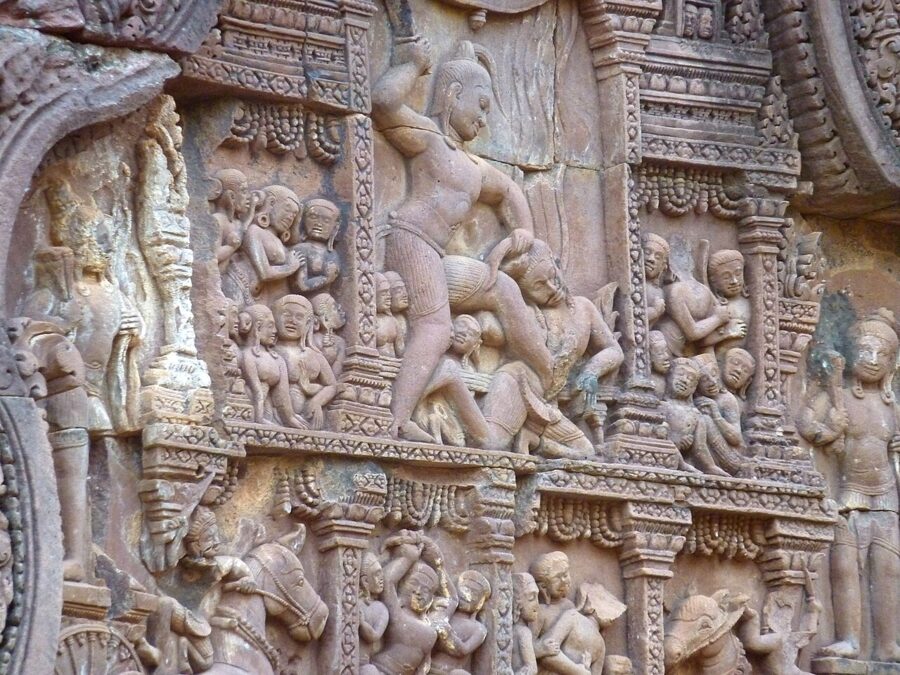
The west gable shows Krishna killing his uncle, the tyrant Kamsa, inside a palace. Look past the fight at the building: posts and tiers of roof, a rare picture of the timber architecture that has otherwise vanished.

The towers, and the boar over the door
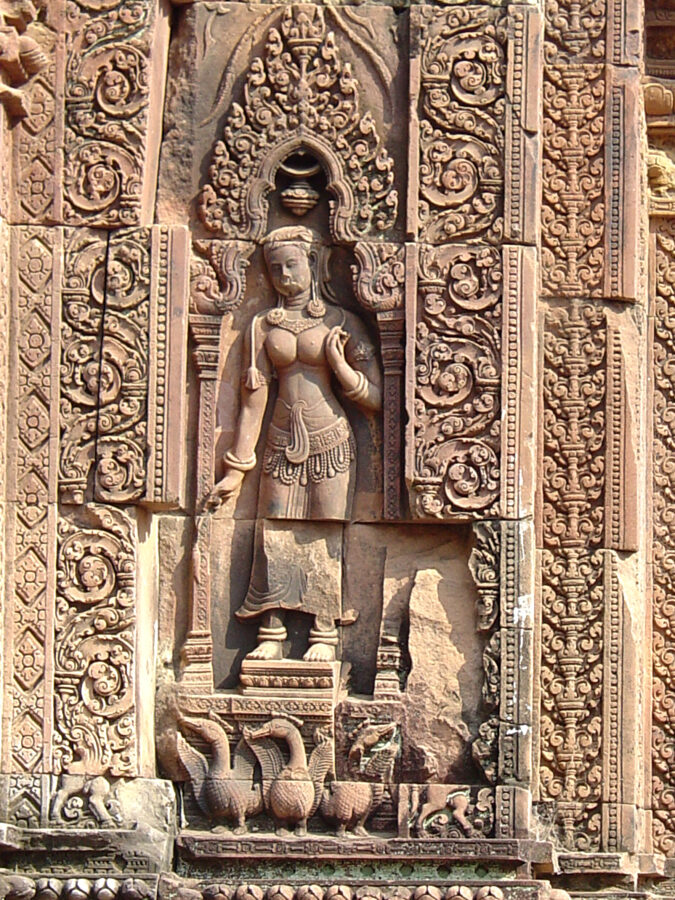
On the corners of the north and south towers, women with plaited hair and flowers in their hands stand in arched niches; on the central tower, young male guardians hold lances. These devatas are what Malraux came for. The lintels of the central tower carry small narrative scenes: Vali and Sugriva again on the north, the abduction of Sita on the west, and on the south a wild boar seen head-on, which Glaize suggested might be a play on the founder’s name, since Yajnavaraha means “sacrificial boar”.

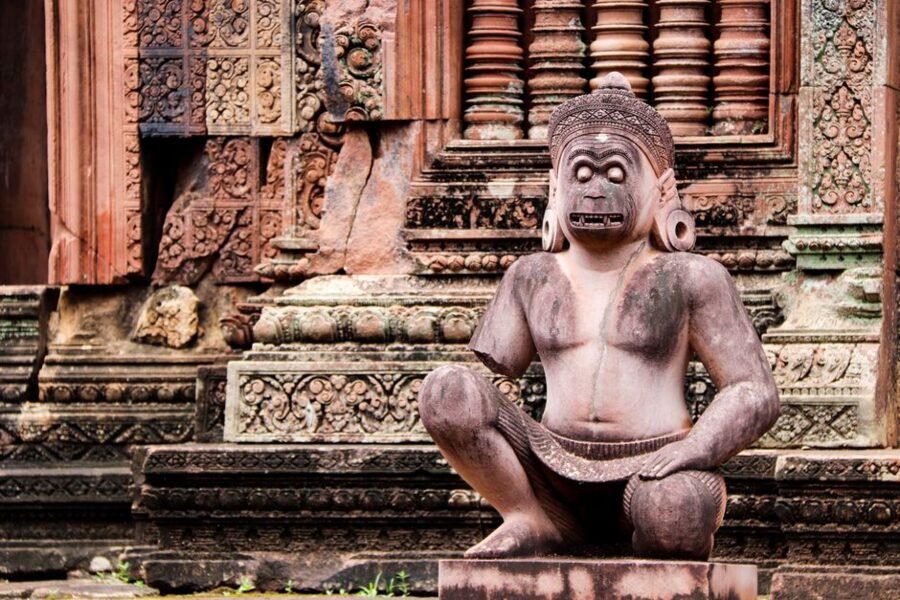
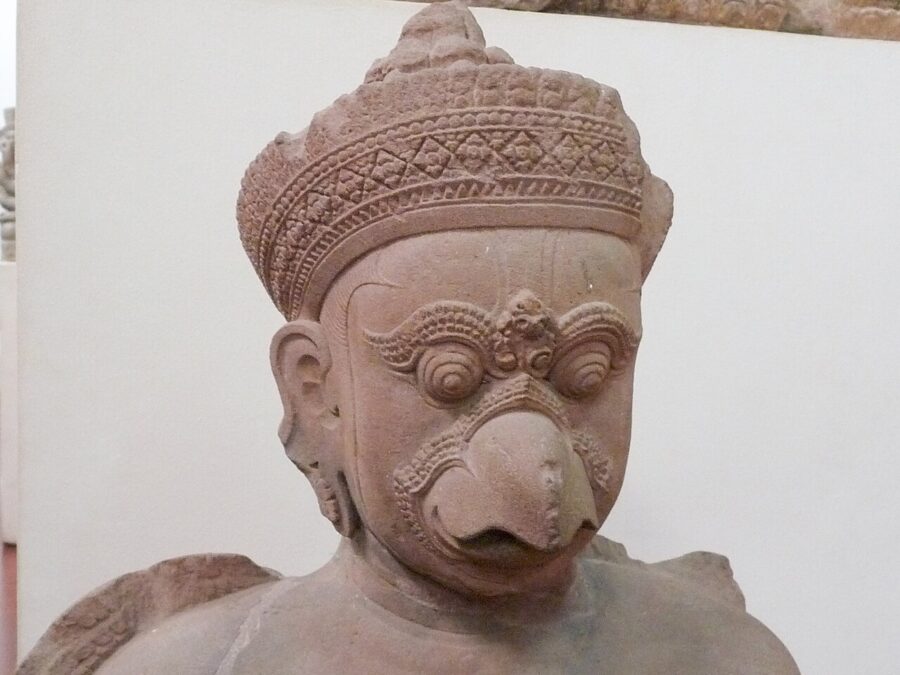
On the stair walls kneel guardians with human bodies and animal heads: monkeys, lions and garudas. The originals were stolen or taken to museums, and even the copies have been attacked.
December 1923
Lieutenant Marec of the French geographic service found the temple in 1914 while mapping the area, and Henri Parmentier of the École française d’Extrême-Orient (EFEO) described it soon after as “a marvel without equal in Cambodia”. André Malraux and his wife Clara read his articles in the library of the Musée Guimet in Paris.
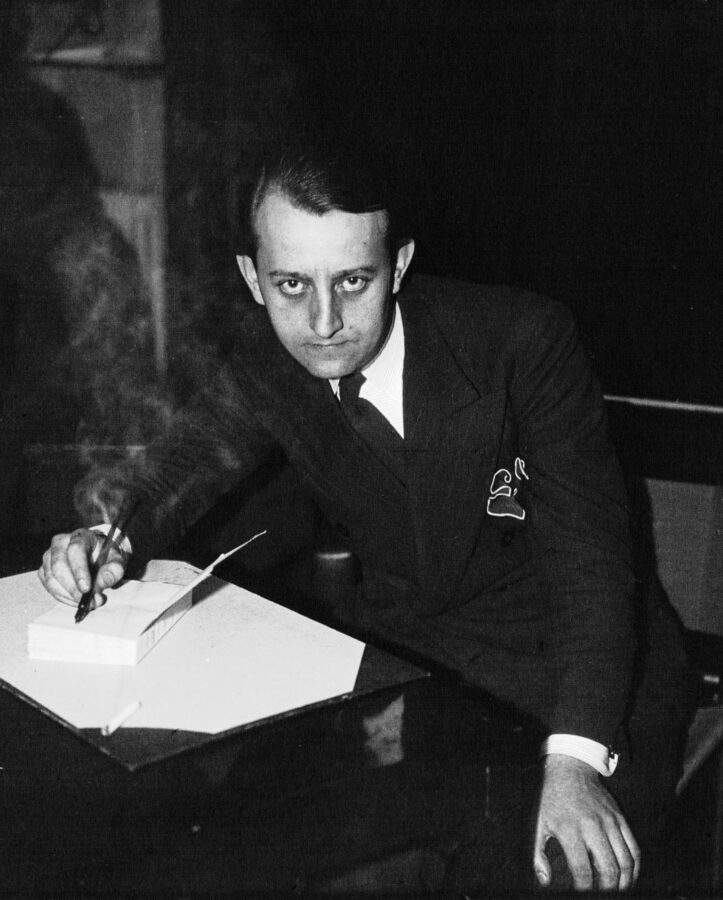
The heist is known from Clara’s memoirs, the trial and the letters of the people who caught them. Short of money, they planned to take statues from a neglected temple and sell them abroad. In Hanoi in November 1923 the EFEO told them plainly that anything they found must stay in place. With Malraux’s school friend Louis Chevasson they reached Siem Reap on 7 December, hired ox carts and porters, and went to Banteay Srei.
There, with saws and chisels, they cut devatas and other reliefs from the tower walls. Accounts of the haul vary: four devatas in some versions, seven pieces on the panel at the entrance today, a ton of stone in the French press of 1924. They crated it and took a steamer across the Tonle Sap.
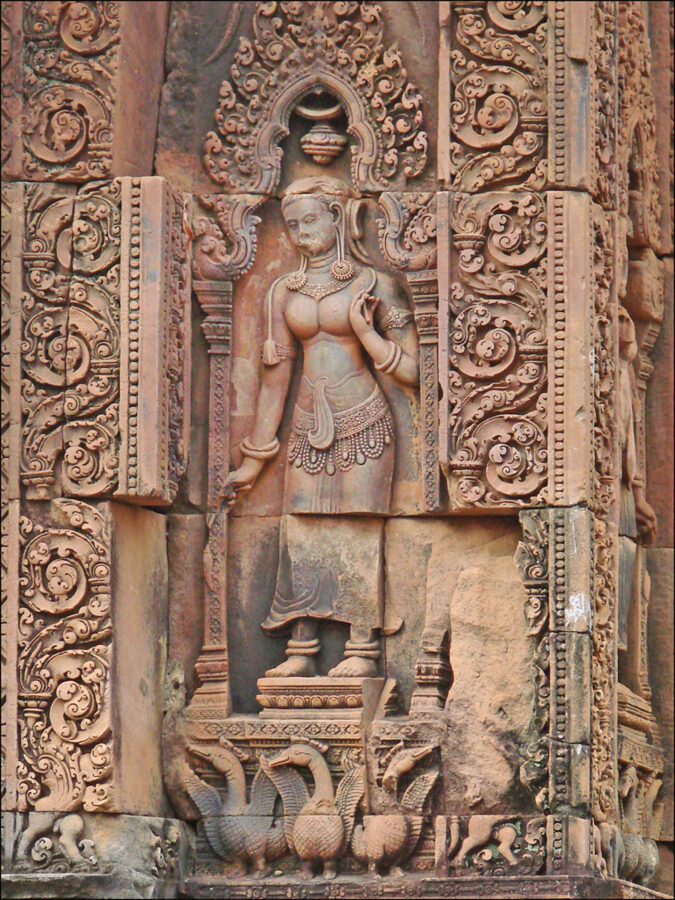

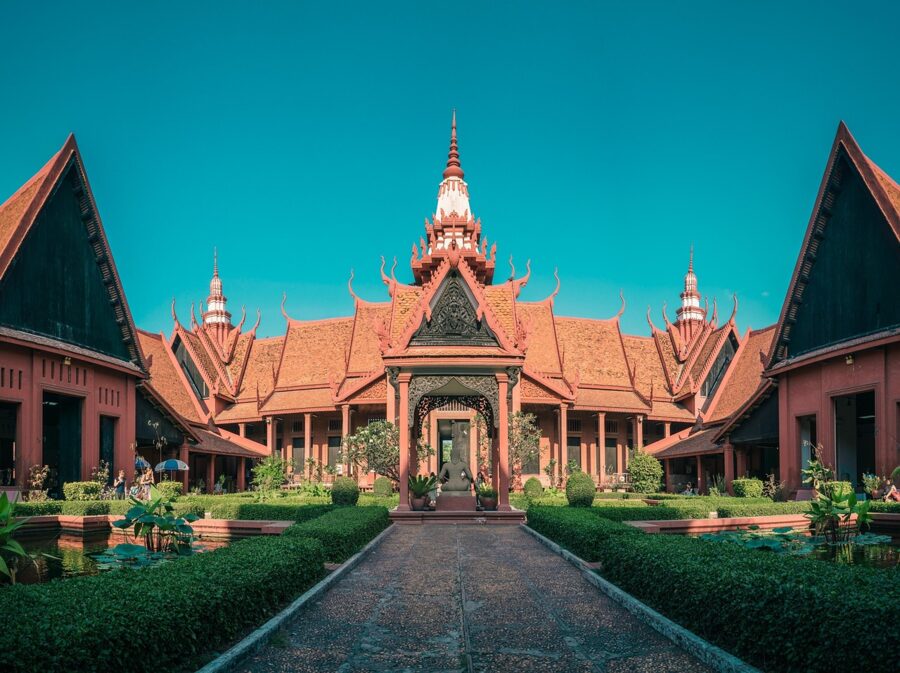
In Phnom Penh, Malraux had already asked George Groslier, director of what is now the National Museum of Cambodia, what Khmer sculpture fetched in Paris. The French official at Siem Reap had men among the porters, and Groslier went after the boat. On Christmas Eve 1923 police boarded it at Phnom Penh, opened the crates and found the reliefs.
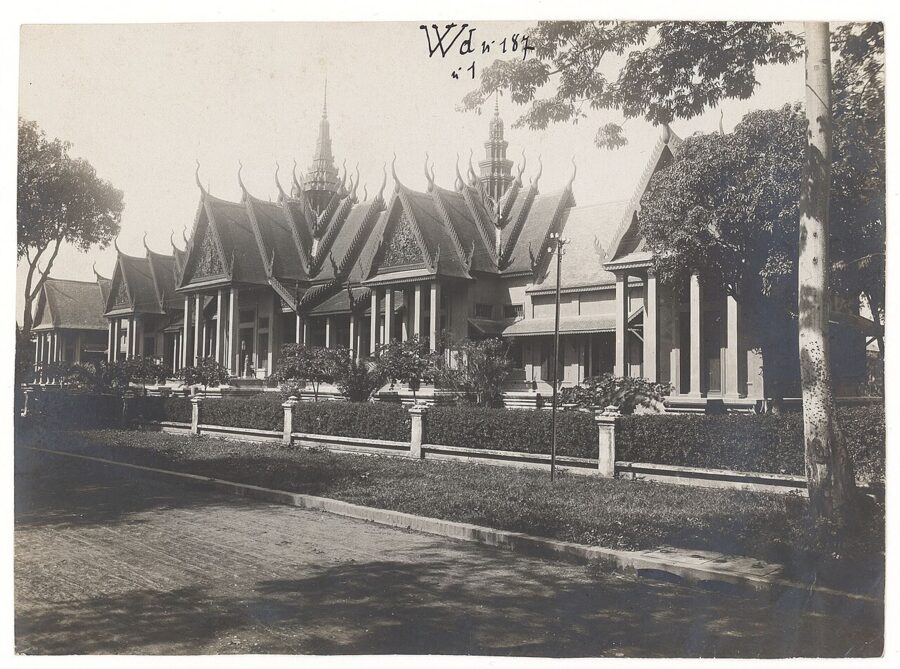
At the trial in Phnom Penh in July 1924 the court sentenced Malraux to three years in prison and Chevasson to eighteen months. In France, Clara gathered writers including André Gide and André Breton behind a petition. In October the appeal court in Saigon cut the sentences to one year and six months, suspended; neither man went to prison. The defence had argued that the temple was not on any list of protected monuments.

The EFEO cleared the site in 1924. Malraux turned the expedition into a novel, La Voie royale (1930), ran an anticolonial newspaper in Saigon in 1925, and became de Gaulle’s minister of cultural affairs in 1959. In Cambodia his name is still shorthand for colonial looting.
Taken apart and put back
Much of what you see was once a heap of fallen blocks. Between 1931 and 1936 Henri Marchal of the EFEO restored it by anastylosis, a method the Dutch had used in Java: take the building down, number and record every block, strengthen the core, then rebuild with the original stones, adding new ones only where something is provably missing.
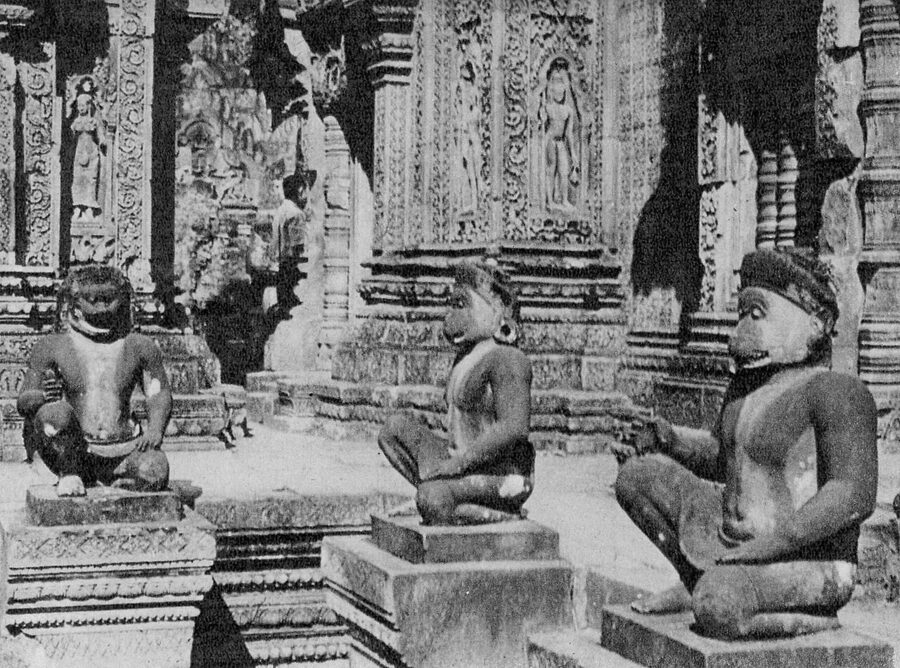
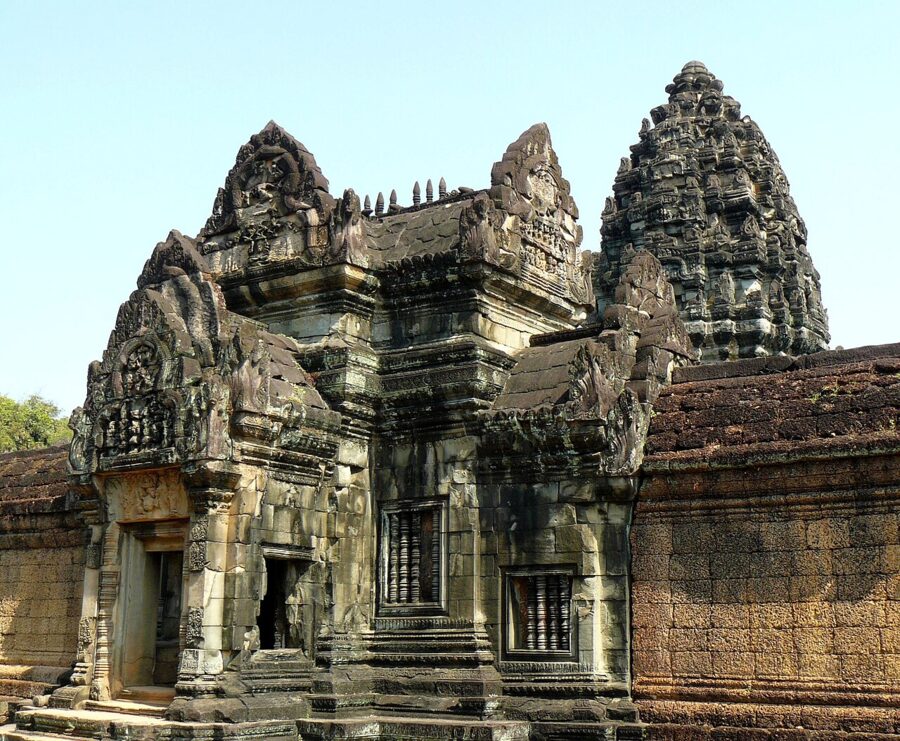
It was the first full anastylosis at Angkor, done on a remote site with untrained workers, and Glaize credited it with making the method standard. Small, durable blocks with sharp carving made it possible. Glaize went on to use the method at Banteay Samre, and it was later used at Thommanon and on the Baphuon. Compare the opposite choice at Ta Prohm, deliberately left in the grip of its trees.
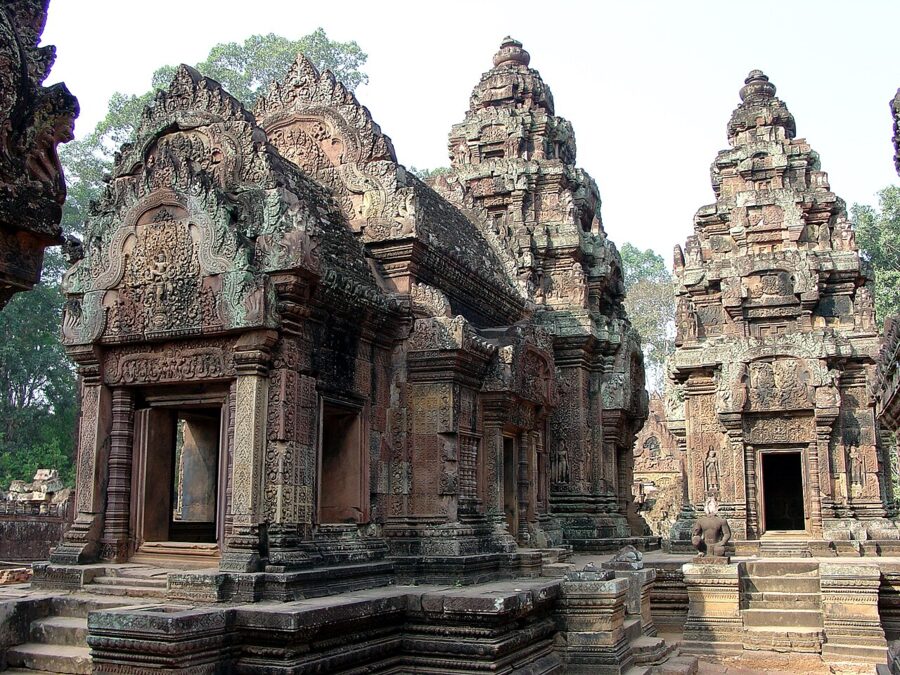

Two gables were judged safer in museums, one in Phnom Penh and one in Paris. Into the 1990s, mines and Khmer Rouge fighters made the road dangerous, and looters went for the guardians and the replicas put in their place.
The Swiss came by chance: a Swiss minister in Cambodia to open Beat Richner’s children’s hospital saw the temple and offered money. The result was a conservation project funded by the Swiss Agency for Development and Cooperation and the Cambodian government, with APSARA as partner and teams from Geneva and Lausanne on site in the early 2000s.
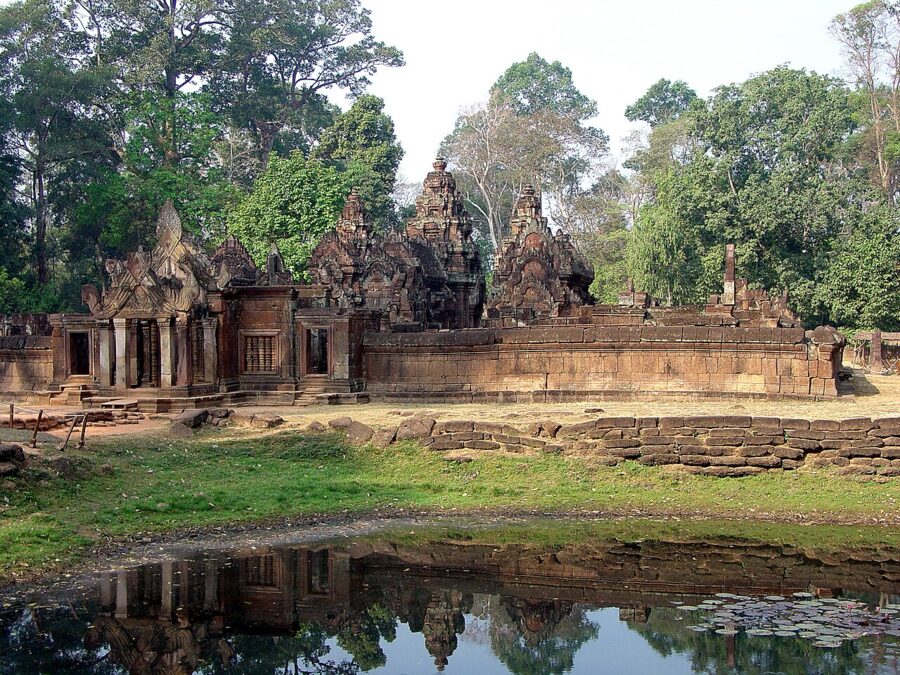

The Swiss-funded project concentrated on three threats, water, trees and people: a drainage system so that rain stopped seeping into the foundations, pruning of branches that could fall on the shrines, and repairs that used original fallen fragments rather than new stone.
Going there
Getting there
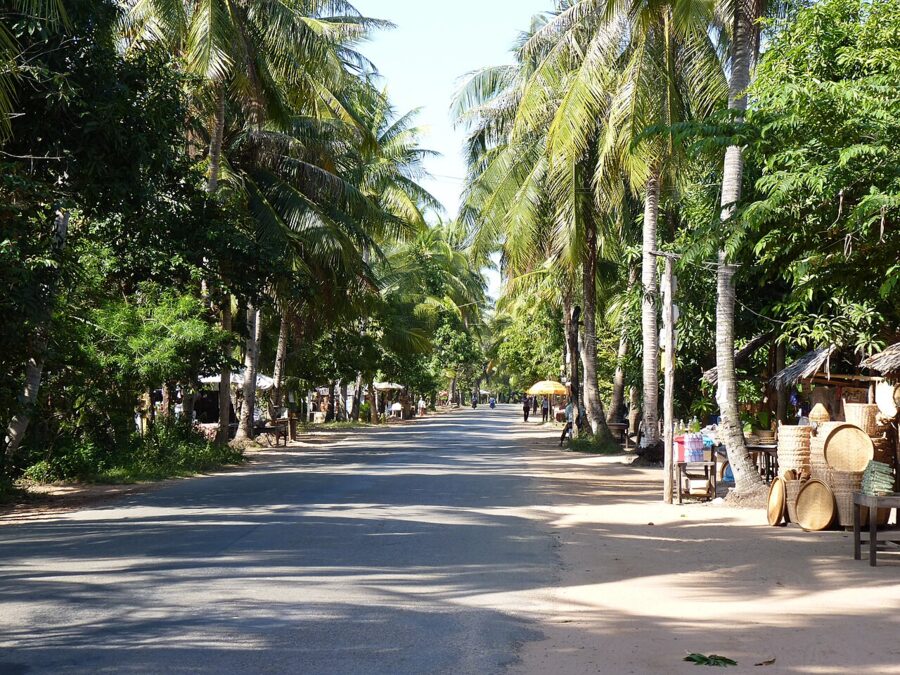
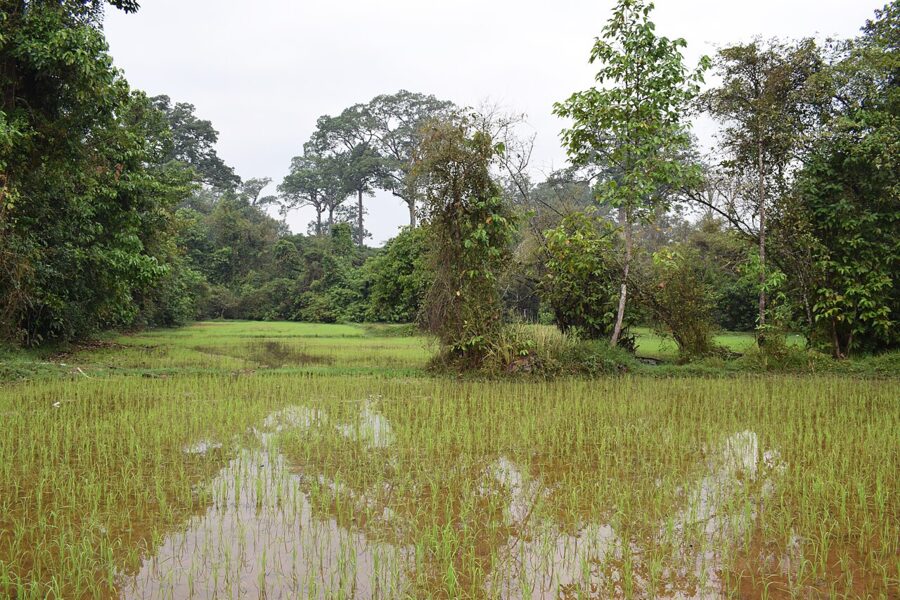
Glaize measured Banteay Srei as 20 km north-east of the Bayon, the temple at the centre of Angkor Thom, as the crow flies. By road it is about 37 km from the centre of Siem Reap, out past Pre Rup to the village of Pradak and then north-east through rice fields. By tuk-tuk allow about an hour each way, a little less by car. Air conditioning earns its price if you go on to Kbal Spean.

Banteay Srei is on the Angkor Pass, so you need no extra ticket. As of November 2026 the pass costs US$37 for one day, US$62 for three and US$72 for seven; the Angkor Pass guide explains the rules. Angkor Enterprise lists Banteay Srei’s hours as 7:30 AM to 5:30 PM.

When to go
Be at the gate when it opens. Tour groups build up through the morning, and by mid-morning the narrow paths of the inner enclosure are queues. Early light also brings out the colour: at midday the stone looks pale, while early and late it turns properly pink and the shadows give the carving depth.
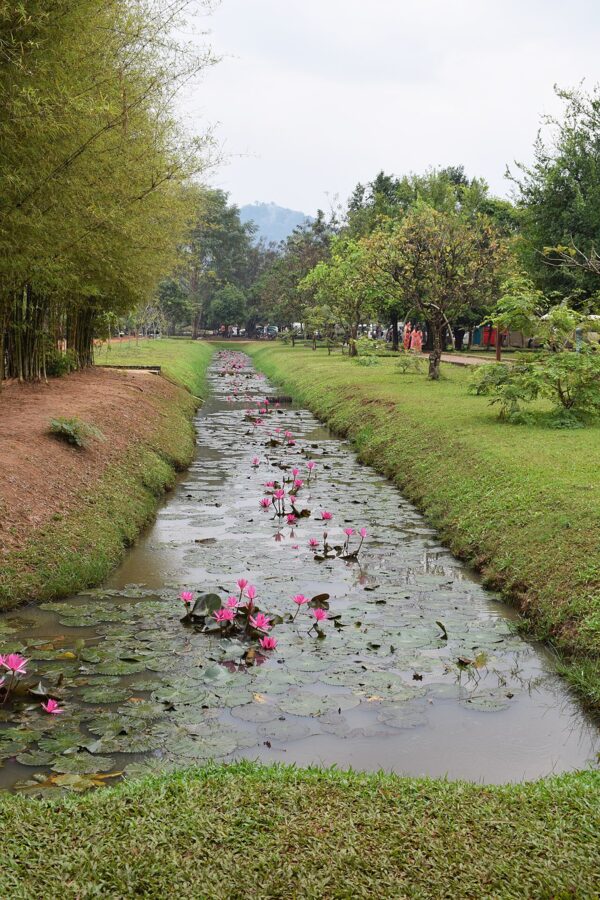
Plan an hour for the temple itself, more if you read every gable. If you are spending several days around Angkor, the five-day itinerary puts Banteay Srei and Kbal Spean together on one morning, with the central temples on other days. In the wet season the moats fill, but expect afternoon rain.

What is roped off
You can walk the causeway, the outer courts and the inner enclosure, but the central platform is closed. Ropes keep visitors off it, so the towers, the entrance hall and the two libraries are seen from the path that runs round them, a few metres away.
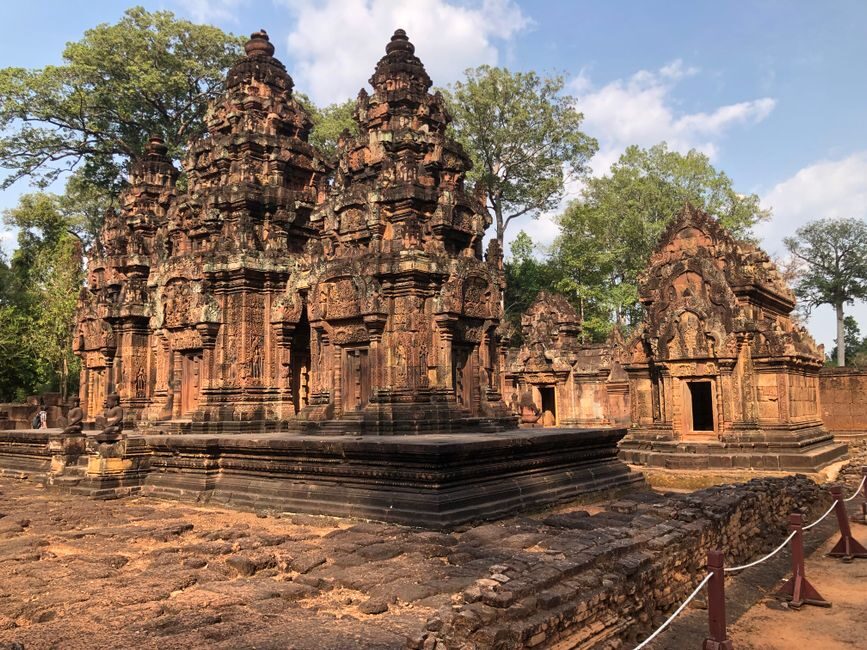
Bring binoculars or a zoom lens: some details, like Shiva’s toe on the mountain, are small. The roping is part of why the carving still looks the way it does.
Kbal Spean on the same morning
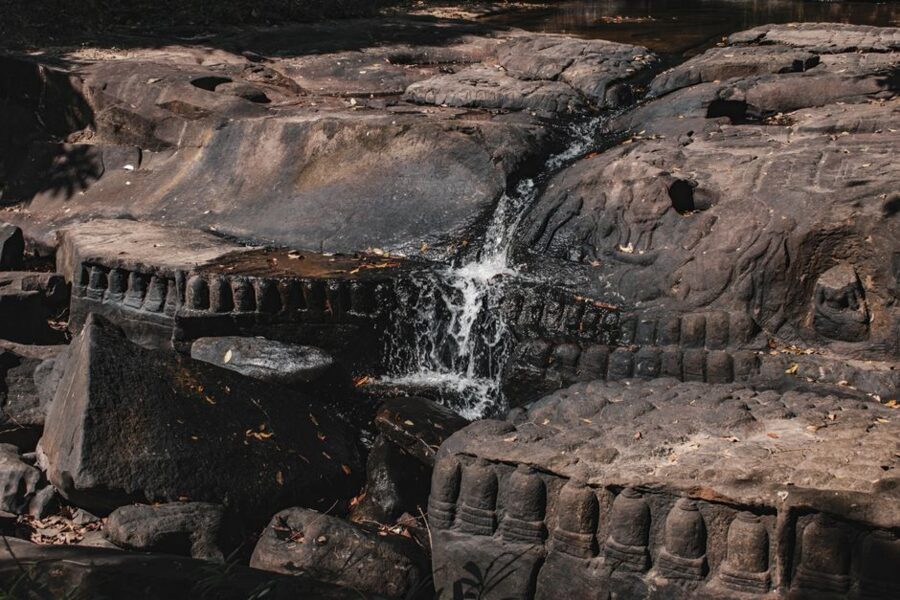
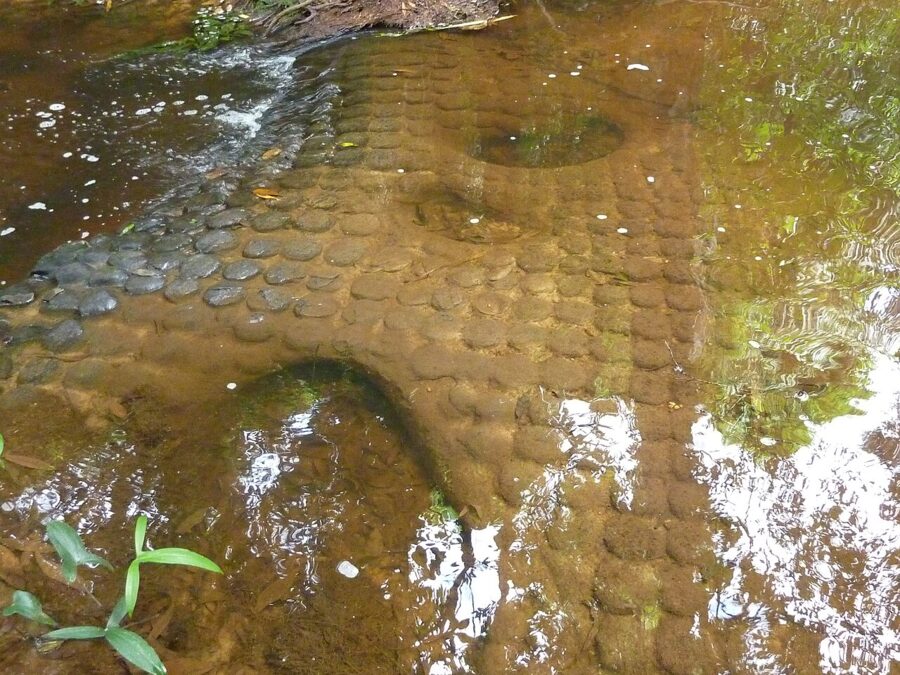
Kbal Spean is a stretch of river in the Kulen hills a further 12 km or so north. Its bed and banks are carved for about 150 metres with lingas, yonis, a reclining Vishnu and other gods, mostly from the 11th and 12th centuries; an inscription records a golden linga consecrated there in 1059. The ethnologist Jean Boulbet found them in 1969.
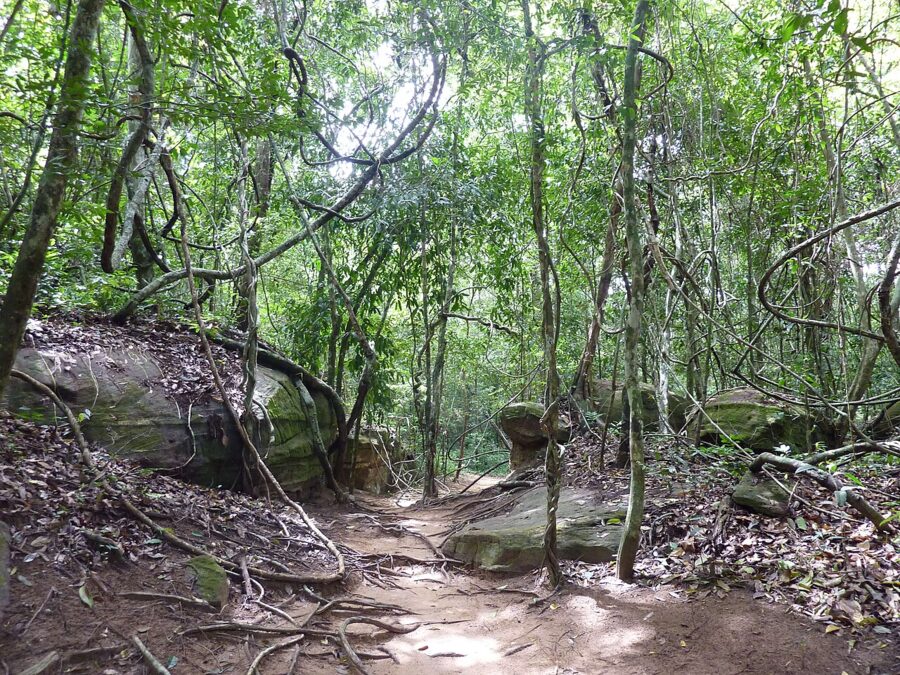

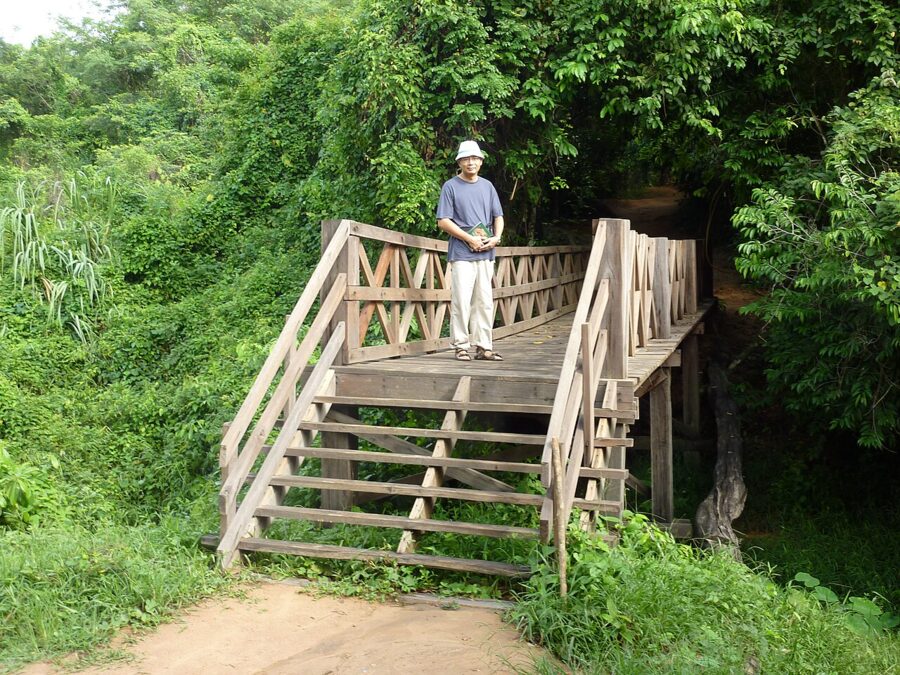
The walk up through the forest, 1.5 to 2 km by different measures, takes forty minutes or so. Angkor Enterprise sells a separate Kbal Spean ticket for US$5 as of November 2026, and I could not find it saying whether the Angkor Pass is accepted, so carry both the pass and some dollars. Go to Banteay Srei first, at opening, and be climbing Kbal Spean before the worst of the heat.


If you would rather not climb, Banteay Samre, a 12th-century temple of the same period as Angkor Wat, stands just off the same road near Pradak and makes a quiet stop on the way back.

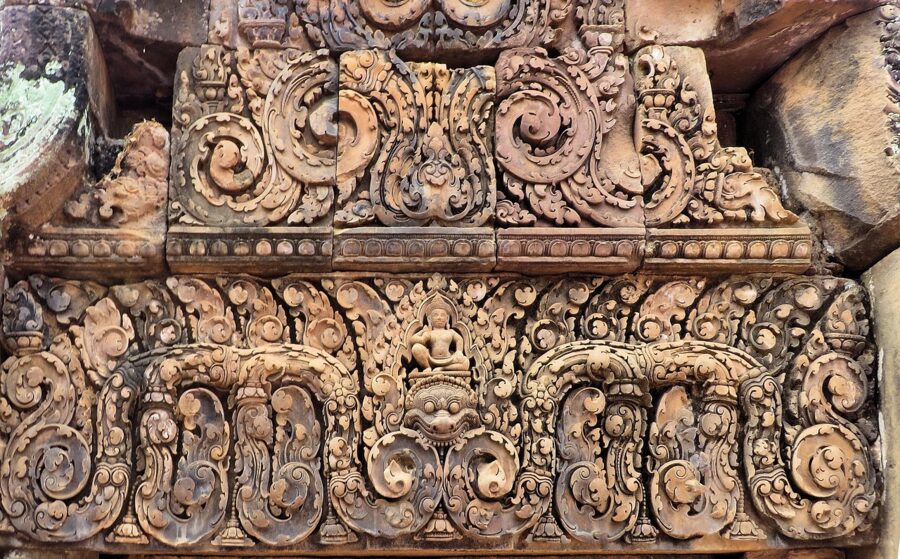
Whatever else you do, finish back at the south library and stand on the path in front of its east gable. Ravana is still straining at the bottom of the mountain, and Shiva is still holding it down with one toe, a thousand years and one theft later.