
Contents
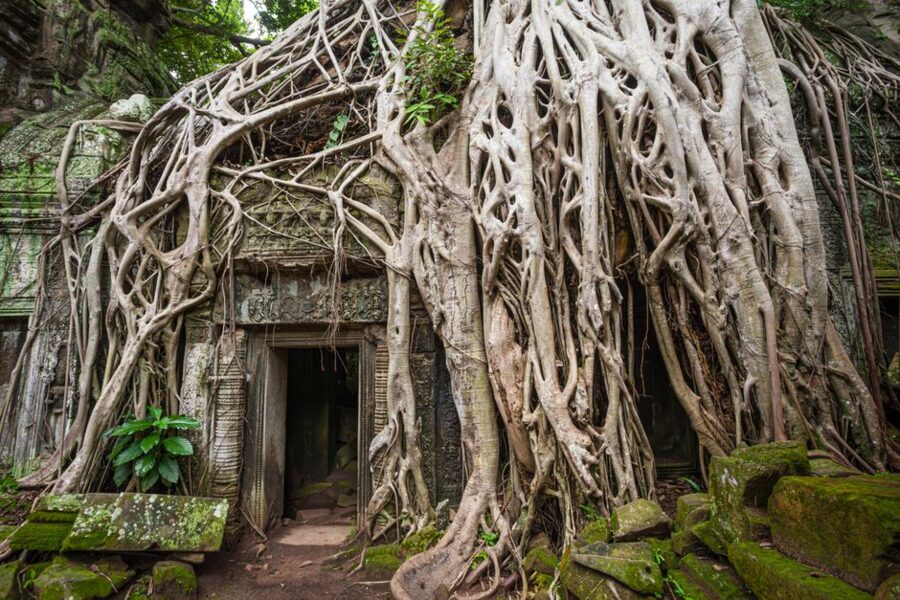
In 1920 Henri Marchal of the École française d’Extrême-Orient (EFEO) cut a path through Ta Prohm, propped what was about to fall, and then, on purpose, stopped. Everywhere else at Angkor the French conservators were pulling trees off the stones. Here they left them, so that one temple would still look the way Angkor looked to the first Europeans who walked into it, and so that you could see by comparison what the others had been saved from.
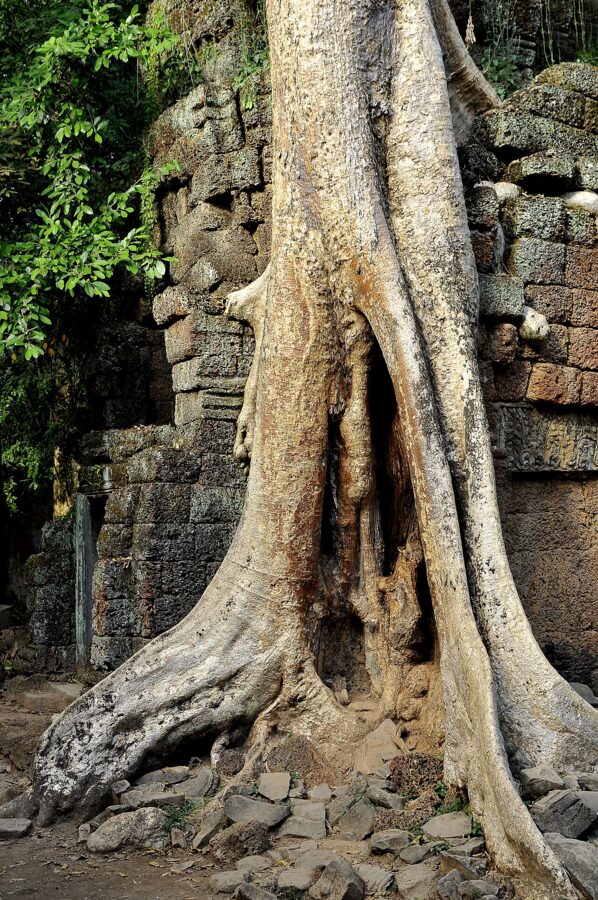

A century on, the trees are still there and so is the argument about them. The roots that make Ta Prohm the most photographed ruin in the park are slowly pulling it apart, and the APSARA National Authority and a team from the Archaeological Survey of India spend their days holding the two in balance. You walk through the result: half monastery, half forest, with props, walkways and a good deal of new stone.


A monastery for the king’s mother
Ta Prohm’s own foundation stele gives the date: 1186, five years after Jayavarman VII took the throne. He called it Rajavihara, the royal monastery, and installed in its central sanctuary a statue of his mother in the form of Prajnaparamita, the Perfection of Wisdom, whom Mahayana Buddhists called the mother of the Buddhas. The name Ta Prohm, “ancestor Brahma”, is a much later Khmer name. Five years on, at Preah Khan, the king did the same for his father.
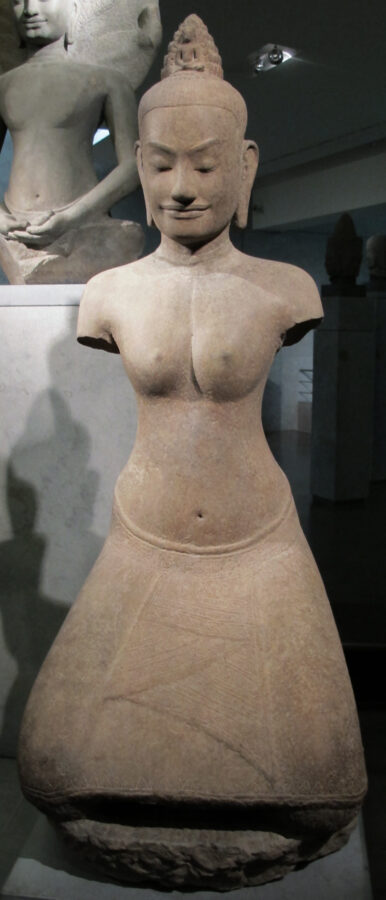

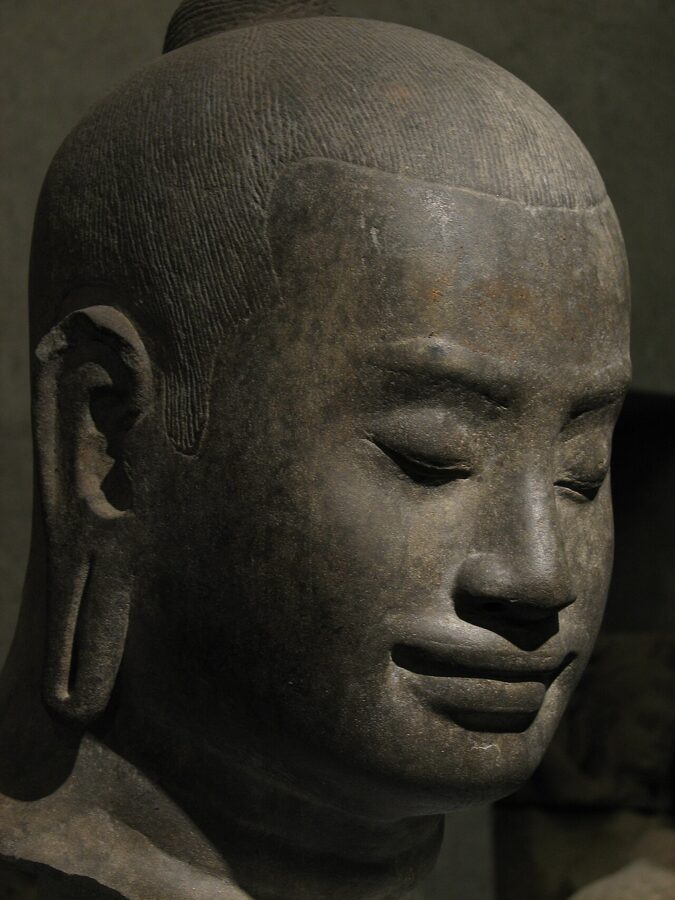
Jayavarman VII is the king of the Bayon and of the walls of Angkor Thom, and Ta Prohm was long credited to him outright. The archaeologists are less sure now. George Groslier pointed out that a building this tangled was not put up in one go, and Maurice Glaize, who wrote the EFEO’s guide in 1944, noted that some parts sit closer in style to Angkor Wat and others to the Bayon. The likeliest reading is that the king took over and enlarged an existing foundation and stamped it as his own.

The plan is a set of concentric galleries around a central sanctuary, all on one level rather than stacked as a temple mountain, squeezed into about 100 metres a side. The outer laterite wall encloses some 600 by 1,000 metres, about 60 hectares, which once held a town of timber houses that have left no trace.

What the stele lists
The stele is a four-sided block of Sanskrit verse, found in a gallery in front of the eastern gopura (gopura, gateway tower) of the second enclosure. George Coedès published the first full translation in the EFEO’s bulletin in 1906, in “La stèle de Ta-Prohm”. It reads less like a dedication than an inventory.
| What the stele counts | Figure |
|---|---|
| People living inside the temple enclosure | 12,640 |
| High priests | 18 |
| Officiants | 2,740 |
| Assistants | 2,232 |
| Dancers | 615 |
| Villages assigned to the temple’s service | 3,140 |
| People in those villages | 79,365 |
| Statues of divinities set up by the king | 260 |
| Hospitals founded across the kingdom | 102 |
The treasury gets the same attention. The inventory usually quoted from it includes gold dishes weighing more than 500 kilograms, 512 silk beds and 523 parasols, with pearls and precious stones counted one by one. Then come the festivals, the food levied from farmers and traders, and the rice.
Verse 51 gives the rice eaten in a year by everyone attached to the temple, measured in khari, an old unit of volume. Turning that into tonnes depends on what a khari held, which is why the Japanese scholar Yutaka Iwamoto wrote a paper on the stele’s numbers. Treat any tonnage you read with caution.

The trees, and why they were left
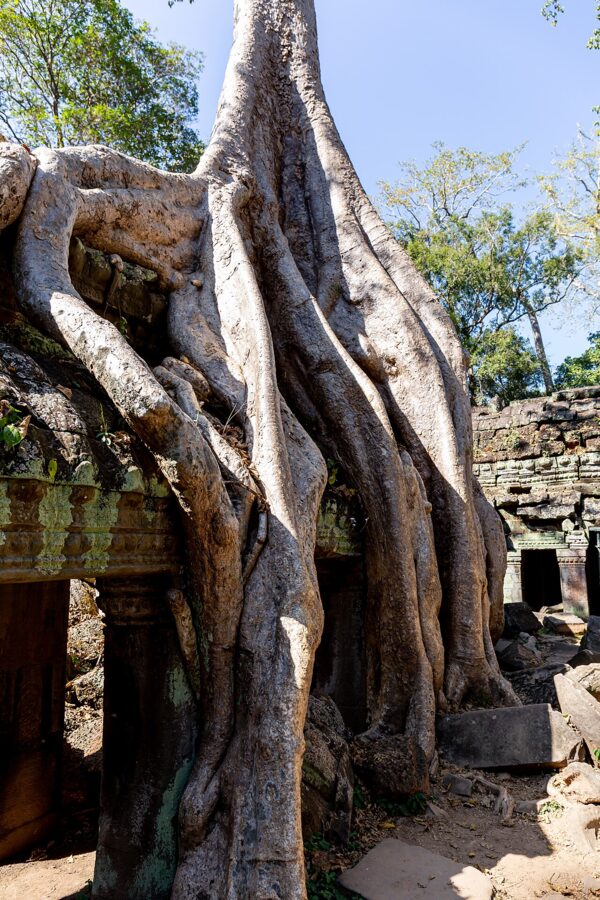
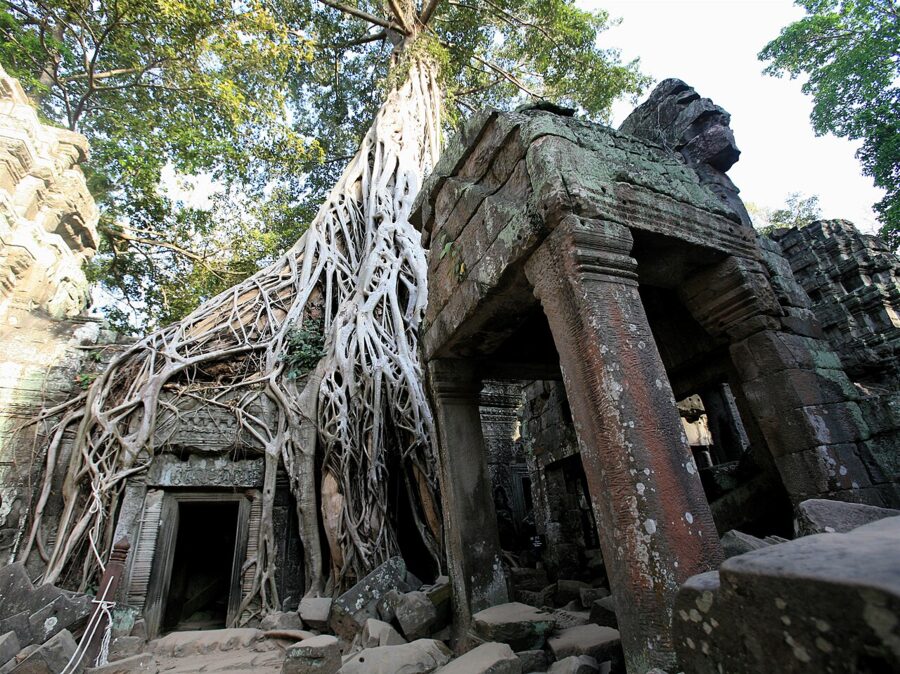
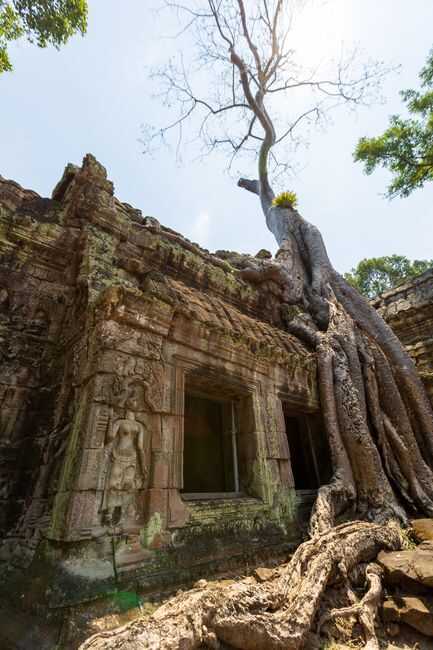
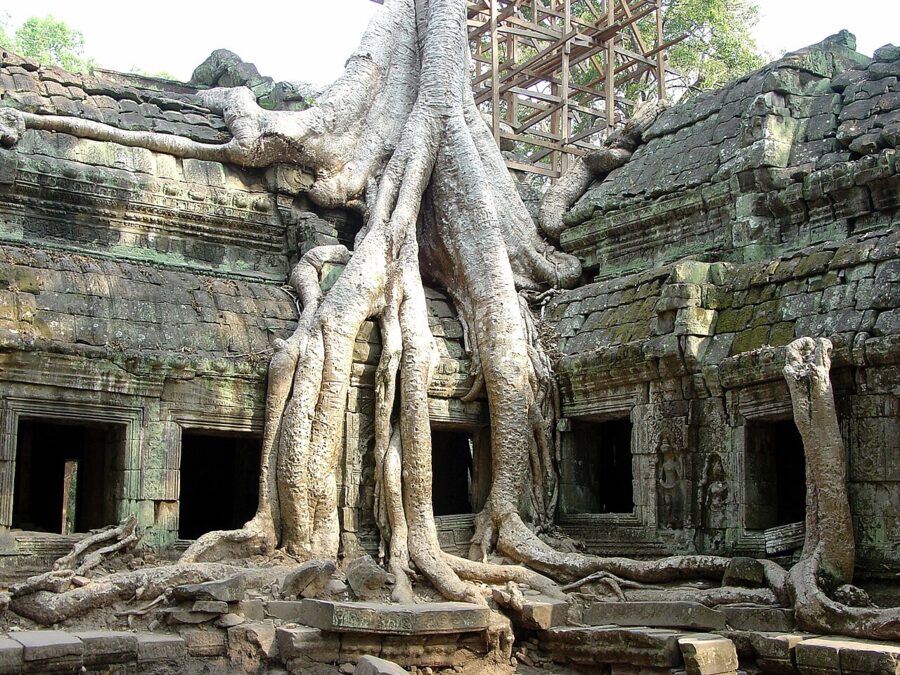
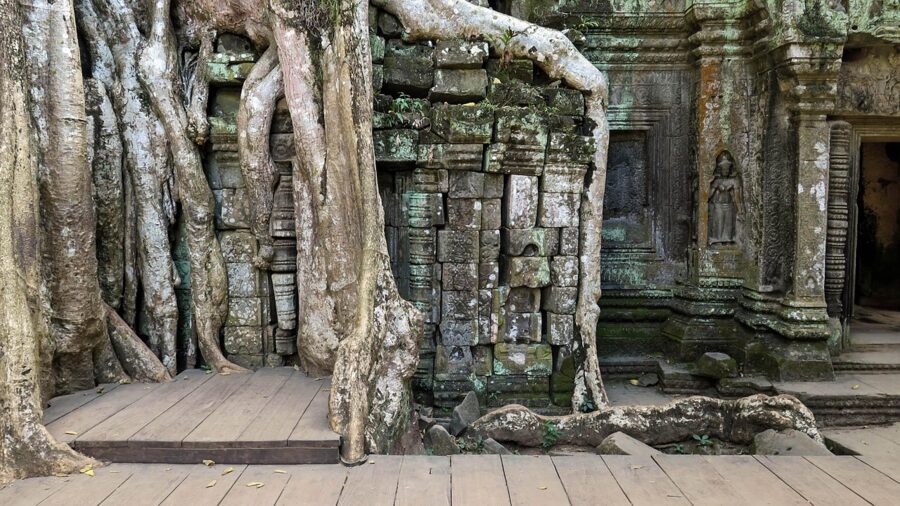
Two kinds of tree do the damage you came to see. The big pale ones, with trunks like poured concrete and roots that run down walls in sheets, are usually called silk-cotton trees, fromagers in French. The species APSARA’s own tree staff name is spung (Tetrameles nudiflora); the true silk-cotton, Ceiba pentandra, is a different tree, and published sources still disagree over which one stands where. The second kind are the figs, whose thinner, darker roots grip and plait around whatever they touch, sometimes another tree.
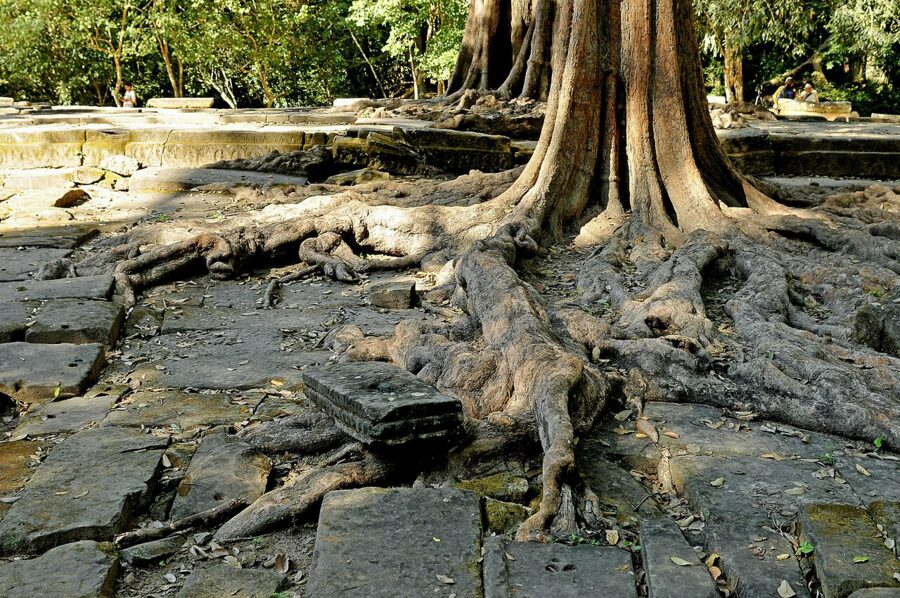

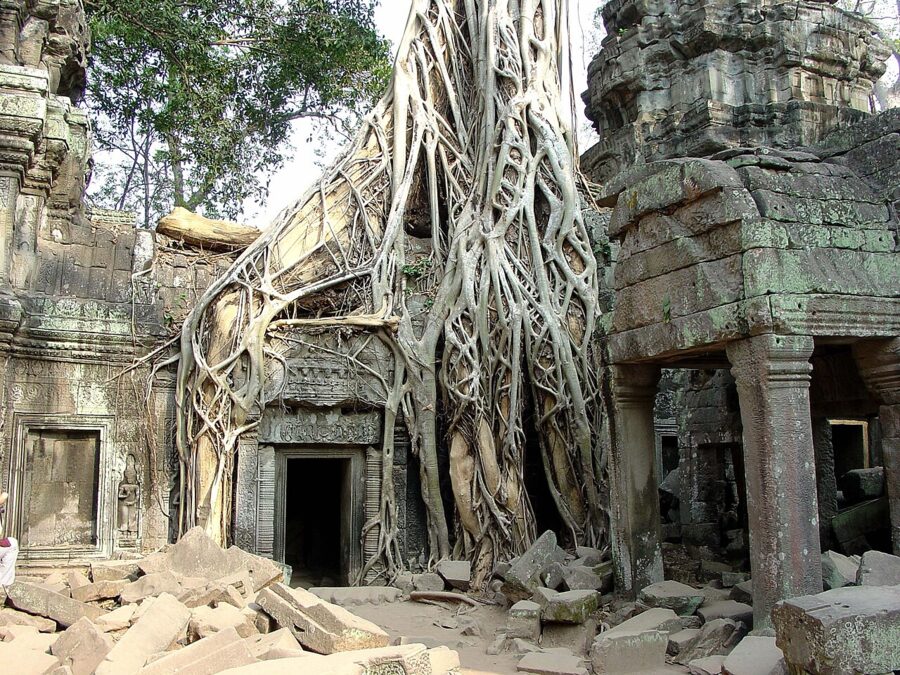

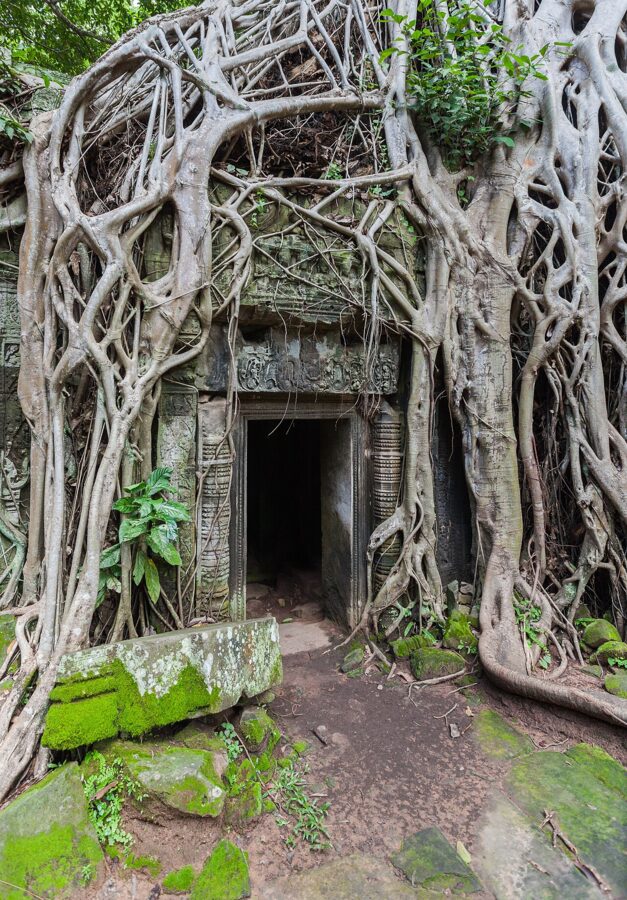
Both start in the same way. A seed, dropped by a bird or blown in, lands in a crack high on a roof where a little soil has gathered, and its roots go down the outside of the wall looking for ground. For a while the roots hold the stones together like a net. Then the tree grows heavier than the wall, the joints open, and when the tree dies or falls it takes the masonry with it.
The EFEO knew all this. Glaize is frank that the vegetation was “the cause of so much damage” and that keeping it was a concession to public taste, made easier because other temples of the same type survived. The work was deliberately limited: clear a way in, then reconcile the roots with the survival of the stone. His reasoning, in the English translation of his guide, still describes the policy.
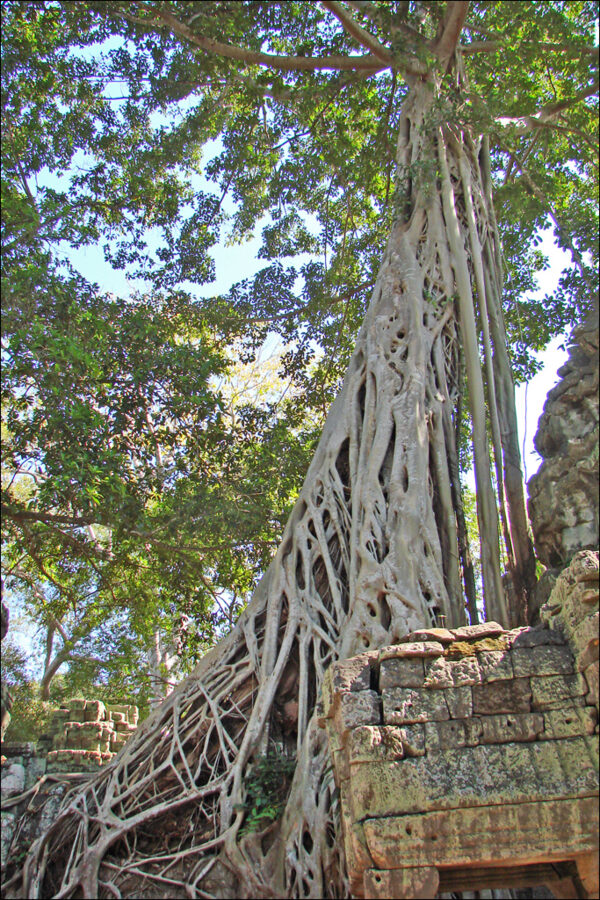

The dilemma has not gone away; it has become a maintenance job. In 2023 APSARA’s tree team said they had treated about 25 large trees at Ta Prohm, digging out rotten roots, filling cavities with soil, resin and lime, and trimming crowns so the trees would not fall on the temple or on people, a method learned from the Indian team. Storms still win sometimes: on the night of 12 to 13 April 2020 high winds brought down four trees at Ta Prohm, one of them centuries old, though APSARA reported no damage to the stone.
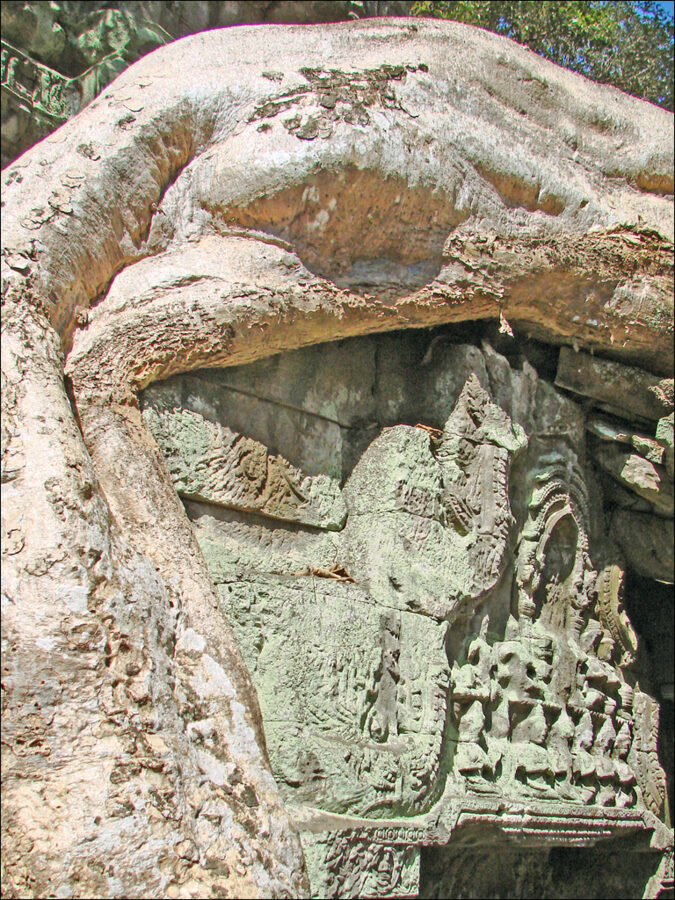

So the props and timber frames around the trunks are the policy, not a stopgap. It is a strange kind of conservation, keeping alive the thing that is destroying what you conserve, and I think it is the right call: nowhere else in the park shows Angkor as the 19th century saw it.
Putting the stone back: the Indian restoration
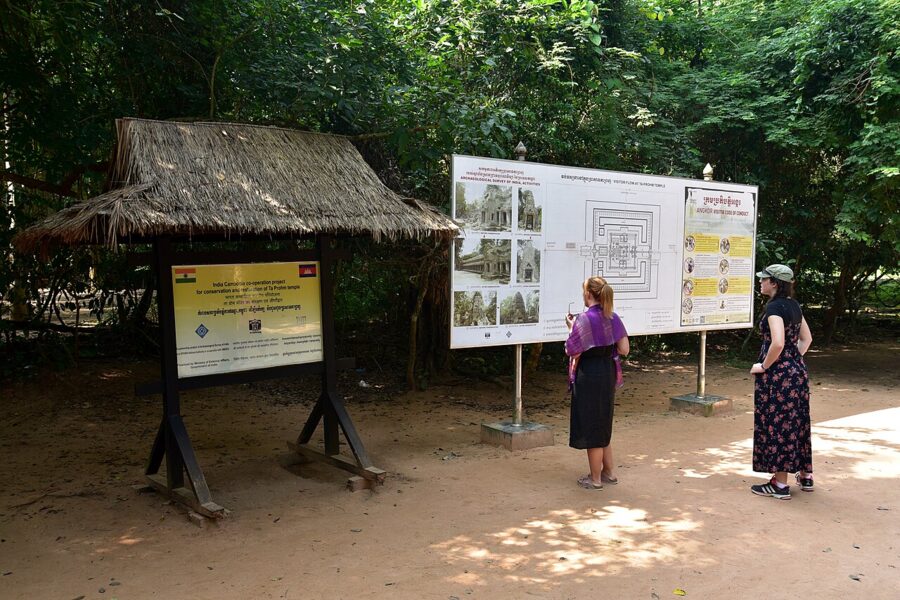
Ta Prohm has been an India-Cambodia project for two decades. The Indian government agreed in 2003 to take on its conservation, and the Archaeological Survey of India (ASI) has worked here with APSARA since the mid-2000s. Their method is anastylosis: take a collapsed structure down stone by stone, number and record every block, strengthen the foundations, and rebuild with the original stones, cutting new ones only where pieces are lost.
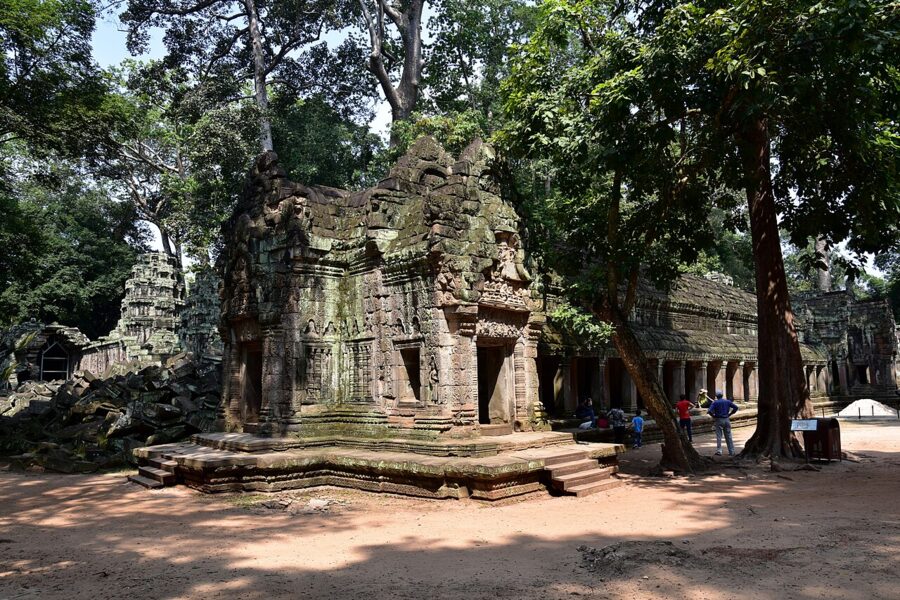

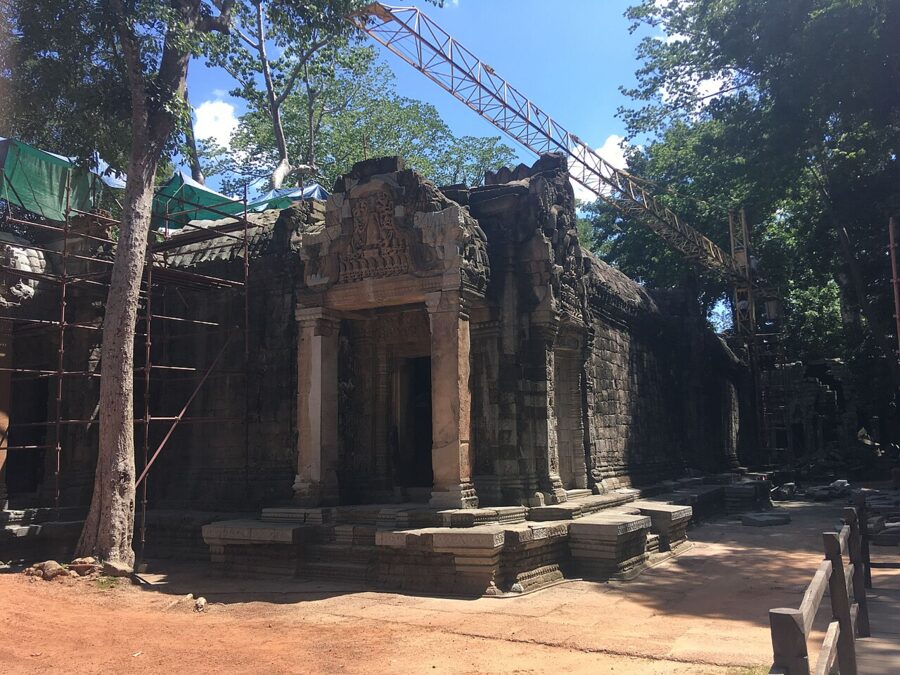

The biggest single job was the Hall of Dancers, in the eastern part of the temple. When work started in 2011 it was, in APSARA’s description, a pile of stone blocks, roof gone and pillars on the ground. The restorers worked through it from the north end and, when they reached the south, consulted the ICC-Angkor committee of experts and decided to leave two large trees growing inside the compound. The hall was almost done in April 2022 and reopened that November.
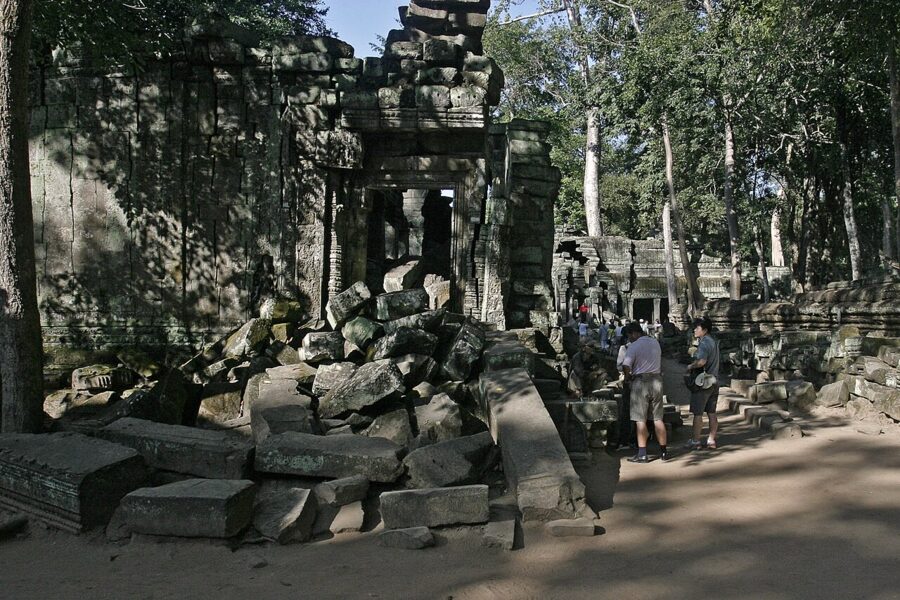

Since then the team has moved round the edges. An eastern gate was rebuilt from January 2022, with new stone added to keep it standing because tree roots had shifted its foundations. The third western gallery, badly cracked at its corners, pillars and roof beams, was reinforced in eight months and finished in August 2025. The south gate, which had collapsed completely, has been under reconstruction since early 2023; in June 2026 APSARA put it at about 75 per cent done, with completion expected by the end of 2026.

What changed for you, and what is closed
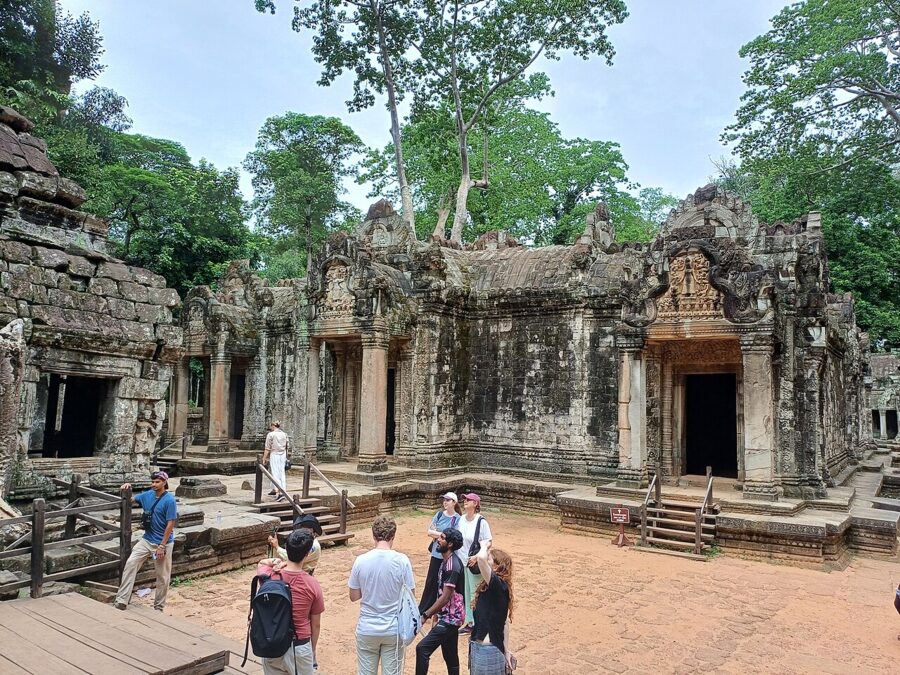
The visit is far more guided than it was. Wooden walkways and platforms carry you along a fixed route marked with arrows, past the famous trees and through the main galleries, and rope barriers keep you off fragile stone and away from the roots, which crack when trodden on. Some doorways people used to pose in are now roped off. The walkways themselves need constant repair (termites ate through a stretch of floor that APSARA repaired in 2021), so a section may be shut for that too.
Glaize warned in 1944 against wandering among crumbling vaulted galleries away from the main paths, and the warning stands. Gates and galleries under restoration are fenced, and what is open changes from month to month.

What to look for, walking west to east
Glaize laid out the route most guides still use: in at the west, out at the east, with your driver waiting at the far gate. Some details below are his, from 1944; restoration has moved a few stones since.
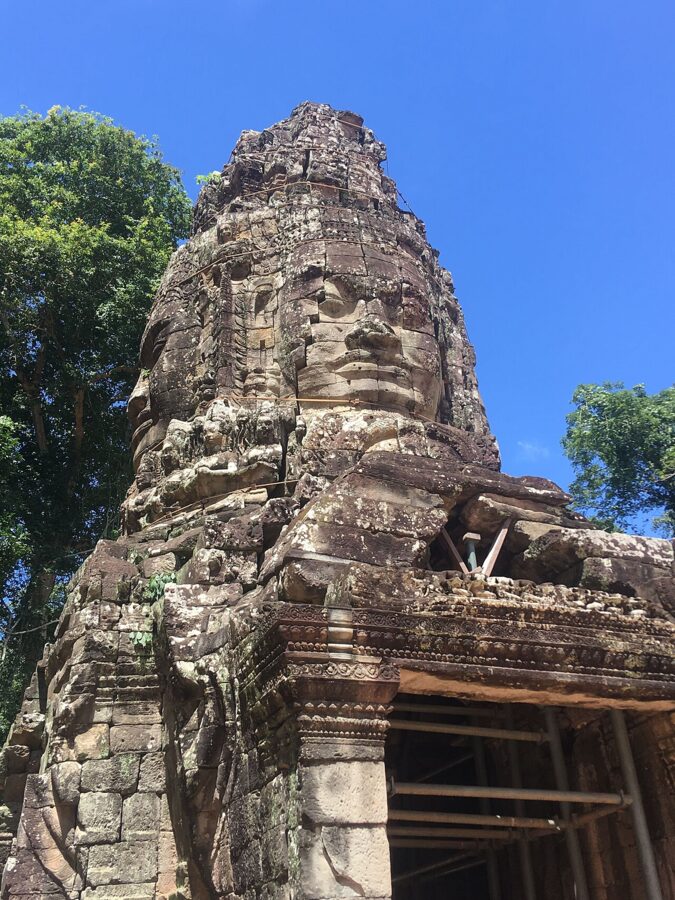

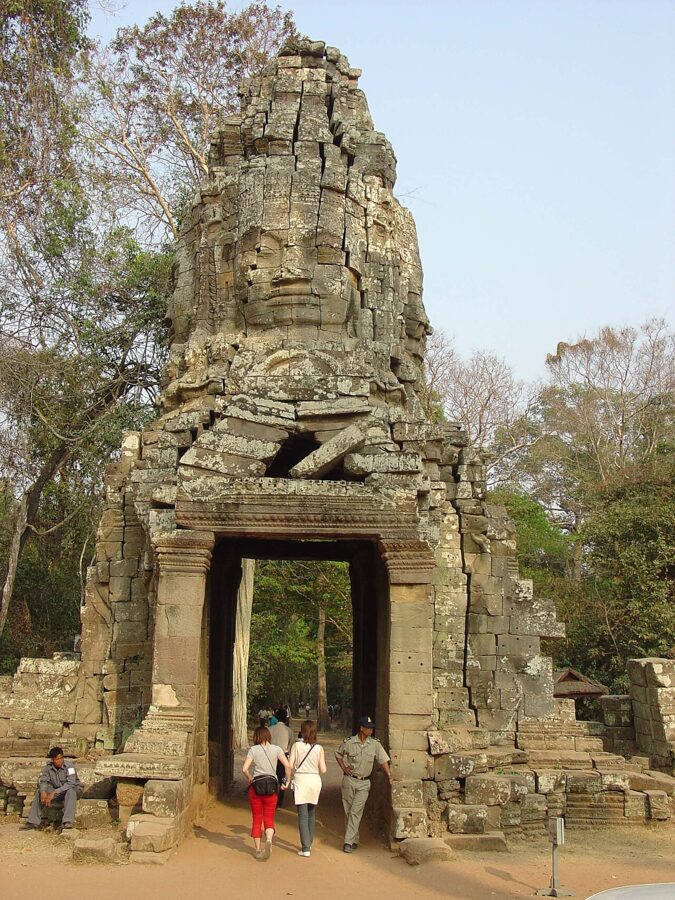
The western gate has the only face tower still standing at Ta Prohm, four faces of the bodhisattva Lokesvara over a band of praying female figures. A forest track of about 350 metres (a fifth of a mile) leads on to a cruciform terrace over the moat, with what is left of lions and serpent balustrades, and then into the first big courtyard of spung trees.
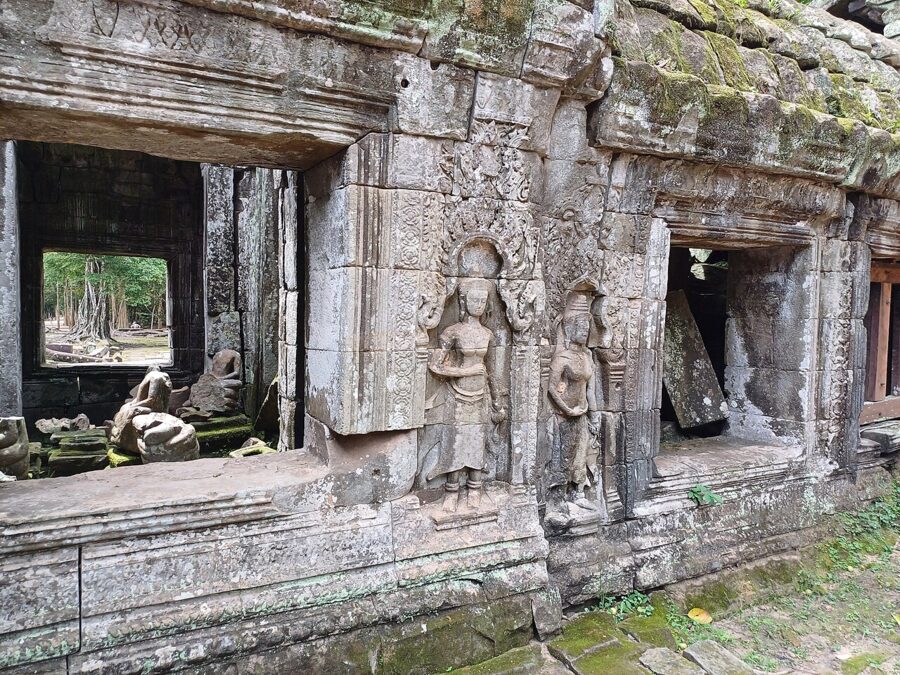

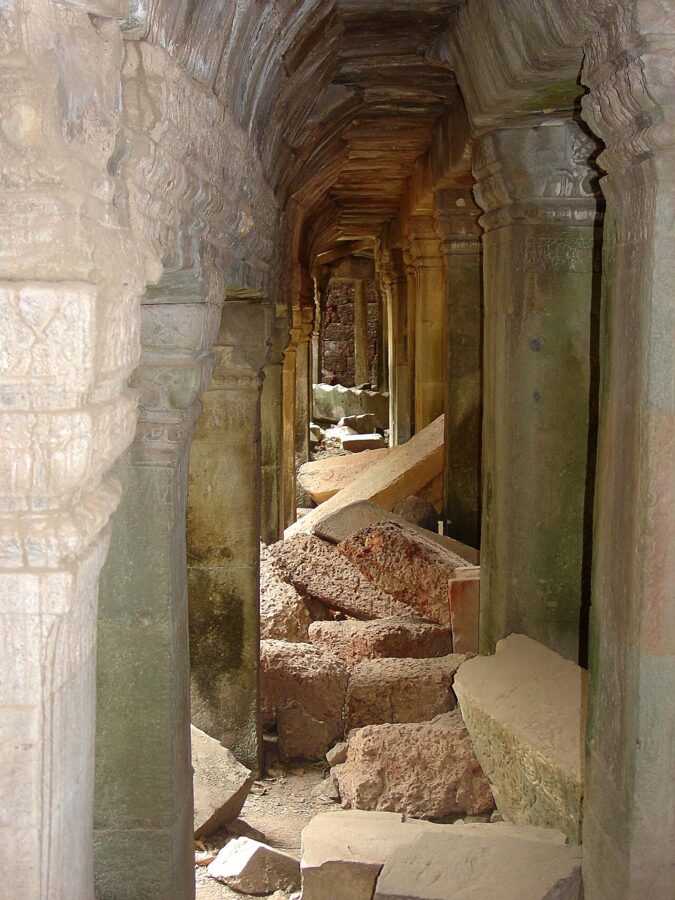
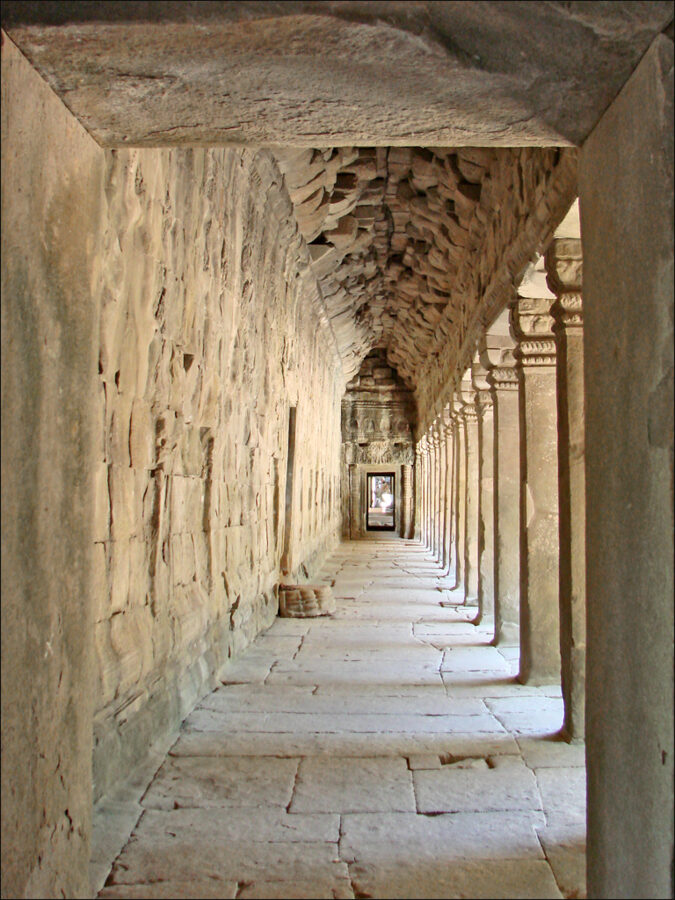
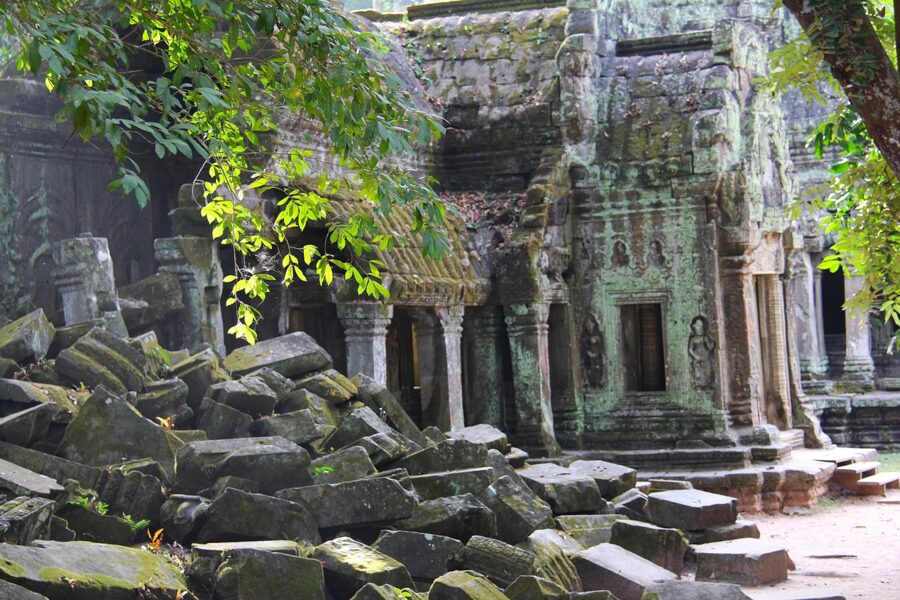
Inside the gopura of the third enclosure, turn right into the gallery with the double row of columns. Its inner wall has large niches that once held the Buddhist triad, every one chiselled out in the 13th-century reaction, and the corbelled vault overhead is in good enough shape to show how the Khmer built it, course by course. Glaize called the light in there “a gentle, serene green”.

Further in, in the small courtyard south-west of the centre, find the pediment of the Great Departure: gods holding up the hooves of the future Buddha’s horse so that nobody hears him leave his father’s palace. Near it Glaize saw a second-enclosure gallery whose pillars hung from the roots of a tree on its vault rather than holding it up.
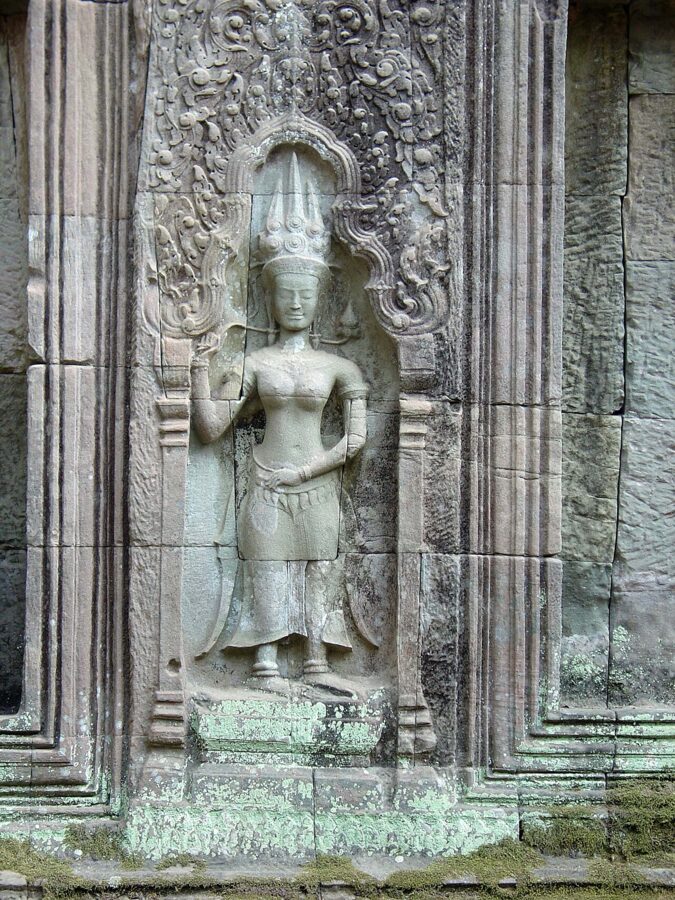

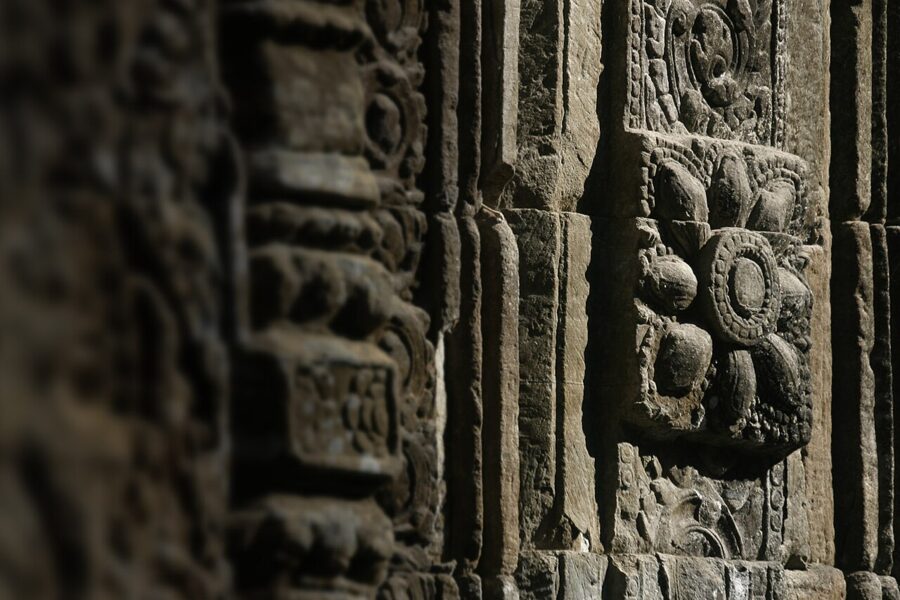
The central sanctuary looks oddly plain. That is because its stone was roughened to take a plaster coat, probably painted or gilded, and the rows of small holes inside held a lining of wood or metal. The gallery walls around the central court, by contrast, are covered like embroidery with foliage, small figures and devatas in niches.

Heading east, the passage north of the axis leads to the gallery where the stele was found; nearby a pediment shows a figure taming a horse. On the third gallery’s east door Glaize found a young tree wrapping each jamb in roots with perfect symmetry. Then comes the Hall of Dancers.

The Hall of Dancers
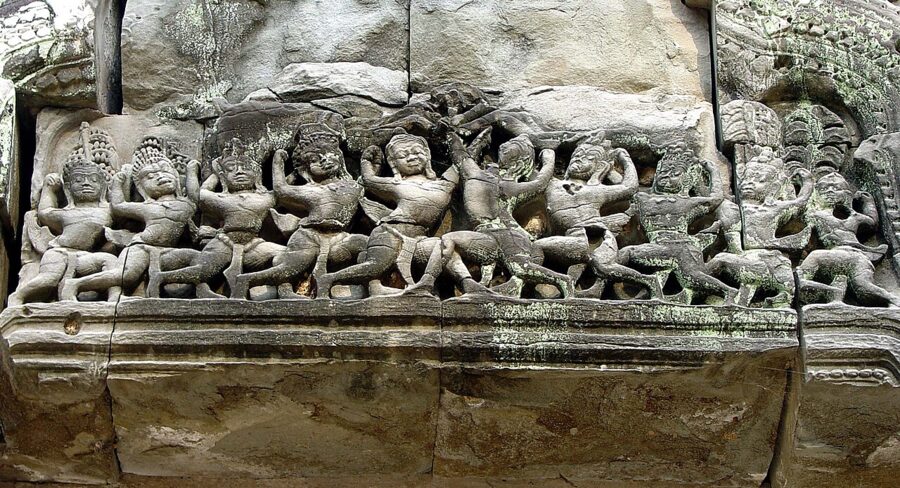
This is the cross-shaped building just inside the eastern side of the temple: four small courtyards formed by crossing galleries, with friezes of apsaras (apsaras, celestial dancers) over the openings that give it its name. Glaize thought it might be the “royal palace” one verse of the stele mentions, or simply a hall for ritual dance. In 1944 a tree in its north-west corner had pushed out a pillar and taken its place, one root carrying the architrave.

The famous trees, and a week of filming
The trees most people come for stand in the eastern half: around the Hall of Dancers, along the third enclosure gallery and in the courts east of the centre, most of them now with a wooden platform in front. Lara Croft: Tomb Raider was shot partly here, during about a week of filming at Angkor in November 2000, and the film’s release in 2001 turned a couple of these trees into the most queued-for views in the park. You do not need to know which one was in the film; the platforms make it obvious.

Two carvings people walk past
The eastern gopura of the fourth enclosure, the big gate on the far side of the Hall of Dancers, is closer in style to Angkor Wat than to the Bayon. Its lateral passages carry carved panels that almost everyone ignores on the way out, and the huge capstone from the crossing of its roof vaults still lies on the floor where it fell, unbroken. Just to the north is a hall of closely set pillars whose purpose, Glaize admitted, nobody knew.

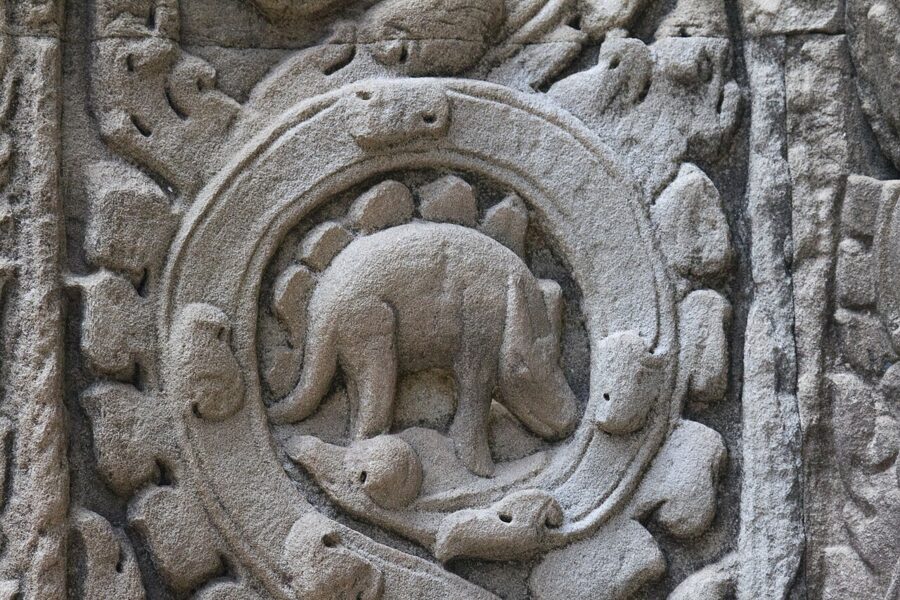
The other is a small carved roundel, about the size of a hand, in a quiet corner of the temple, showing an animal with a row of plates along its back. It has become famous online as a “stegosaurus”. Look at the plates closely and they match the leaf shapes in the roundels around it; the animal under them is most likely a rhinoceros or a boar, both common in Khmer carving. Most licensed guides know where it is.

How to visit Ta Prohm
Ta Prohm sits on the Small Circuit, east of Angkor Thom and about 3.5 kilometres (2 miles) north-east of Angkor Wat as the crow flies. The road out of Angkor Thom’s Victory Gate passes Thommanon and Ta Keo on the way. There is no separate ticket: you need an Angkor Pass, and Angkor Enterprise lists Ta Prohm among the temples covered by the cheapest, one-day pass.
| Angkor Pass (as of November 2026) | Price | Use within |
|---|---|---|
| 1 day | US$37 | 1 day |
| 3 days | US$62 | 7 days |
| 7 days | US$72 | 30 days |
Those are the prices on Angkor Enterprise’s ticket page, which also gives the park’s hours as 5am to 6.30pm (as of November 2026). Children under 12 go in free but may need a passport to prove it. Buy only from Angkor Enterprise, online or at its ticket office on Road 60; passes sold anywhere else are not valid. The full rules, and how to pick between the three passes, are in the Angkor Pass guide.
When to go
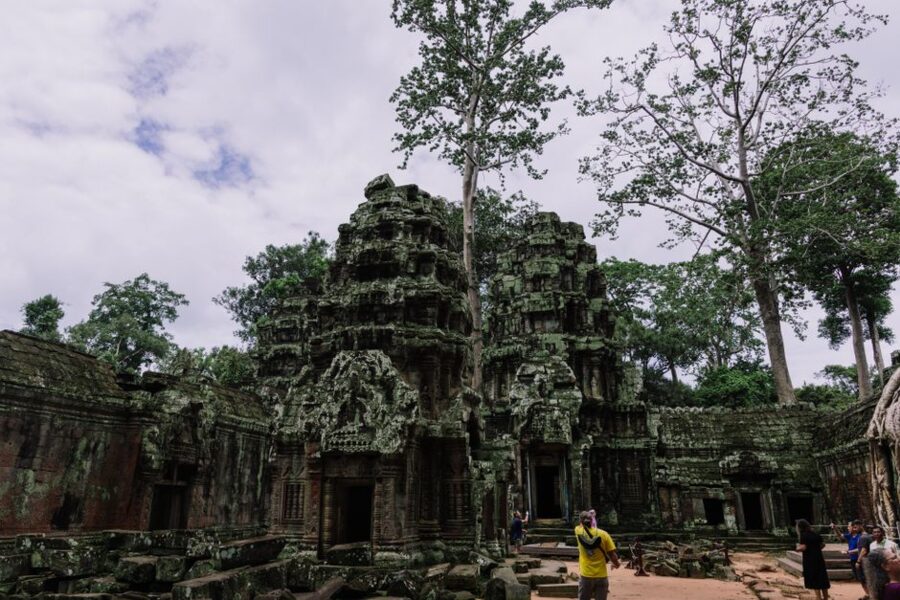
Glaize recommended the early morning or the afternoon, and I would follow him. The standard tour day goes sunrise at Angkor Wat, then the Bayon, then Ta Prohm, which puts the groups here from mid-morning to lunch. At opening the forest is cool and loud with birds; late in the day the low sun slides in under the canopy.
Crowds are thinner than a few years ago in any case. Angkor Enterprise counted 359,471 international visitors to the whole park between January and May 2026, and pass sales for the first eight months of the year were down by close to a third on 2025, partly because of the border conflict with Thailand. On a weekday in the rainy months (roughly May to October) you may have whole galleries to yourself.
East or west entrance?
The famous trees and the Hall of Dancers are in the eastern half, about ten minutes’ walk from the east gate. The west gate gives you the face tower, the forest track and the whole temple in order, but you reach the trees last. If time is short or the crowds are already in, come in from the east, see the trees first, and walk west against the flow; if you are there at opening, do it Glaize’s way, west to east. Either way, tell your tuk-tuk driver to wait at the opposite gate.
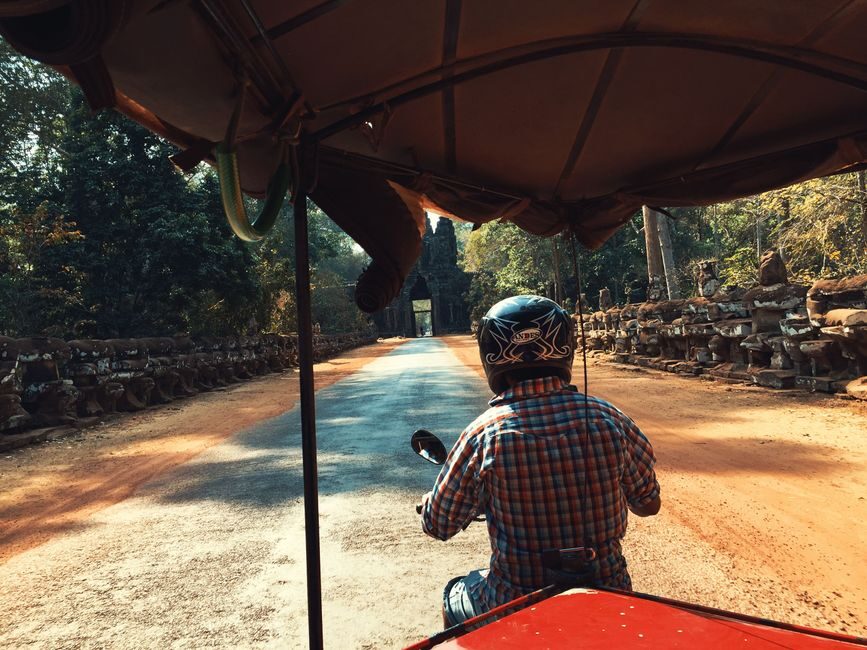
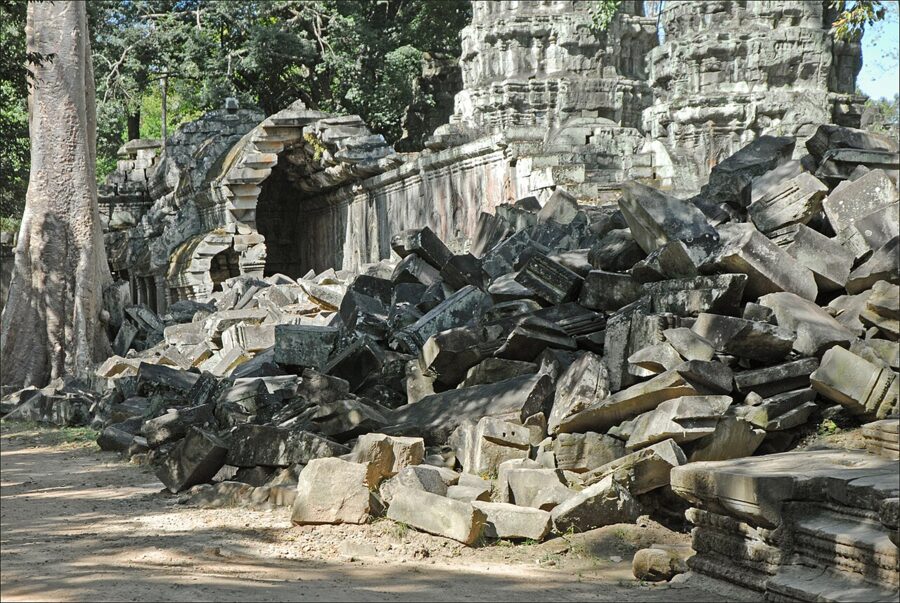

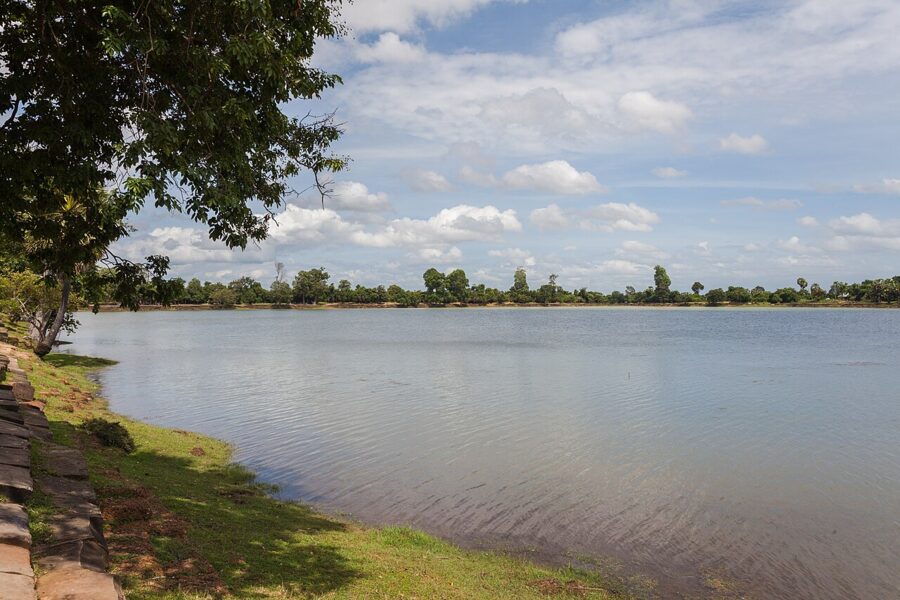
Give it at least an hour and a half, two if you want to look for the carvings above. Wear shoes with grip; roots and tilted slabs are slippery after rain. From the east gate, Banteay Kdei, another of Jayavarman VII’s monasteries, is about 600 metres away by road, and the royal bathing pool of Srah Srang lies just beyond it. If you are fitting Ta Prohm into a longer trip, the five-day plan puts it on a dawn morning with Srah Srang, and saves Banteay Srei for another day.
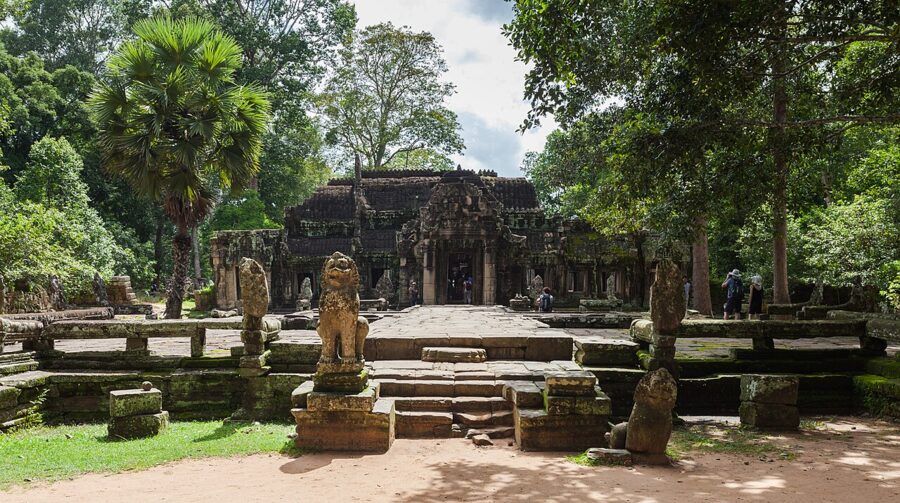

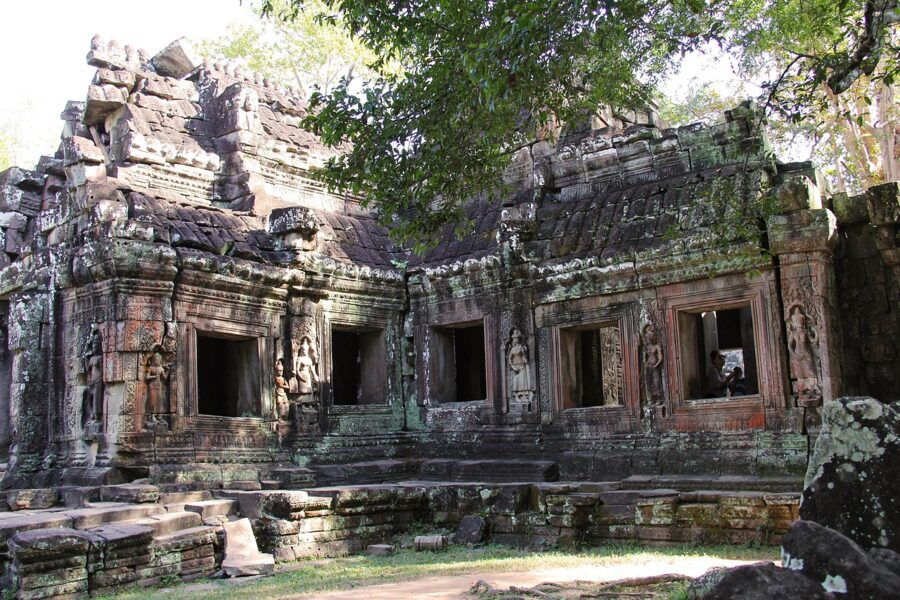

Before you go, stand once in one of the inner courts with your back to a wall and do nothing for a minute. Marchal could have cleared all this. Everything you are looking at, the props, the platforms, the new stone and the trees left standing on purpose, comes from one decision in 1920 to stop, and a century of people since then deciding to keep stopping.