
Contents
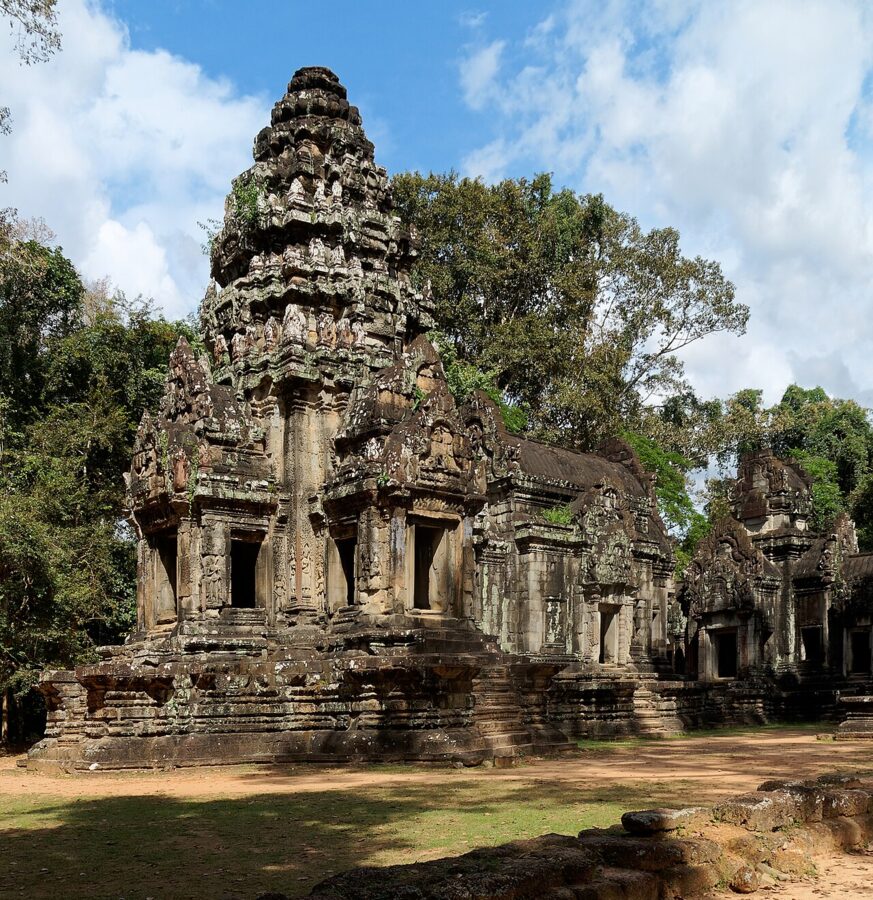

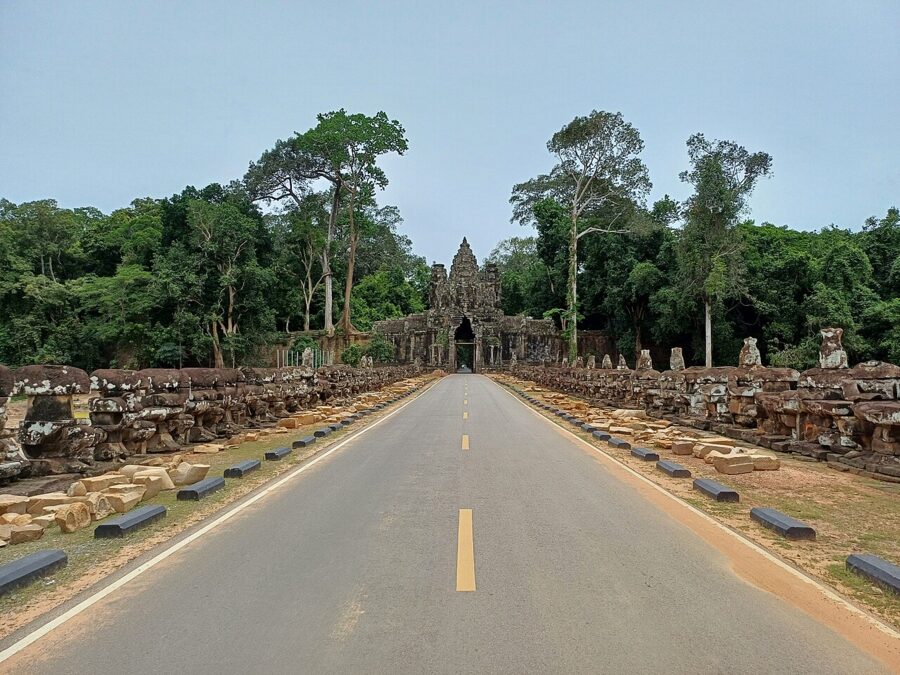
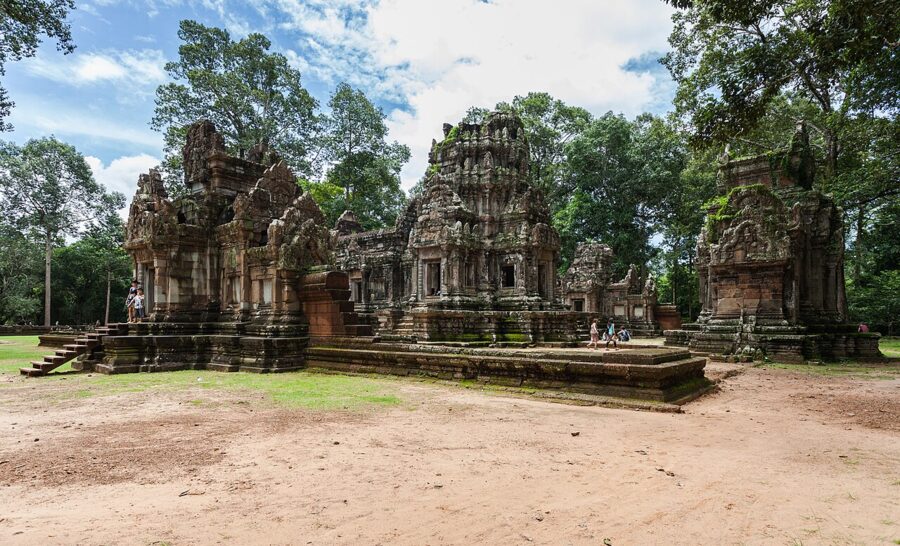
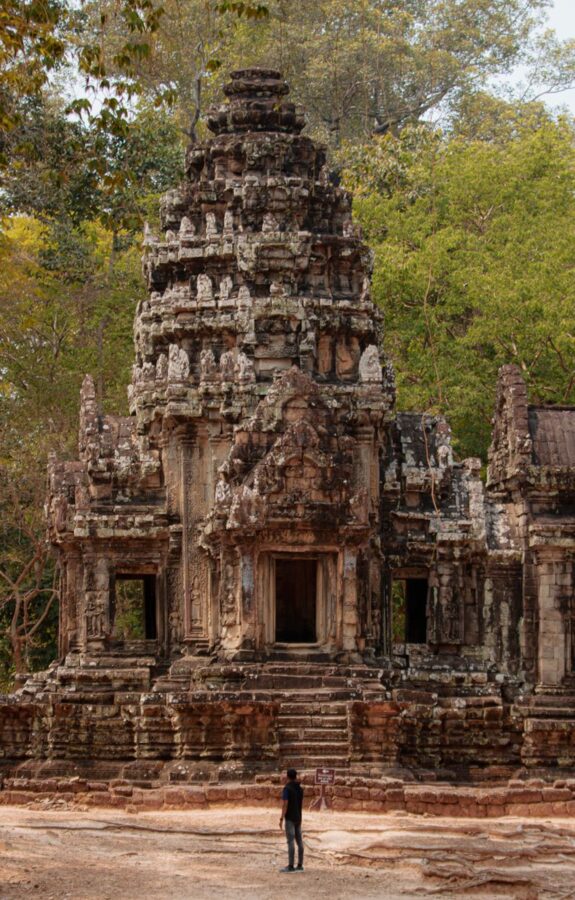
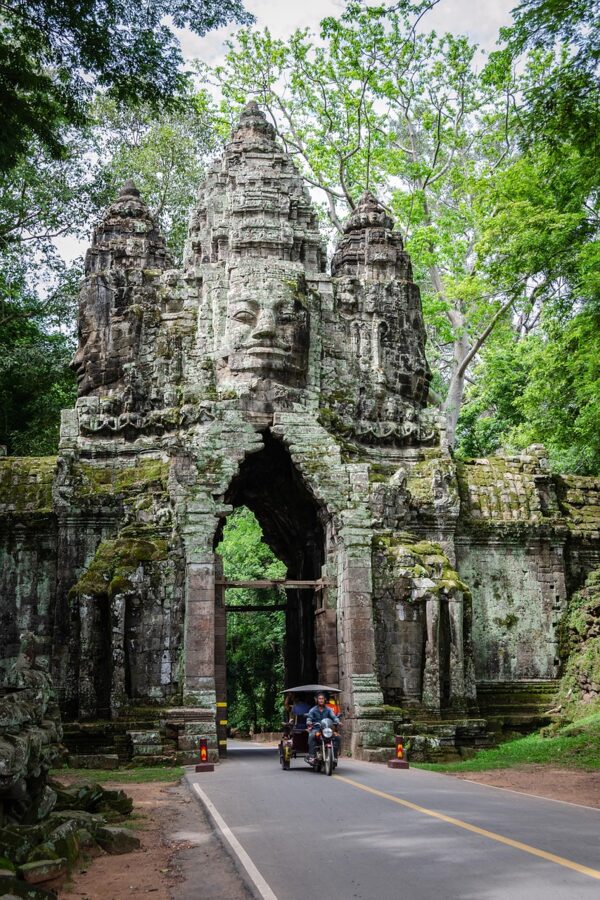
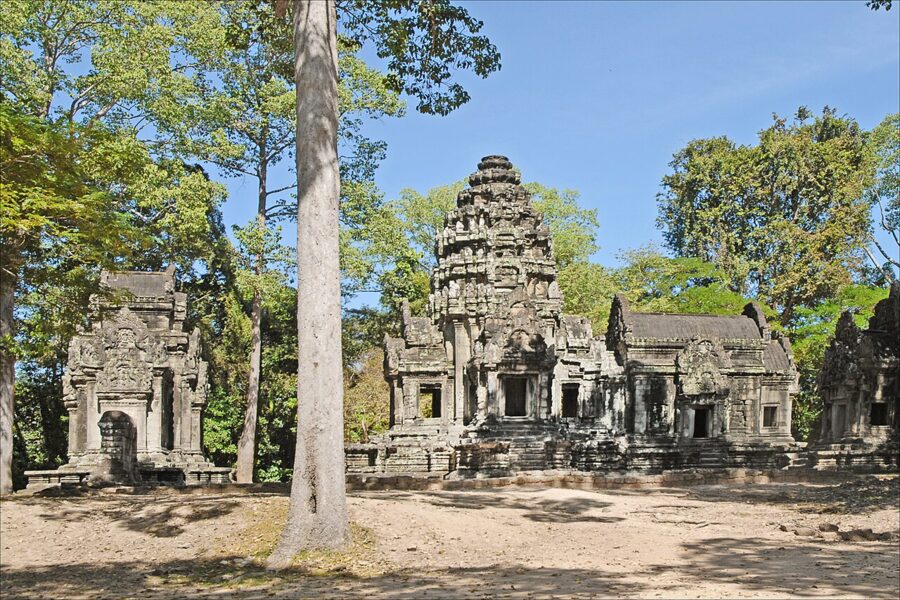
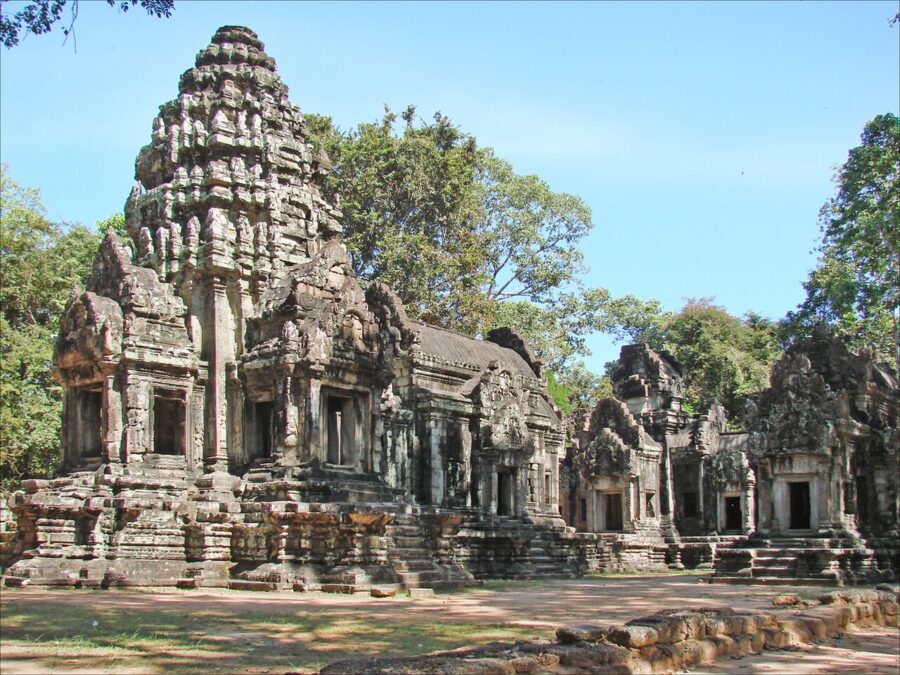
Leave Angkor Thom by the Victory Gate, follow the road east for about 500 metres (a third of a mile), and it runs between two small sandstone temples, one on each side, close enough to call across. On the left stands Thommanon, its single tower still wearing most of its carving. On the right is Chau Say Tevoda, put back together within the last thirty years from stones that had lain for centuries in the grass and in the river. A great many small-circuit days pass straight between them on the way to Ta Prohm.
They repay the stop for two reasons. The carving at Thommanon is as fine as anything at Angkor Wat, and here you can stand a hand’s width from it with nobody behind you. And the pair, side by side, show two answers to the question every restorer at Angkor has had to face: how much new stone is too much?


Two temples on the road out of the Victory Gate
The road you are standing on is older than the gate. It runs east on the axis of the Royal Palace, and the Victory Gate was set into the wall of Angkor Thom only when Jayavarman VII rebuilt the city in the late 12th and early 13th centuries. Thommanon and Chau Say Tevoda were already standing by then. Their tidy framing of the “Victory Way” is an accident of history, not a plan.
Thommanon sits on the north side of the road and Chau Say Tevoda on the south, and both face east, towards the Siem Reap River a couple of hundred metres further on. The APSARA National Authority’s notes on the pair suggest they may have served as models for the roadside rest houses that Suryavarman II and, later, Jayavarman VII built along the empire’s highways. It is a suggestion, not a finding, but it fits their size and their place beside a road.
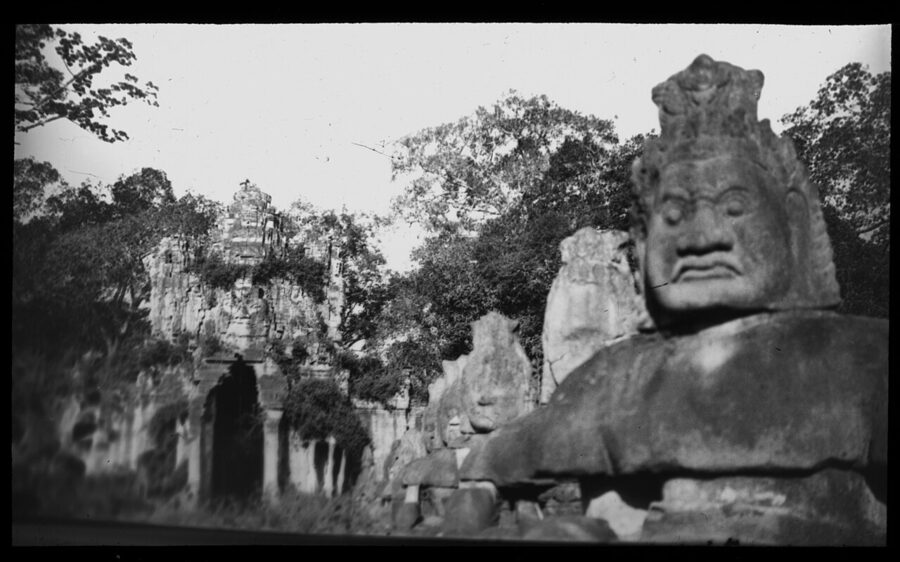
Why do so many people miss them? Mostly the schedule. The usual small circuit runs from Angkor Wat to the Bayon and the terraces, then out through this gate towards Ta Keo and Ta Prohm, so a tuk-tuk reaches this stretch in the hot late morning with the next famous name minutes away. And neither tower clears the trees.
Who built them, and when (with the doubts left in)
Neither temple carries an inscription, so every date you read for them is an argument from style. Maurice Glaize’s guide to the monuments, written when he was conservator of Angkor in the 1940s, placed both between the Baphuon and Angkor Wat: the late 11th century or the first half of the 12th. He saw them as two variations on one composition that also turns up at the core of Beng Mealea and at Banteay Samre.
Within that bracket, opinion leans towards Suryavarman II, the king who built Angkor Wat and reigned from 1113 to about 1150. APSARA’s summary puts Thommanon near the beginning of the 12th century and Chau Say Tevoda towards the end of Suryavarman’s reign, around the middle of the century, which would make the “twins” a generation apart. Yet the same page’s fact box still gives the late 11th century under Jayavarman VI, an older attribution that some writers keep for Thommanon.
The devatas are part of that argument: the researcher Kent Davis showed that their gestures and skirts match Angkor Wat closely, which pulls Thommanon towards Suryavarman II. My reading: treat both as Angkor Wat-period temples, Thommanon probably the elder, and accept that nobody can be sure. If you have already been to Angkor Wat, you will recognise the hand at once.
Twins, but not identical
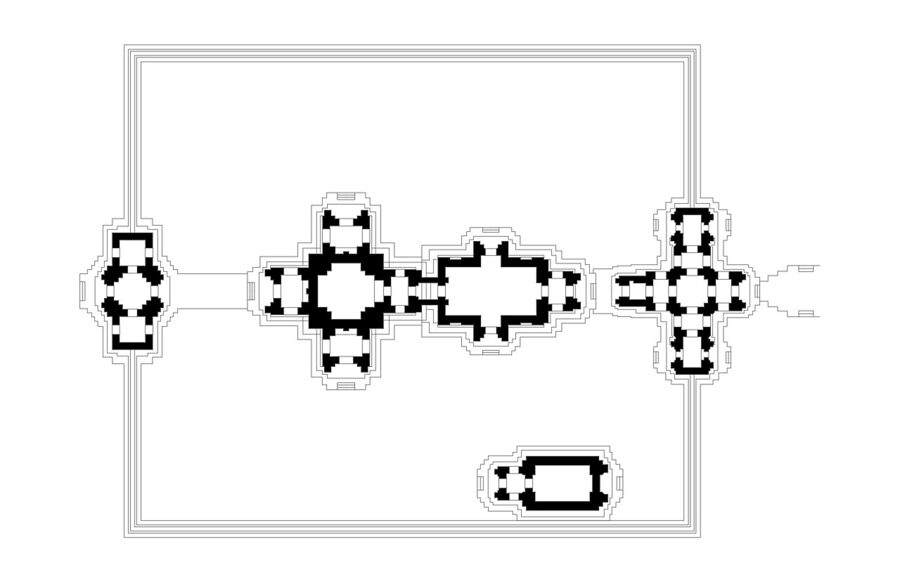
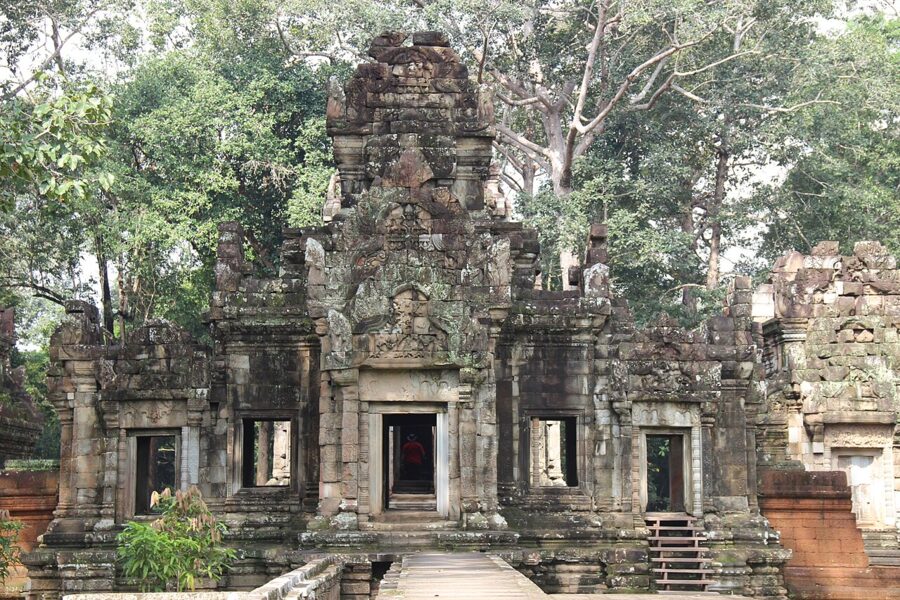
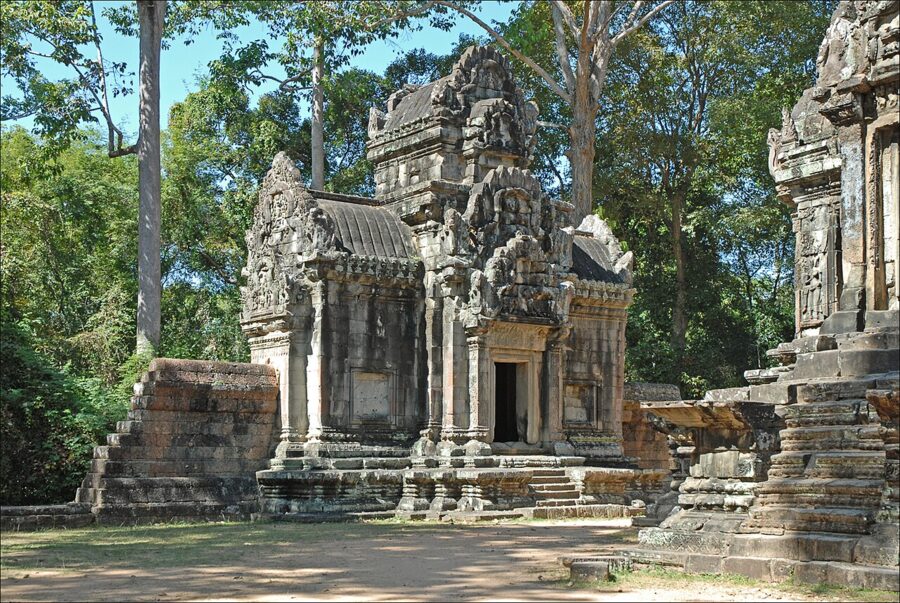
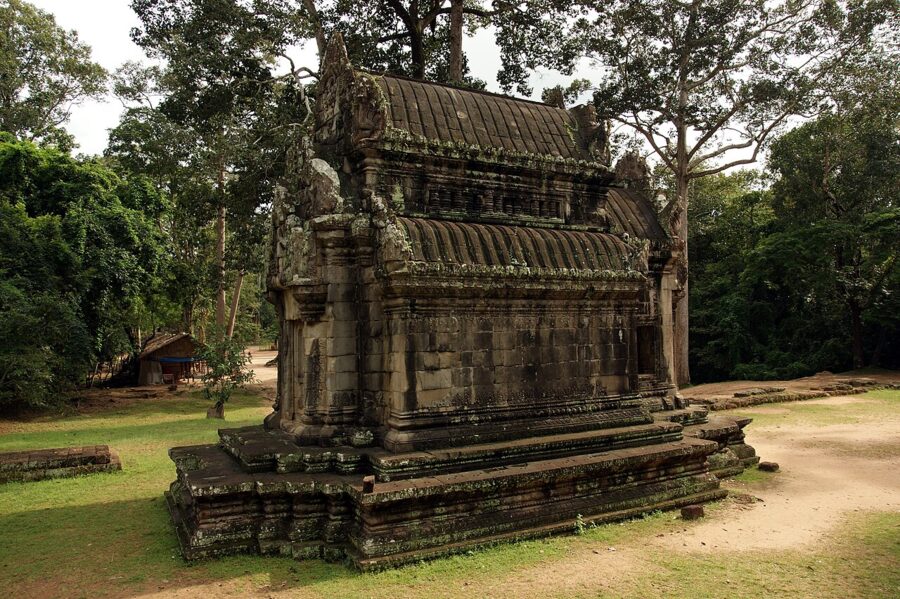
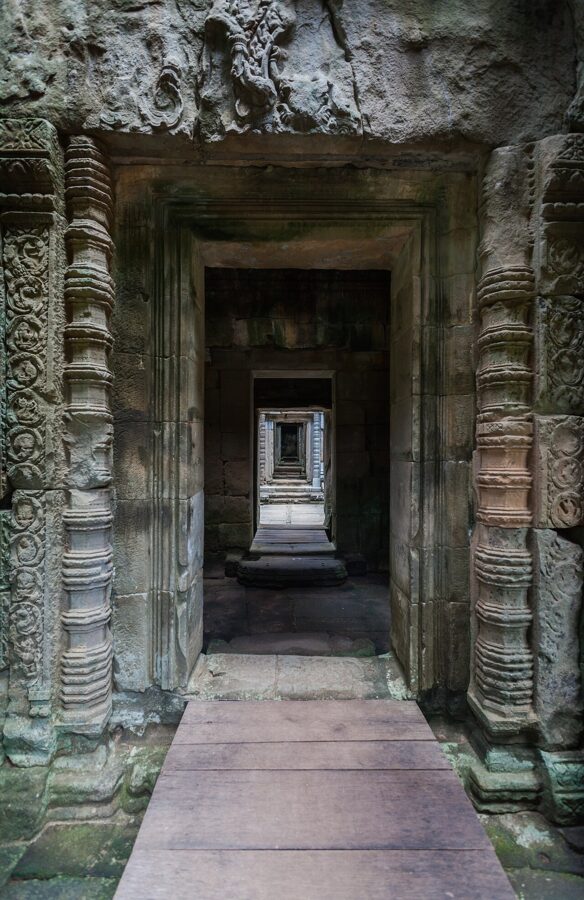
Both temples follow the same plan, which you can read on the ground in a few minutes. A square sanctuary tower with four porches stands on a high moulded base. Its east porch leads through a short vestibule into a long rectangular hall, the mandapa, which runs east to a gopura (gateway tower), and a wall, now mostly footings, closed off the whole.

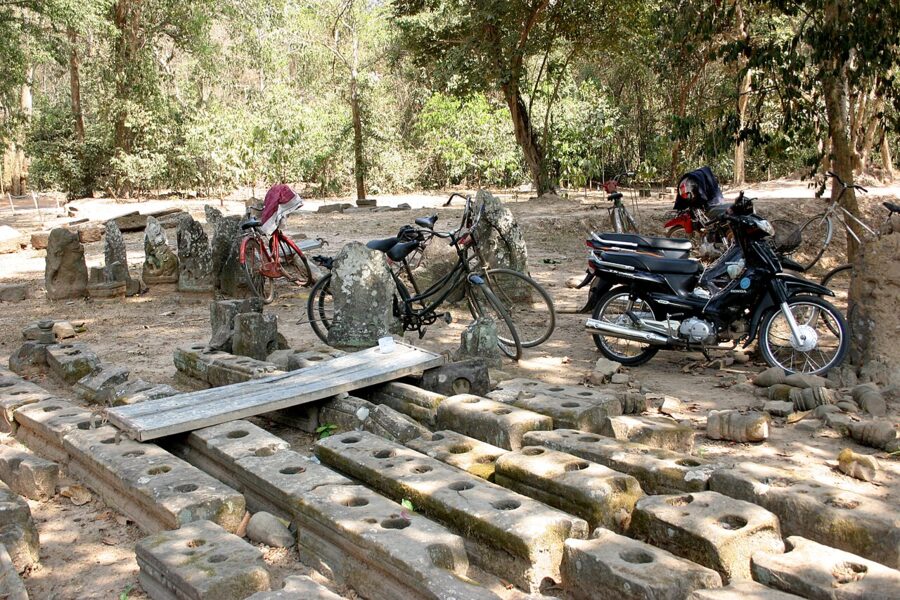
The differences are where it gets interesting. Thommanon’s north and south walls have openings where gateways seem to have been intended but never built. Chau Say Tevoda’s east gopura was joined to the river by a walkway raised on three rows of octagonal pillars, which Glaize judged later than the temple.
| Thommanon | Chau Say Tevoda | |
|---|---|---|
| Side of the road | North (left as you leave the gate) | South (right) |
| Enclosure | About 45 by 60 metres | About 40 by 50 metres |
| Gopuras | Two, east and west | Four |
| Libraries | One | Two |
| Date suggested by APSARA | Early 12th century | Mid-12th century |
| Restored by | EFEO, 1960s | Chinese government team, 1998 to 2008 |
Glaize thought Thommanon the more majestic of the two, and I agree with him. Its tower’s corner piers rise unbroken to the top of the pediments, while at Chau Say Tevoda a cornice cuts across them at the height of the hall’s vault, so the tower sits lower and squatter. Chau Say Tevoda answers with denser ornament spread over every free surface.

Thommanon: what to look for
The devatas
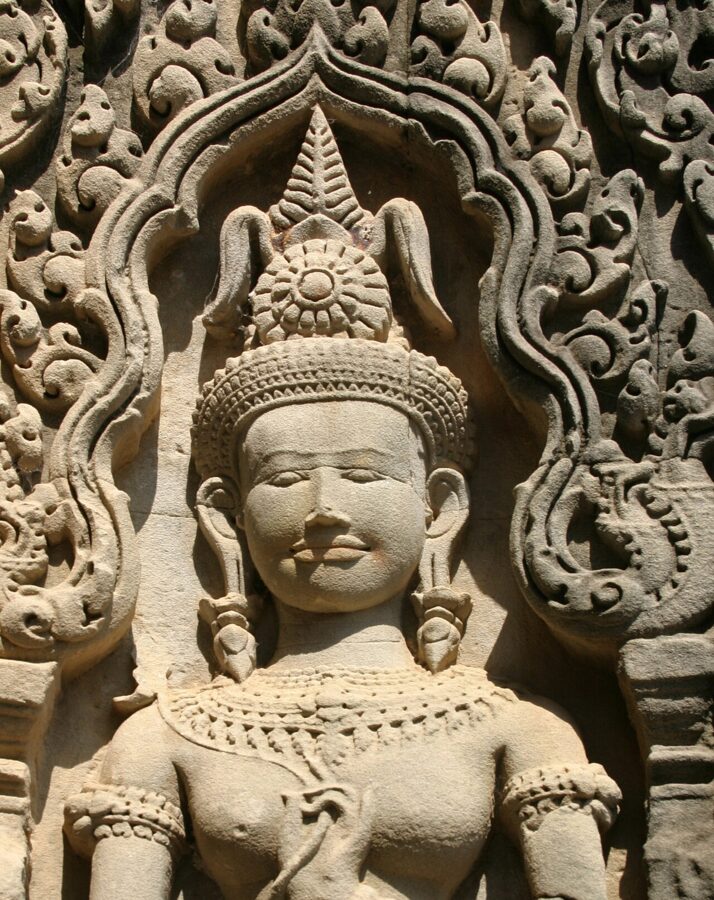
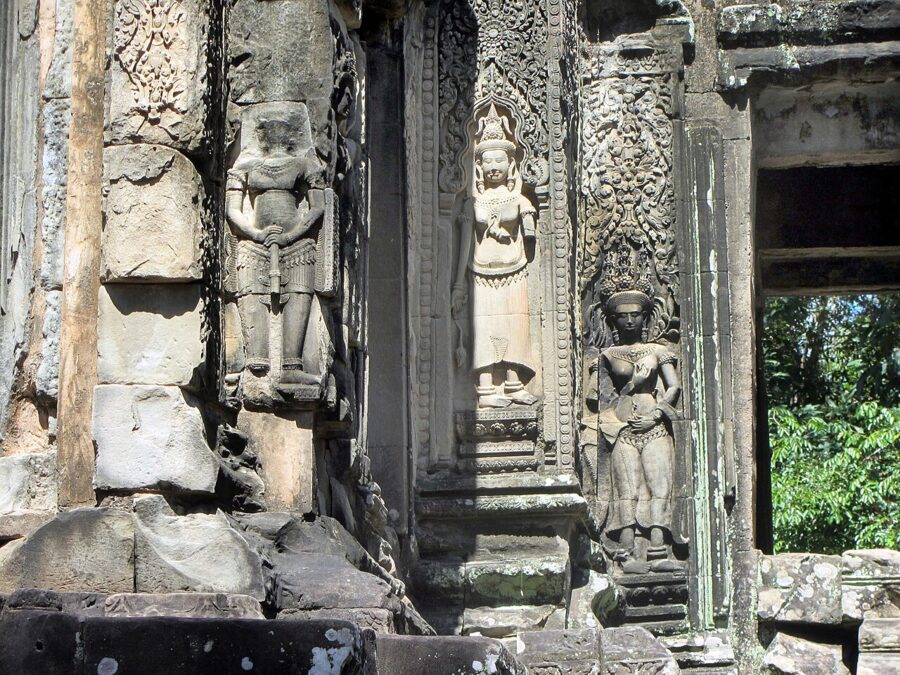
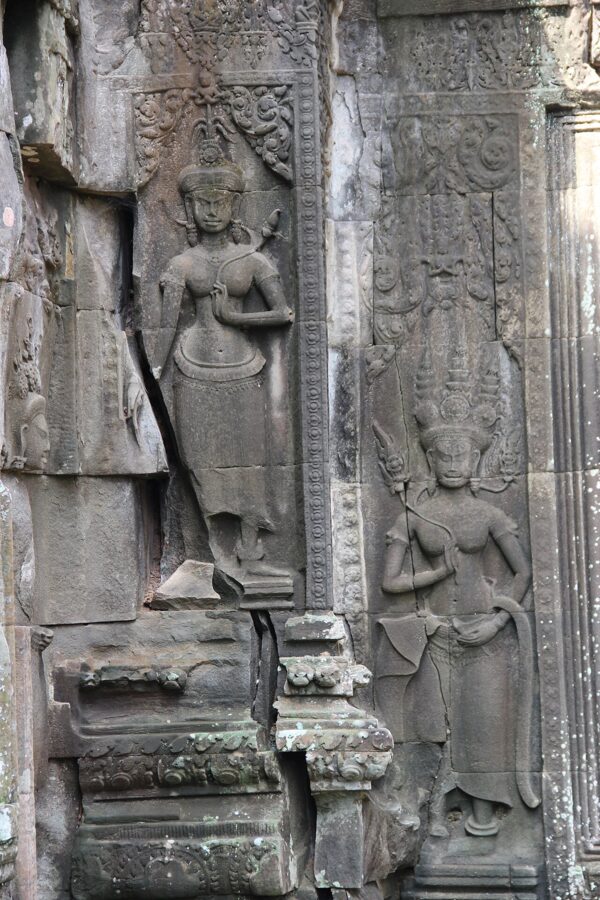
Start at the sanctuary tower and walk all the way round it, slowly. The walls are lined with devatas, female divinities carved in high relief, standing in niches under arches of foliage, each with her own crown, jewellery and patterned sampot (the wrapped Khmer skirt). Door guardians, dvarapalas, stand beside the porches, heavier and more plainly dressed.
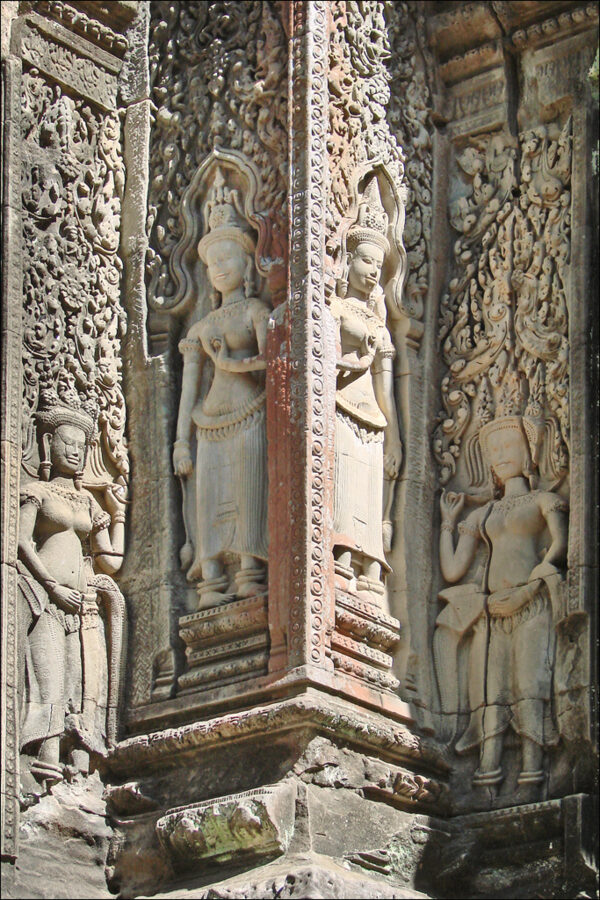

Look at their hands. Many hold a flower stem between the thumb and the two middle fingers, with the index and little fingers flicked outwards, the same gesture you will find all over Angkor Wat. Then look at the skirts: most wear patterned cloth with a looped fold at the hip, the Angkor Wat fashion, but a few wear an older pleated style seen on temples of around 900, and these tend to stand higher on the walls.
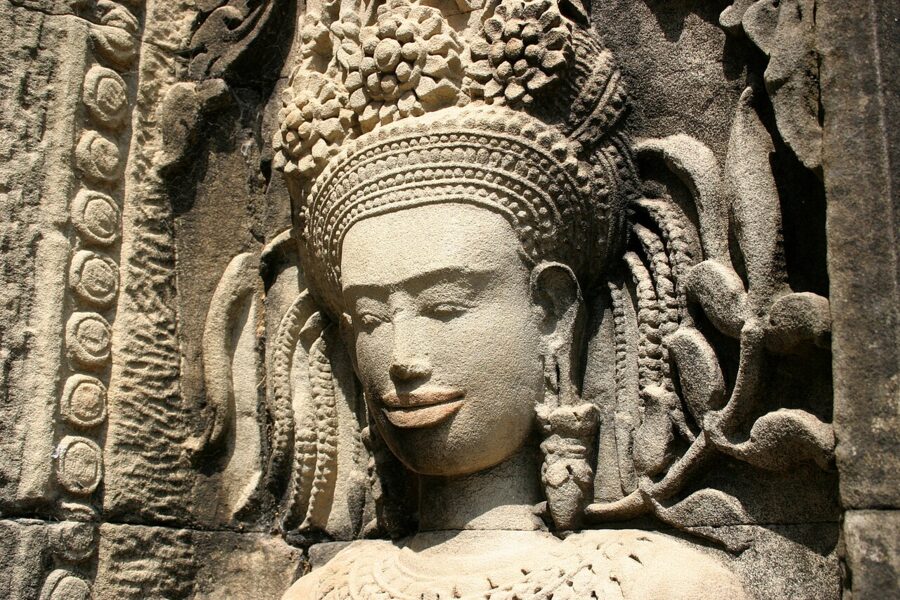

Glaize called the Thommanon devatas “highly stylised”, and they are, but the carving is so precise in places that the beads of a necklace stand out one by one. Low sun from the side brings them up best: the east faces in the morning, the west in the late afternoon. Don’t touch them; the sandstone surface is fragile and skin oil darkens it.


Lintels, pediments and false doors
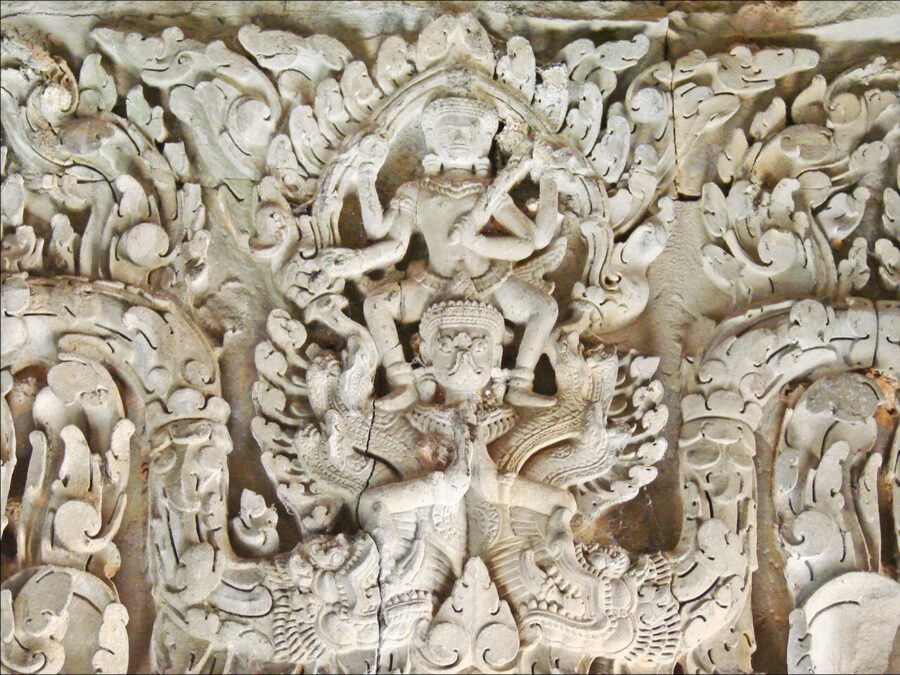
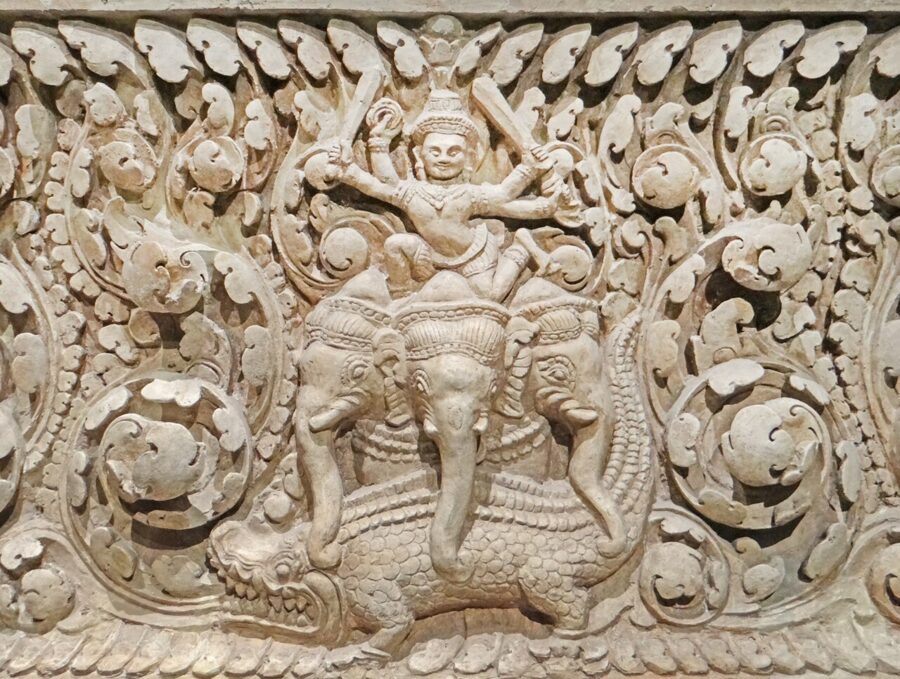
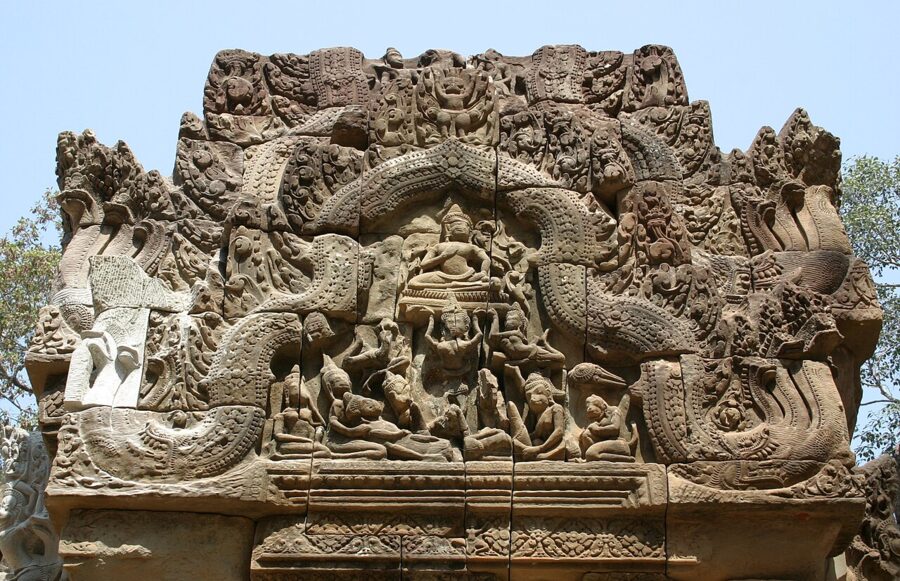
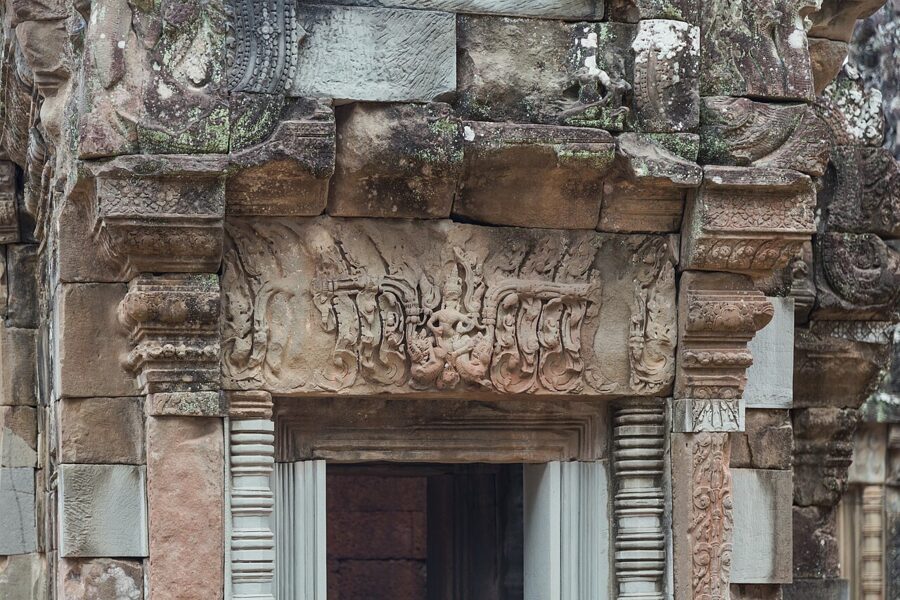
Now look up. Over the sanctuary’s east door the lintel shows Vishnu riding Garuda, the bird-man, in a sea of swirling foliage. On the west gopura, the most carefully finished building in the compound, the pediment shows Vishnu on Garuda again, this time fighting the asuras (demons), and the bases of the pilasters carry tiny scenes with figures, a detail typical of the Angkor Wat period.

The long hall holds the stories. Above its south door Ravana, many-headed and many-armed, shakes Mount Kailasa where Shiva sits enthroned. Inside, over the door to the vestibule, is the death of Valin after his fight with his brother Sugriva, an episode from the Ramayana. These pediments are worn, so give your eyes a minute to settle.
The ridge of that hall ends in little stone Garudas instead of the usual lotus petals; on the west gopura the end tiles become small lions. None of these is large, and all are easy to miss.

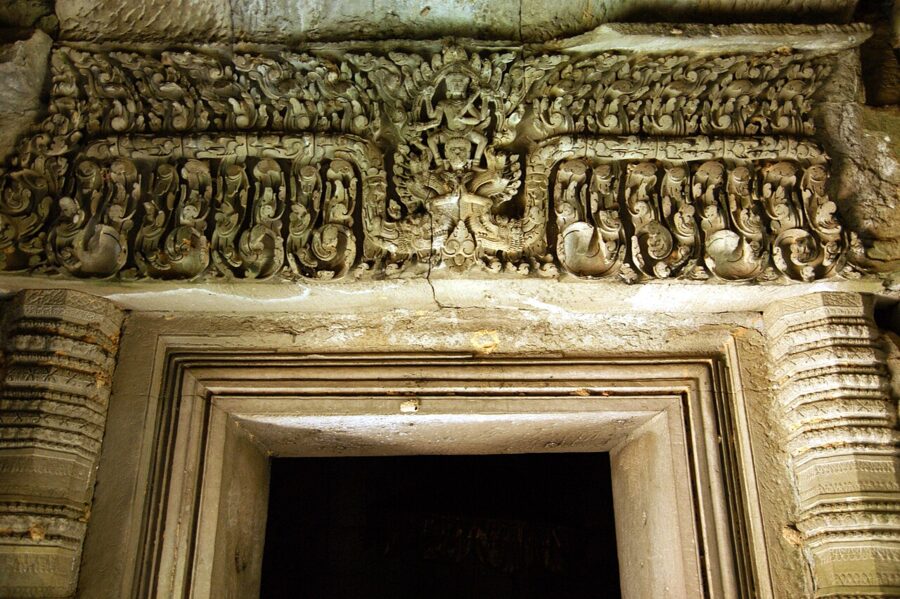

Three of the tower’s four porches end in false doors, stone panels carved to look like wooden doors with their studs and mouldings, and Glaize rated them among the finest at Angkor. They are easy to ignore precisely because they look like doors.
One of Thommanon’s lintels has also been seen in Paris without ever leaving Cambodia. Louis Delaporte’s mission of 1881-1882 took moulds here, and the plaster cast of the east lintel of the antarala (the vestibule between tower and hall) was on show at the Musée Guimet in early 2014, labelled as Vishnu rescuing the king of the elephants.


Chau Say Tevoda: what to look for
Cross the road. Chau Say Tevoda’s devatas are livelier than Thommanon’s, with more movement in the body and more invention in the dress. One wears her hair in long, thick braids coiled up on her head; another has a crown with a central element that nobody has yet convincingly explained. They line the sanctuary and the vestibule, and several flank the windows of the hall.
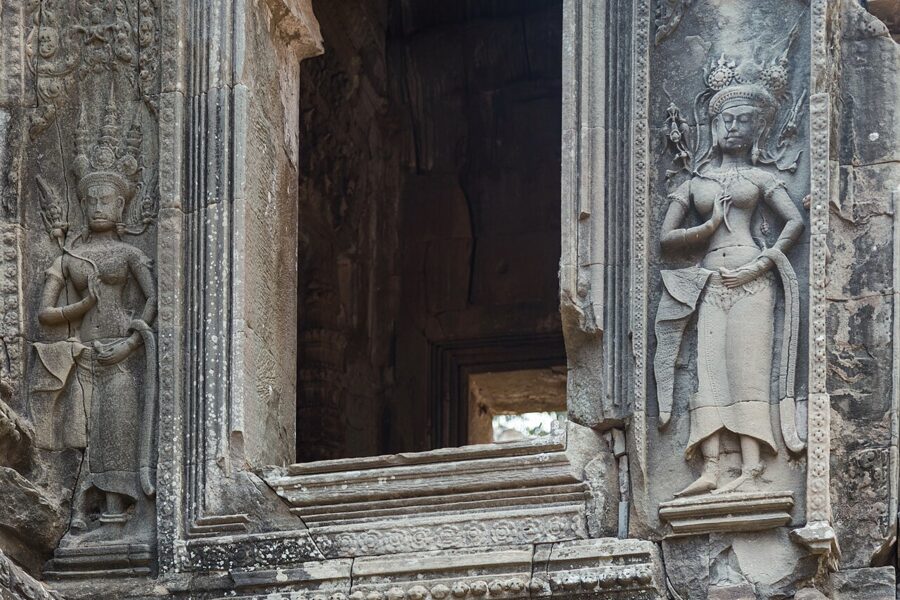

Look closely at the walls of the vestibule and the hall. They are covered with small rosettes set in squares, cut shallow into the stone, a motif Glaize compared with Banteay Srei and the Baphuon. The false doors use scrolling foliage where Thommanon’s have vertical patterns, and the pilasters carry horizontal diamonds.
The pediments mix the two great Hindu gods: Shiva and Vishnu scenes alternate across the temple. Two at least come from the Ramayana, the fight between Sugriva and Valin again and a crowd of monkeys on the east gopura. In Glaize’s day several fallen pediments lay reassembled on the ground on the south side, among them Shiva and his consort Uma riding the bull Nandi.

APSARA also notes a few Buddhist scenes here, damaged in a way that suggests they were defaced in the 13th century, when a Hindu reaction followed Jayavarman VII’s Buddhist reign. Then leave by the east along the raised walkway on its short pillars; APSARA singles it out as the photograph to take here.

Two restorations, two answers
Both temples were cleared of jungle by Henri Marchal for the EFEO, the French school that ran the conservation of Angkor, in 1919-1920 and again in 1925-1927. After that their stories split.
Thommanon was restored in the 1960s under Bernard-Philippe Groslier, then conservator of Angkor, by anastylosis: taking a building down, recording every block, strengthening the core and rebuilding with the original stones, adding new ones only where nothing else will do. The west gopura was done between 1961 and 1966. That is why Thommanon looks both old and whole.
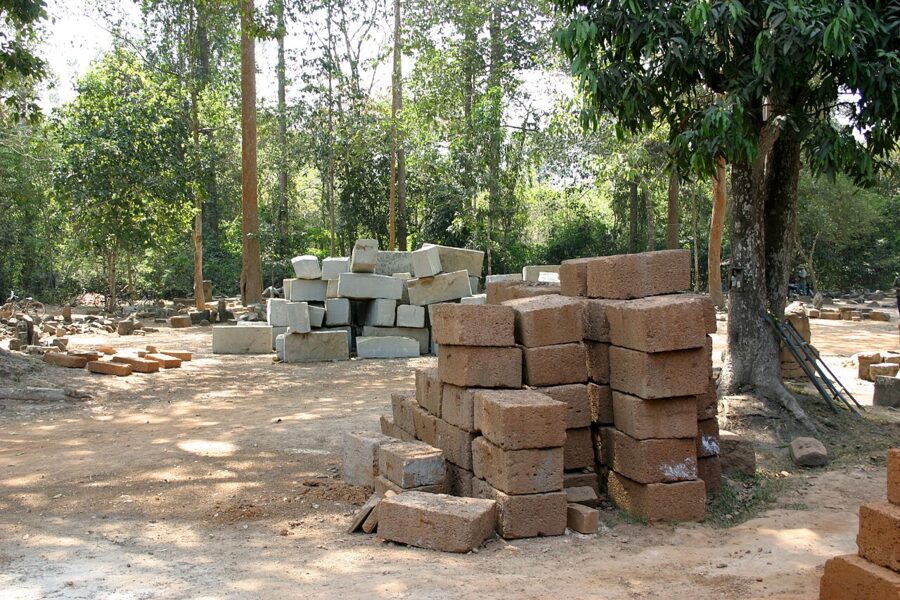
Chau Say Tevoda waited much longer. Glaize blamed its collapse partly on the builders’ habit of setting double wooden beams inside the masonry: when the wood rotted, the stone above fell. By the 1990s more than 4,000 blocks and fragments lay scattered around the site, many of them in the bed of the Siem Reap River.

China took it on as its government’s first large heritage project abroad. A team from the Chinese Academy of Cultural Heritage began survey and excavation in 1998, the restoration was formally launched on 29 March 2000, and the Chau Say Tevoda project was completed in 2008. The temple reopened to visitors in 2009, the completion date APSARA gives, and the same team went on to work at Ta Keo.
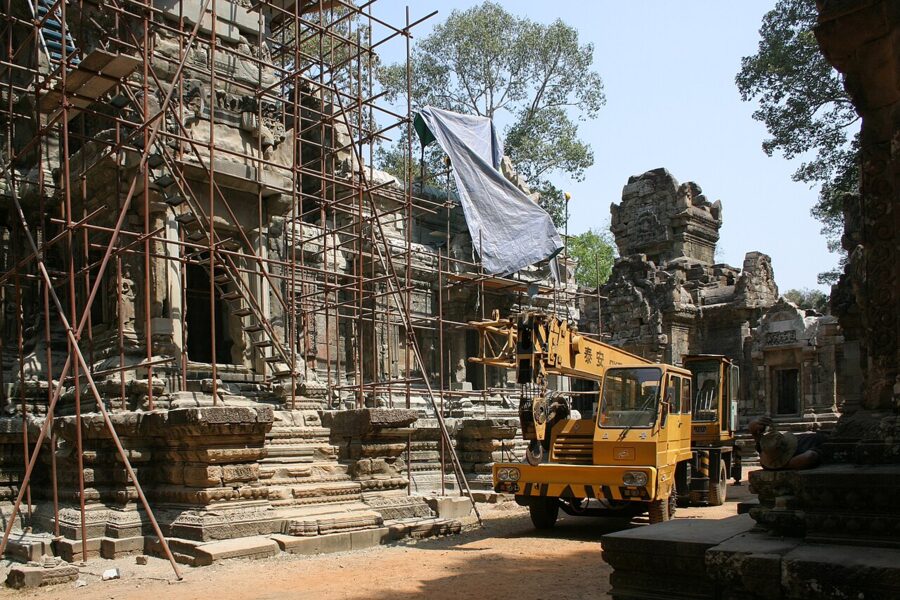

Where blocks were lost for good, the team cut new sandstone to replace them, and the account of the reopening by Kent Davis notes that other teams at Angkor had turned that approach down. You can see the result plainly. On lintels, colonnettes and pilasters the new stone is paler, cleaner and mostly plain, and APSARA’s own description of the temple puts the question openly: how far should restorers go?

I like being able to see where the old work stops; plenty of people find it jarring. On the ground it comes to this: at Thommanon you see a 12th-century temple put back together, at Chau Say Tevoda one that was a heap of stones within living memory, made legible again with blocks you can tell apart at a glance.

Fitting them into your day
The pair sit on the small circuit, the standard loop through the middle of the park: come out of Angkor Thom through the Victory Gate and they are the first stop, with Ta Keo under 2 kilometres (just over a mile) further east. On a longer stay, such as five days at Angkor, they belong on the small-circuit day.
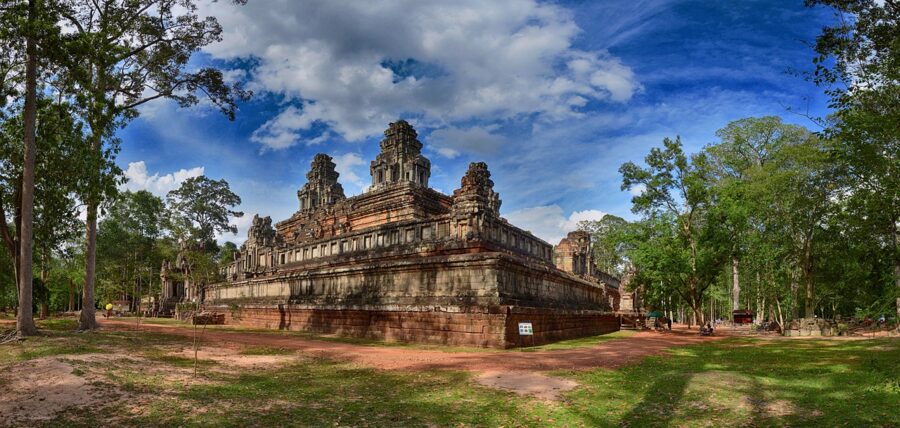
I would not come when most people do, in the late morning after the Bayon. APSARA lists the temples as open from 7:30am to 5:30pm, and the two ends of that day are better: early, when the sun is low on the east fronts and the stone is still cool, or late afternoon, when it swings round onto Thommanon’s west gopura. Starting the small circuit in reverse, from Ta Prohm and Ta Keo, brings you here in the morning without trying.
Give them 45 minutes for both, an hour if you want to look properly at the devatas; APSARA suggests half an hour each. In October 2023 the authority also laid out two walking routes round the pair. Take the longer one, which starts at Thommanon and brings you into Chau Say Tevoda from the east, through its main gateway, the way the temple was meant to be entered.
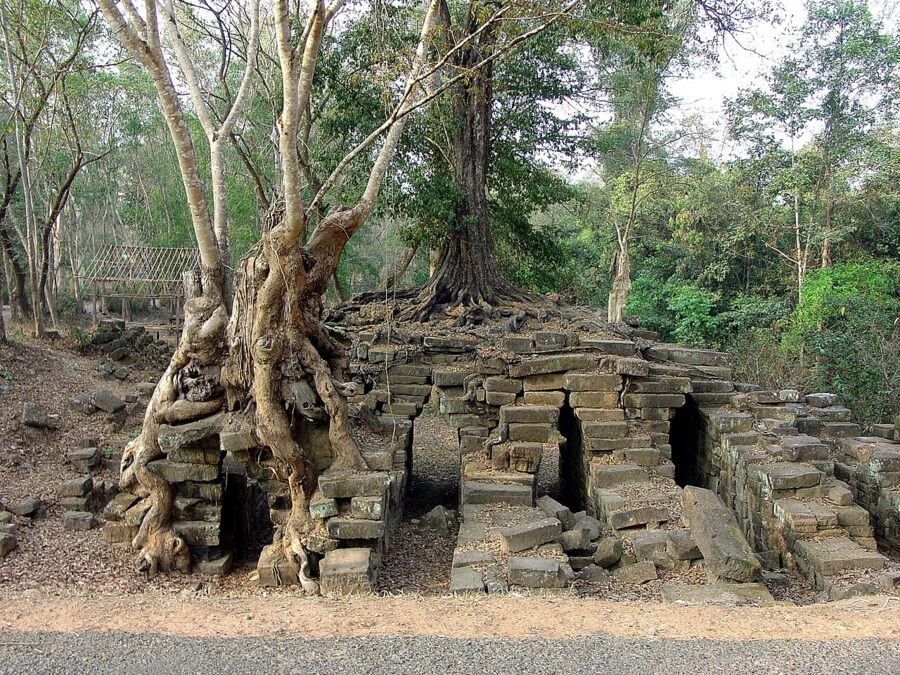

Before you move on, walk 200 metres east of Thommanon to Spean Thma, the “stone bridge”. Built with blocks reused from older temples, it once carried this road over the Siem Reap River; the river has since shifted and cut down, leaving its 14 narrow corbelled arches high and dry. It is later than the temples, though nobody has dated it firmly.
Both temples are covered by the Angkor Pass. As of November 2026 Angkor Enterprise sells it at US$37 for one day, US$62 for three days and US$72 for seven, online or through its official app.
Before you climb back into the tuk-tuk, stand at Thommanon’s west gopura and look across the road at the pale new stone of Chau Say Tevoda. Two halves of the same idea, one carved some nine centuries ago and put back sixty years ago, the other rebuilt less than twenty years ago, and most of the traffic on the road still passes straight between them.